

What Just Happened #82
Midnight Oil at Zhongnanhai

Welcome to Common Sense and Whiskey. Today, Kier Starmer goes deal making, Chinese military intrigue, oil in Mexico and Cuba, the Board of Peace in a far-flung map, and we peek into the Moldovan president’s bank account.
The winter’s coldest temperatures have arrived here in Atlanta, with temperatures at night dropping to the teens Fahrenheit. That’s pretty cold but it’s nothing like in Kyiv:

Give a thought to innocent civilians there who are living with no heat because Vladimir Putin’s Russia intentionally targets Ukraine’s heating and power infrastructure.
Common Sense and Whiskey goes deeper than the headlines on a few stories a week, in a presentation that busy people can absorb quickly. It’s a short, sharp look at the world out there.
If you’re reading this as an email, maybe have a look at the online version at CommonSenseandWhiskey.com, where all the content is available, and if you like what you see, please subscribe. Talk to me in the comments section or directly, at BillMurrayWriter (at) gmail.com. Let me know what you think.
•••••

BRITAIN AND CHINA: The British Prime Minister led a delegation of around 60 business leaders to Beijing Wednesday, but his chief interlocutor, Xi Jinping, may have been a wee bit distracted.
The last British leader’s visit to China was Teresa May’s 2018 official state visit. Back then London was flush with having declared itself Singapore on Thames, just eighteen months after the Brexit vote and two years before the formal Brexit day. There to greet her, like he was to greet Starmer this week, was China’s president-for-life, Xi Jinping.
As a result of Prime Minister May’s visit a “Golden Era” in UK-China relations was declared, trade deals were announced and there came the usual flurry of declarations: there was an agreement to step up cooperation and dialogue on trade and investment, a joint trade and investment ‘review,’ strengthened cooperation on areas like services and financial markets and so forth.
This time, Kier Starmer hoped to return with actual real stuff - but post-meeting announcements touted the usual generalities like “expansion of opportunities for UK businesses” in a “warm,” “constructive” meeting that made “good progress.”
Spokespeople said the two sides had “reached a series of significant outcomes” and Starmer, dogged by terrible polling and a political insurgency back home, wanted all the concrete accomplishments he could get. The main tangible accomplishment seems to have been visa-free travel for Brits traveling to China.
Meanwhile back home in London, the British government signed off on plans for a new Chinese embassy last week that alarms critics, who fear the risk of Chinese espionage. They say it sits too close to buried fiber-optic infrastructure, and that parts of the embassy underground are too close to internet and financial data routes. You didn’t hear much about that in Beijing.
Remember that Singapore on Thames moment, when the brexiteers were flush with the victory and intent on taking back control? We’re now a decade on from the Brexit vote and on Tuesday it wasn’t Starmer and England, but European Commission President Ursula von der Leyen who announced what she called the “mother of all deals,” a trade agreement between the EU and India, involving a combined two billion people who account for about a quarter of earth’s GDP.
The EU continues to diversify its global economic relationships, as NATO squabbles over charting a course more independent from Mark Rutte’s Daddy. Just ten days before the India deal von der Leyen and António Costa, President of the European Council, traveled to Asunción to sign a separate trade deal with Mercosur, the South American trading block. That deal comprises over 700 million consumers.
In the larger global context, Starmer joins a parade of Western leaders to Beijing. Canadian PM Mark Carney visited January 13th to 17th, Finnish PM Petteri Orpo led a delegation from January 24th to 29th, and this week it’s been Starmer. Xi will consider that the visits validate China’s push for a “multipolar” world order.

CHINA: Whether President Xi was fully engaged in the minutiae of Starmer’s visit is anybody’s guess. That’s because also this week, President Xi relieved his military second in command - second only to Xi himself.
First Vice Chairman of China’s Central Military Commission (CMC) Zhang Youxia, was placed under investigation last weekend for “serious violations of discipline and law.” Another CMC member, Chief of the Joint Staff Liu Zhenli, was tossed out at the same time.
It’s hard to understand what’s really going on here because it’s just so unusual. Now five of the seven members of the CMC have been purged by Xi since 2023, and all of them were put there by Xi himself after Xi secured a third term as party General Secretary in 2022.
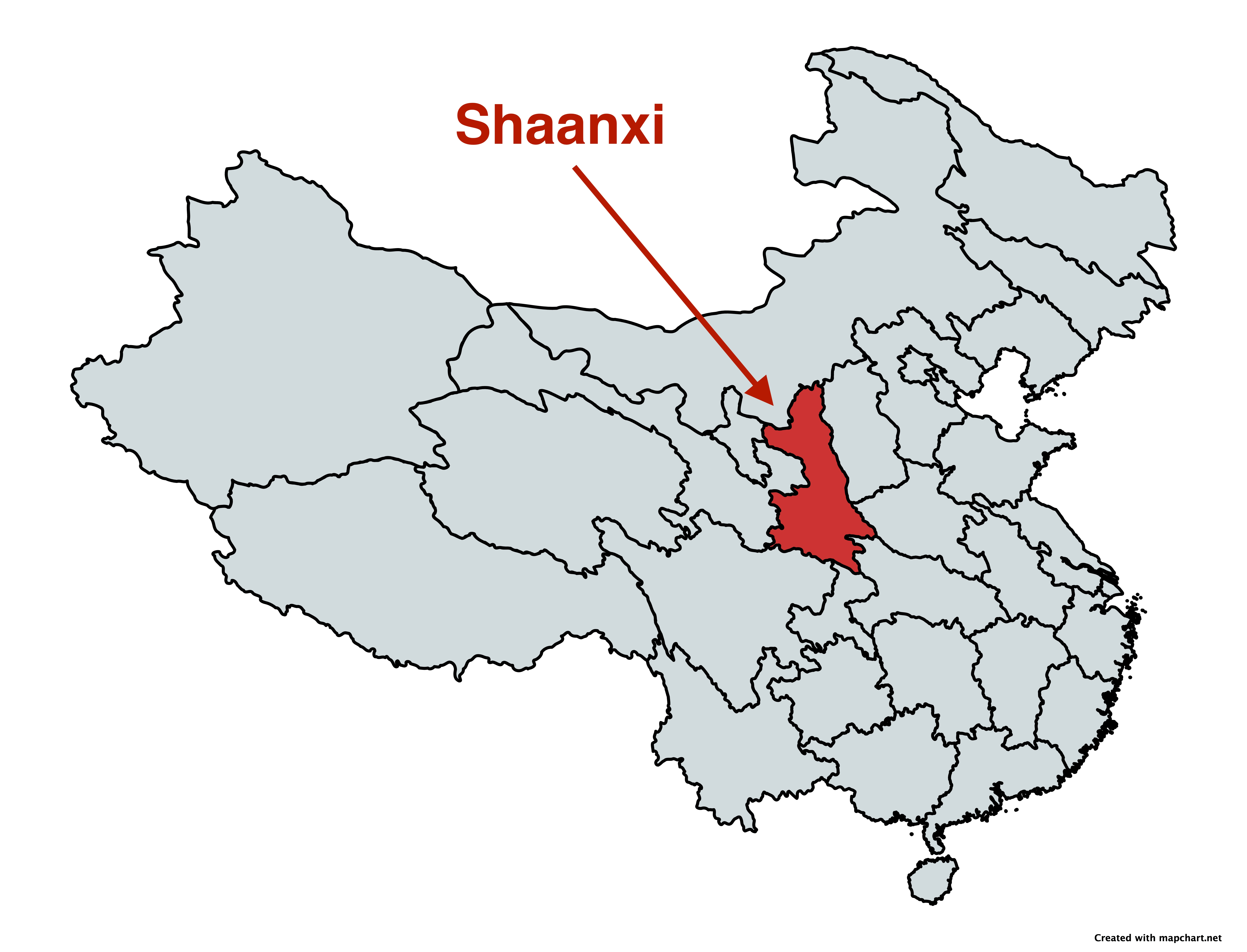
This case has an extra twist because Zhang and Xi have a history. Zhang’s father’s served with Xi Zhongxun, Xi’s father, in the People’s Liberation Army’s (PLA) Northeast Army Corps before 1949, both are from Shaanxi Province and childhood friends. They attended school together.
There have been allegations of leaks of military secrets, even a Wall Street Journal charge that Zhang sold nuclear secrets to the Americans. Most of the experts I’ve read think such behavior from a 75 year old military lifer is improbable, not least because a person of such high rank would scarcely have an opportunity for espionage, even if he had read too many spy novels. He would be surrounded by staff and security at all times.
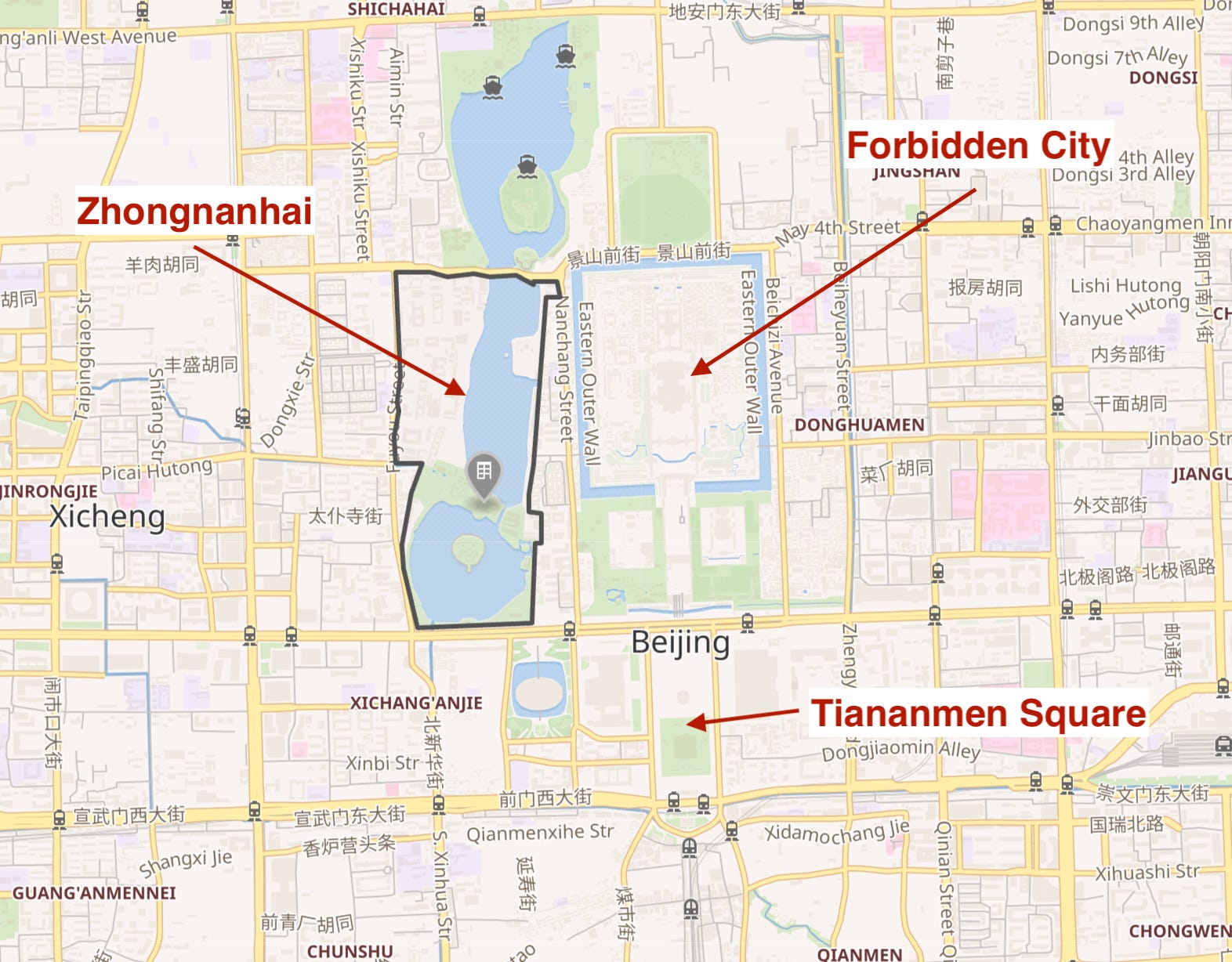
Here are two more likely explanations: that this is primarily Xi’s anti-corruption campaign finally reaching the very top, or that Xi is removing senior figures who have become too powerful. Either way it’s likely they’re burning the midnight oil at the Zhongnanhai, the Chinese leadership compound.
The French Institute Montaigne reads tea leaves and settles on two contradictory interpretations: either “Xi is now a naked and cornered emperor, threatened by a mutiny that would end his reign,” or “he is a tactical genius, who has now got rid of the most likely other center of power apart from the CCP:” the People’s Liberation Army.
Institut Montaigne suggests one more thing:
“There have been rumors that Xi Jinping and the army’s leadership diverged on the management of the Taiwan issue - the PLA would be more weary of a test, while Xi insists on preparing for it and would be supposedly dissatisfied with the results so far.”
This is the best kind of rumor mongering. It suggests that as a result of this week’s intrigue, either an eventual attack on Taiwan is now more likely … or else it isn’t.
If Xi has just bared his dragon fangs across the strait and thrown caution to the wind, then conflict is closer. If not, then the upheaval at the top of the CMC suggests that a lengthy period of weeding out corruption in the PLA looms ahead.
That the entire CMC has turned over in under four years most likely suggests that corruption is endemic in the PLA. That or that Xi is afraid there’s a whole lot of plottin’ going on.
There’s good reason to suggest Xi is sensitive to corruption - he has watched the dismal performance of the Russian military against Ukraine since 2022. And Zhang, the purged second in command, was in charge of army procurement, with large budgets and presumably the temptation of large kickbacks.
In any case, Taiwan will surely be watching the Zhang case with interest. Taiwan’s defense ministry this week called the leadership changes “abnormal.”

LESSONS IN LEXICOLOGY: To read official statements from the Chinese government is to endure bureaucratese. That’s not unique to Chinese communiqués, but there’s one thing that I think is: the overuse of adjectival and adverbial intensifiers.
Here’s a random example in a quote about Liu Zhenli, the other CMC member to lose his job this week. This is from the New York Times:
”Gen. Liu Zhenli, had ‘trampled on’ the authority of the military chairman — that is, Mr. Xi — and had ‘severely undermined the party’s absolute leadership over the military,’ the editorial said. Their actions had ‘rendered massive damage.’”
It’s a clear example of something you see all the time - the overuse of adjectives and adverbs. Not just undermined, but “severely” undermined. Not just leadership but “absolute” leadership. Not just damage but “massive” damage. Three intensifiers in two sentences. You don’t see that so much in US government pronouncements. They tend to let the facts speak more for themselves.
I know nothing of Mandarin or Cantonese, but I looked into it and here is what I learned. I’d welcome elaboration or correction from Chinese speakers.
In Chinese, both verbs and nouns rely on modifiers because their meaning is broad by nature. This “disyllabic compound,” 损害, for example, generally means “damage,” but can indicate anything from a slight inconvenience to an utter catastrophe.
We do the same thing in English, of course. But where the word “damage” could mean anything from a slight inconvenience to an utter catastrophe, there are many English synonyms to “damage,” like “sabotage,” “cripple,” “devastate,” “breach” or “violate,” that could substantially narrow down the meaning.
Chinese core verbs and nouns, I’ve learned, apparently often don’t encode shadings like magnitude, duration, or finality in the way English verbs and nouns do. Combine that with the formulaic government-speak of Beijing’s bureaucracy and you get constructions like “severely” undermined, “absolute” leadership and “massive” damage. Again, if anyone can correct me or elaborate, please do.
•••••
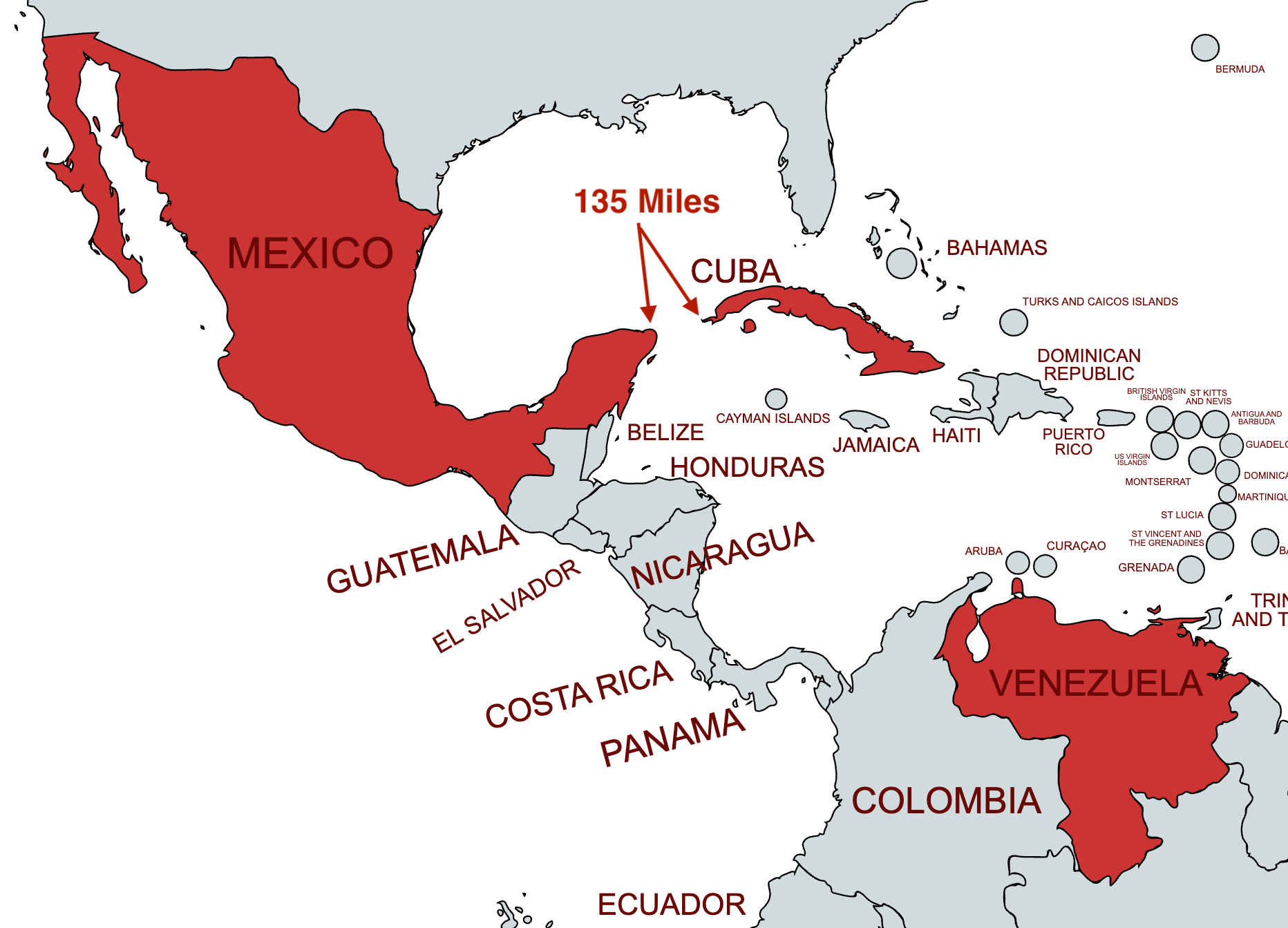
MEXICO AND CUBA: The Yucatan Channel is only about 135 miles wide at its narrowest point. People in today’s Mexico and Cuba have mixed and mingled for centuries. Most significantly in recent history, Fidel Castro sailed from Tuxpan de Rodríguez Cano on Mexico’s east coast to Cuba in November 1956 to ignite a revolution.
So it’s an obvious question whether Mexico might step in to cover any shortage of oil previously supplied by Cuba’s ally, Venezuela. In our Venezuela Special just after the American military action against Nicolás Maduro in Caracas, we looked at whether Mexico might step up. I quoted Stephen Bryen, a former Deputy Under Secretary of Defense on trade:
“Mexico emerged as a critical secondary source (of oil to Cuba) in 2023 and 2024, though its support has been inconsistent due to its own domestic oil production struggles. In 2024 Mexico provided approximately 20,000 bpd. In a massive “solidarity” effort, Mexico sent over $3 billion in subsidized fuel between May and August 2025 (briefly reaching peaks of over 300,000 bpd in a single month). However, by late 2025, these regular shipments fell by 73% as Mexico focused on its own fuel shortages. In December 2025, Mexico sent emergency shipments totaling 80,000 barrels to help Cuba manage a total grid collapse during the holiday season. It is unclear if Mexico will step in again since the US could expand its embargo to cover Mexican oil to Cuba.”
There were reports on Thursday that Pemex, the Mexican state oil company, has cancelled a scheduled crude oil shipment to Cuba in late January. President Sheinbaum confirmed they’ve been “halted” for now, calling it a sovereign decision by her government, and not something done under direct U.S. orders. But recall that Donald Trump told FOX News the day after his strike on Caracas that:
“Mexico’s run by the drug cartels … the cartels are running Mexico … and, you know, something’s going to have to be done with Mexico.”
There’s sure to be more on this to come.
•
So far, China looks to be the biggest loser of Venezuelan oil. Here’s a chart that shows the change:

•••••
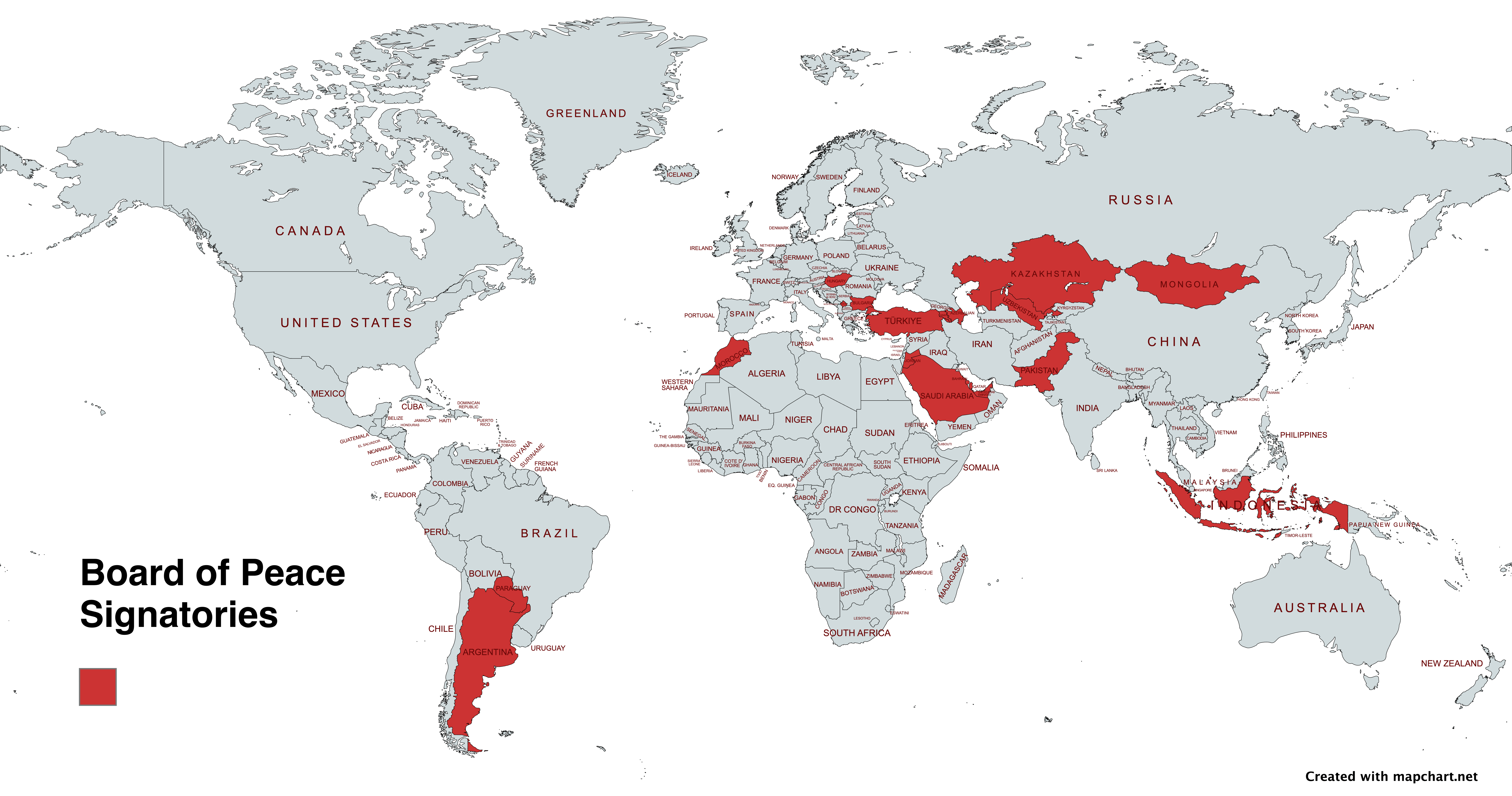
BOARD OF PEACE: An early criticism of BRICS was that a map of the first members showed no geographical coherence - that the grouping looked more like an arbitrary collection of random countries than a coherent regional or strategic bloc. Here is a map of countries who sent a representative to Donald Trump’s Board of Peace signing event in Davos.
They were: Isa bin Salman bin Hamad Al Khalifa, minister of the prime minister’s court, Bahrain, Nasser Bourita, minister of foreign affairs, Morocco, Javier Milei, president, Argentina, Nikol Pashinyan, prime minister, Armenia, Ilham Aliyev, President, Azerbaijan, Rosen Zhelyazkov, prime minister, Bulgaria, Viktor Orban, prime minister, Hungary, Prabowo Subianto, president, Indonesia, Ayman Al Safadi, minister of foreign affairs, Jordan, Kassym-Jomart Tokayev, president, Kazakhstan, Vjosa Osmani-Sadriu, president, Kosovo, Mian Muhammad Shehbaz Sharif, prime minister, Pakistan, Santiago Peña, president, Paraguay, Mohammed Bin Abdulrahman Al Thani, prime minister, Qatar, Faisal bin Farhan Al Saud, minister of foreign affairs, Saudi Arabia, Hakan Fidan, minister of foreign affairs, Turkey, Khaldoon Khalifa Al Mubarak, special envoy to the U.S. for the UAE, Shavkat Mirziyoyev, president, Uzbekistan and Gombojavyn Zandanshatar, prime minister, Mongolia.
•••••

If you’re reading this as an email, be aware that your provider may clip the article before the end. Try clicking on ‘view entire message’ to see the whole thing, or you can always read everything at Common Sense and Whiskey online.
•••••
ABOLISH ME, PLEASE: There’s a story I meant to mention a couple of weeks back but then came Venezuela and then came Greenland and then came Davos and it sort of got lost in the general foreign policy fog. But today I want to note that the president of Moldova, Maia Sandu, told interviewers on January 12th that if given a chance, she would vote to abolish her country.
It’s not everyday.
She didn’t frame it that way, naturally. She said if there were a referendum, she would vote for Moldova to reunify with Romania. Not many national leaders, I’ll wager, would vote themselves out of a job, and Ms. Sandu said that, anyway, a referendum isn’t in the cards.
The two countries are very close. Moldova speaks Romanian and any Moldovan citizen who wants one can get a Romanian passport.
Romania and Moldova have changed shape repeatedly as the result of wars and the rise and fall of empires. A unification of Moldova with Romania wouldn’t exactly be a “reunification” of a political entity past.
Old Moldavia, a Principality from the14th to 19th centuries, was bigger than today’s Moldova, stretching from the Carpathians to the Black Sea, for example. It didn’t include the left bank of the Dniester River like today’s Moldova does. That smallish region, called Transnistria, was added to the Republic of Moldova during Soviet times. Today it’s the contested part of Moldova that the Russian Federation held onto in the early nineties when it collapsed.
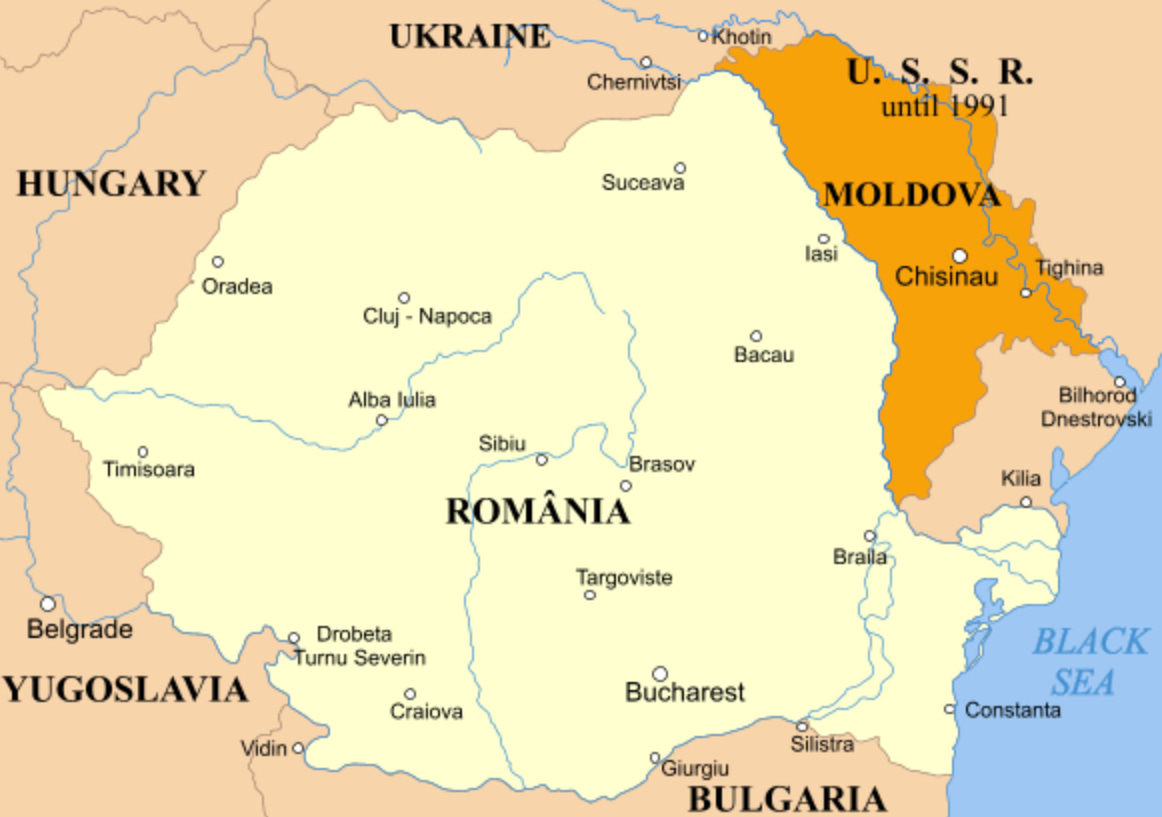
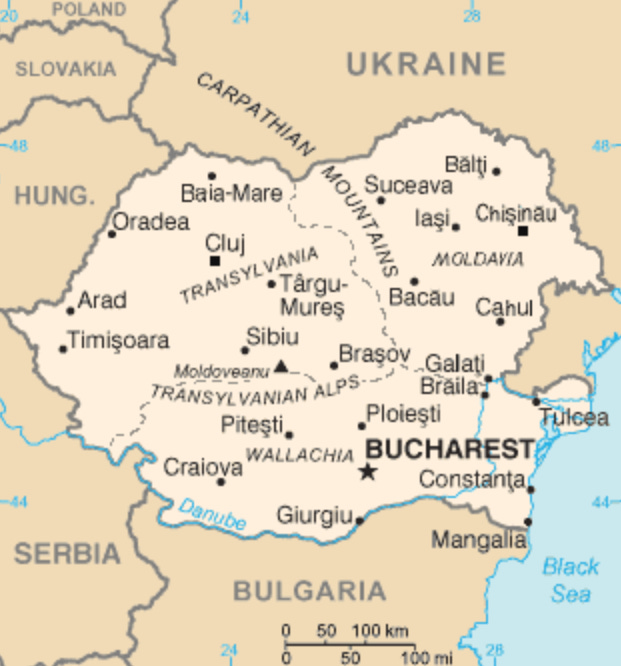
So any union of Romania and Moldova wouldn’t be a clean reversion to previous borders, and as such it’s inevitably politically loaded. For Romanian nationalists, it may suggest an unfinished historical project. For Moldovans from Transnistria it can sound like a forced annexation.
•
While the annexation issue kicked up a political storm in Moldova, I was more interested in poking my nose where it doesn’t really belong, in this item, widely reported across the Moldovan press:
President Sandu presented her income and asset declaration for 2025, and it didn’t change much from the previous year.
According to Moldpres, she earned a salary of 269,000 lei, or $16,117, 154,000 lei for travel per diem, or $9,230, 55,000 lei, or $3,299 for unused vacation days, and listed one bank account, holding 21,000 lei, or $1,277. She listed her only property as the same 74.5 square meter apartment that she has lived in for many years.
Wages in Moldova increased to 15487.80 lei per month in the third quarter of 2025. That’s $925.78, which makes Moldovans’ average yearly income $11,109.36.
•••••
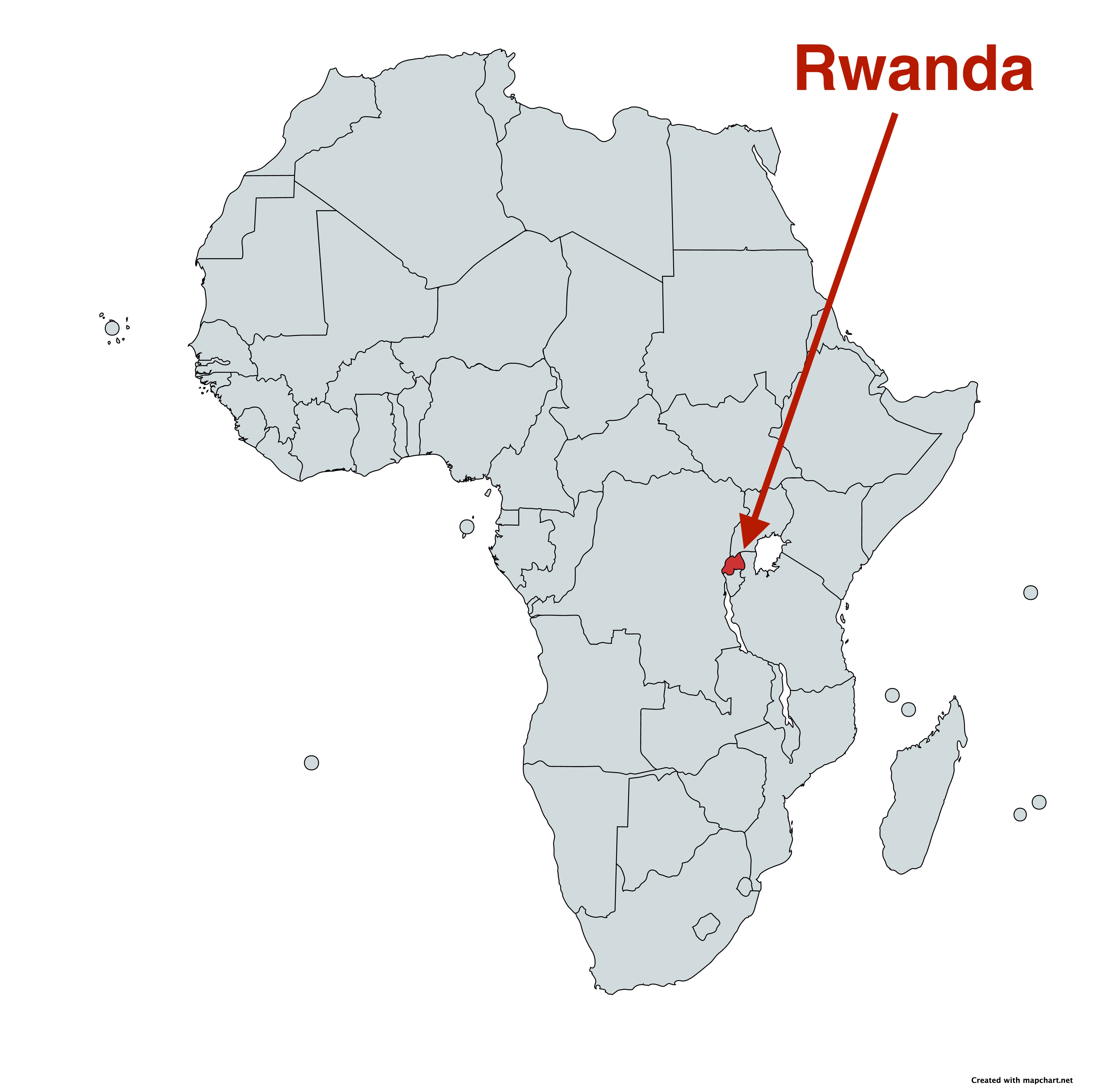
AND FINALLY: We end where we began, with challenges for Kier Starmer. Africa News reports that “Rwanda has filed an arbitration case against the United Kingdom saying it’s owed more than $130 million as part of a cancelled asylum scheme.”
Remember the “migration partnership” the Boris Johnson government negotiated with Rwanda in 2022? London was to pay Kigali to house asylum seekers and immigrants who arrived in Britain illegally. Prime Minister Keir Starmer scrapped the plan in 2024.
Kigali says it agreed to forgo further payments if the treaty was terminated and new financial terms were agreed. But according to Rwanda’s complaint, those discussions never took place.
•••••
That’s it for this week. Thanks for reading all the way down to the end.
See you next week. Please pass this article around and invite your friends to subscribe. And do let me hear from you.
Content on Common Sense and Whiskey is free. There’s no paywall, but if you subscribe for $5 a month or $50 a year, next time I’m in town I’ll come over and wash your car. Maybe I will.
Cheers,
Bill
