

Venezuela Special
Bits and Pieces, Early Framing, First Impressions

Welcome and thanks for opening this email. Today I thought I ought to put in print a few bits, pieces and ideas on the extraordinary US raid on the Venezuelan leadership compound yesterday.
I can’t offer any conclusions yet because I haven’t quite yet worked out what I think. Rather, just some first thoughts on an event we’ll surely discuss far into the future. Some of this is going to seem a little random because it is a little random, but I throw it out as grist for conversation among friends about what just happened. Please send me your thoughts.
Common Sense and Whiskey goes deeper than the headlines on a few stories a week, in a presentation that busy people can absorb quickly. It’s a short, sharp look at the world out there.
If you’re reading this as an email, maybe have a look at the online version at CommonSenseandWhiskey.com, and if you like what you see, please subscribe. Let me know what you think. Here goes.
•••••

BITS AND PIECES, EARLY THOUGHTS, FIRST IMPRESSIONS
• As far as I can tell this was the first direct US military attack on a South American country.
• Nothing in international law says it’s all right, under whatever circumstances, for one country to storm another’s national leadership compound and extract its leader. It is not as if the United States hasn’t done it before, and the US is not likely to be held liable for it in any way other than future manifestations of the resulting loss of trust in America.
On the other hand, removal of Nicolás Maduro and his wife, Cilia Flores, is a contingent victory for Venezuelans - contingent on what comes next. But it’s unlikely Donald Trump will be fretting the consequences of disregarding international law. His administration has been leading the charge against it.
Still, the administration will be sure to cite America’s rights under international law when it comes time to demand restitution from the Venezuelan taxpayer for all that oil equipment Chavez nationalized.
• It’s a big personal victory for the new ‘Viceroy of Venezuela’, Secretary of State/National Security Advisor Marco Rubio. He’s made no secret, maybe ever, of wanting to replace the leadership of Venezuela and Cuba (more below).
• On Meet the Press this morning, Sunday January 4th, Rubio said “all that (elections), I think, is premature at this point.” Instead, American will run Venezuelan policy through the country’s remaining regime leaders for now. Reporters will be sure to remind the Secretary of State/National Security Advisor of that the next time a coup happens in Africa and a gang of barefoot hoodlums in the back of pickup trucks promises elections in just eighteen months. Not to make comparisons.
• It’s ironic how loudly Donald Trump initially railed against the drone attacks Russia alleged that Ukraine had carried targeting Putin personally (before we learned that wasn’t true). Obviously, attacks on individual leaders would have set a bad precedent for their personal safety. And now days later Trump has gone and done it himself.
• EU leaders, with no idea what to do about this entire Venezuelan event, spent the weekend impersonating pretzels. YLE, the Finnish national broadcaster, writes: “Finnish President Alexander Stubb has said that Venezuela’s government has lacked legitimacy for years, while stressing that all states must continue to respect international law.”
• One thing the Maduro capture illustrates is that Donald Trump thinks seizing Venezuelan oil infrastructure outweighs his personal animus toward Volodomyr Zelenskyy since, all things being equal, more oil on the market ought to eventually drive down world oil prices, hurting financing of the Russian war effort.
And since that is true, not surprisingly:

• Nevertheless, in a new world where capturing other countries’ leaders is okay, Zelenskyy will be unnerved, and double up on personal protection, after today’s events. Interesting question is, which other leaders will do the same. Greenlandic Prime Minister Jens-Frederik Nielsen?
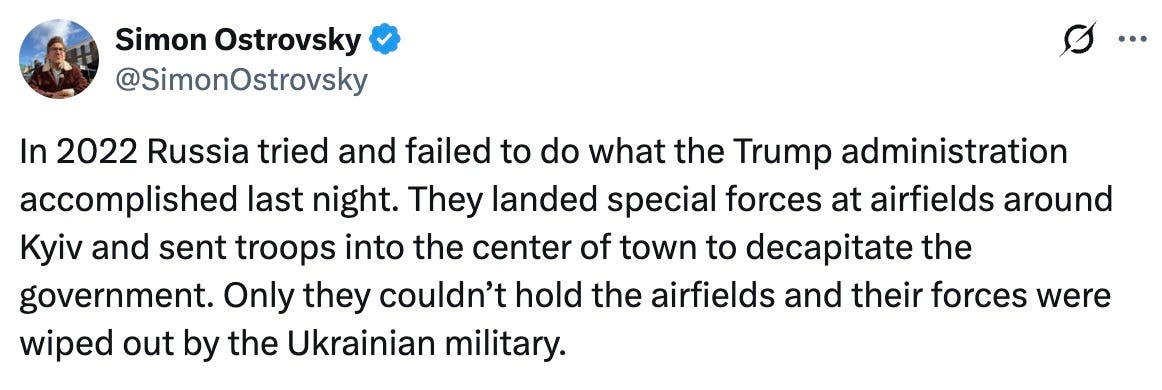
• The United States seized Panamanian leader Manuel Noriega in 1989, though arguably with more justification - U.S. Marine Lt. Robert Paz had been killed and the George H W Bush administration claimed Noriega threatened the stability of the Panama Canal. But it’s also fair to note that the US isn’t the only country to have attempted such a seizure of the leader of another country, as Simon Ostrovsky does here:
• Background from The Atlantic:
“Venezuela has the largest estimated oil reserves in the world—accounting for about 17 percent of global reserves, or more than 300 billion barrels, according to the Oil & Gas Journal. But Venezuela produces only 1 million barrels of oil per day. Its potential is largely unrealized because of poor infrastructure, mismanagement, limited resources, and U.S. sanctions. What little is produced has to be sold on the black market for Venezuela to profit. About 80 percent of Venezuela’s oil, which is of low quality, currently goes to China, at least 15 percent goes to the U.S. via a remaining joint venture with Chevron, and the remainder goes to Cuba.”
• And from Geopolitics Unplugged:
“Venezuela’s staggering oil endowment: proven reserves of approximately 303 billion barrels, far surpassing Saudi Arabia’s 259 billion and representing roughly 18-20% of the world’s total identified conventional and heavy oil stocks.”
Still, for all that promise, Venezuela accounts for well under 1% of global oil supply.
• Donald Trump wouldn’t be drawn on who’ll ultimately be running the show in Venezuela, beyond ‘we’re gonna run it,’ and neither would Rubio on Meet the Press today.
In the first few hours the Venezuelan Vice-President, Delcy Rodriguez, declined to assume the presidency, sticking with “Interim President.”
“There is only one president in Venezuela, and his name is Nicolas Maduro Moros,” she said.
Trump said he wanted to work with her, yet she later called for Maduro’s release. As of today Interior Minister Diosdado Cabello, Defense Minister Vladimir Padrino and Jorge Rodríguez, the head of the National Assembly (and brother of now interim President Delcy Rodriguez) are apparently still in place.
Which sets up at least the possibility that there was some sort of internal arrangement made between this group (and possibly others) and the US before the US action. If it was some sort of internal coup against Maduro, that might help us understand why there were so few reported casualties. But it would also suggest that a true commitment to democracy wasn’t foremost in the American’s minds, but rather more of a neo-colonial play for Venezuela’s oil.
• In yesterday’s press conference, Trump declined to work with 2025 Nobel Peace Prize winner María Corina Machado, saying she lacks sufficient internal support and respect. He said he preferred to work with Vice President Delcy Rodriguez.
It strikes me that if the Nobel committee is going to diss Trump in favor of Machado, fat chance he’ll be giving her respect.
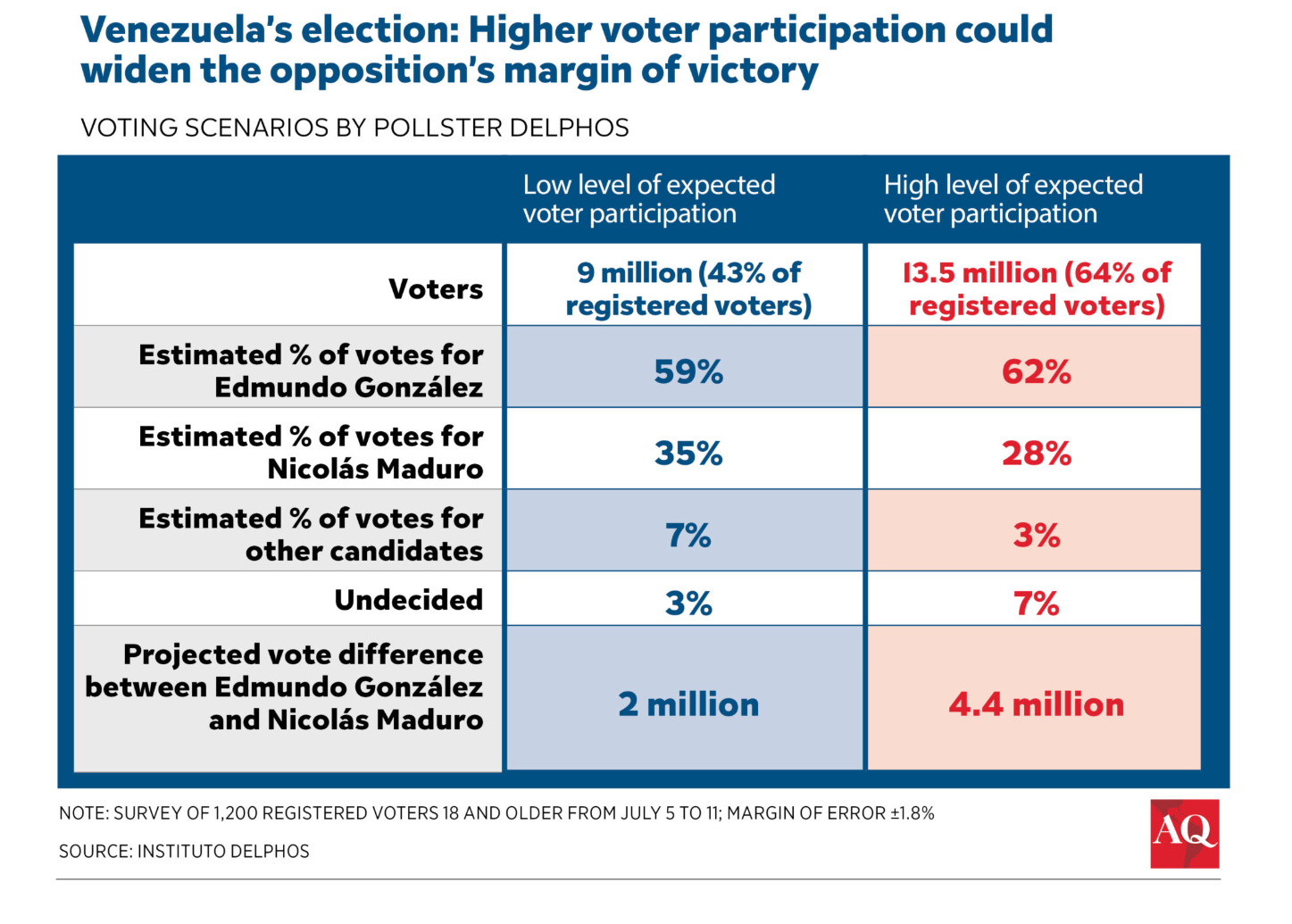
• For the record, and contrary to what many people believe, María Corina Machado, the 2025 Nobel Prize winning opposition leader many suggest to be the next leader of Venezuela, did not win the most recent, stolen election in Venezuela. From Americas Quarterly:
“María Corina Machado was the most prominent opposition leader and winner of the opposition primaries for the 2024 election, but she was disqualified from running by the regime-controlled National Electoral Council. Machado supported Edmundo González’s candidacy and campaigned alongside him as the leader of the opposition movement. Polling had González well ahead.”
Here’s some idea how well ahead:
• As usual in the early days following a big international event like this, several things look to be true at once. From a technical viewpoint, as far as we know so far, the attack was apparently masterfully carried out. But Michael McFaul was also right, in an article written five days before the attack:
“My biggest fear as an American, however, is my doubt over Trump’s sincere commitment to promoting democracy in Venezuela. I see little evidence that democracy promotion is high on Trump’s list of priorities. In fact, I’m not even sure it’s on his list. Oil seems much more on his mind, including even trying to take back American assets lost to nationalization decades ago.”
• And there is no doubt that for all its America First sloganeering, the Trump administration has come with a blizzard of foreign involvement in its first year, which critics say is all meant to divert many Americans’ attention from their increasing precarity. Indeed, here’s a viewpoint from the economic left:
“What we’re doing in Venezuela is the price of oligarchy. Your cost of living keeps going up and your middle-class status keeps getting squeezed because you exist in a system that requires the US government to find reasons to perpetually bomb and invade foreign countries. No permanent war economy, no trillion-dollar war machine; no trillion-dollar war machine, no forever wars. And a permanent war economy, in turn, is oligarchy’s fix to its regime of wealth-hoarding that could otherwise not sustain itself amid declining growth (or a declining rate of profit).”
• And finally, some historical context on US intervention in Latin America, and a look at Venezuela in statistics.
•••••

If you’re reading this as an email, be aware that your provider may clip the article before the end. Try clicking on ‘view entire message’ to see the whole thing, or you can always read everything at Common Sense and Whiskey online.
•••••
To close, I believe Donald Trump means what he says on Cuba and Latin America. Last month’s National Security Strategy document spoke of American “goals in the western hemisphere:
“We will expand by cultivating and strengthening new partners while bolstering our own nation’s appeal as the Hemisphere’s economic and security partner of choice.”
And expand they have, although while giving Venezuela no choice as to whether they might want to be a new partner.
“The U.S. Government will identify strategic acquisition and investment opportunities for American companies in the region.”
Identified. Acquired.
So will Cuba be next? Cuba is already experiencing power outages, but now, presumably, the US will prevent any more oil getting thru to it from Venezuela, which has been its longtime supplier.
Stephen Bryen is a generally pro-Russian former Deputy Under Secretary of Defense (on trade and technology security policy during the Reagan administration) with whom I broadly disagree on matters of Russia’s war on Ukraine. But we was once a Deputy Under Secretary of Defense on trade, and I defer to his presumed expertise on an interesting Mexican angle to the Cuba question, namely, whether Mexico might help Cuba with expected shortages of oil:
“Mexico emerged as a critical secondary source (of oil to Cuba) in 2023 and 2024, though its support has been inconsistent due to its own domestic oil production struggles. In 2024 Mexico provided approximately 20,000 bpd. In a massive “solidarity” effort, Mexico sent over $3 billion in subsidized fuel between May and August 2025 (briefly reaching peaks of over 300,000 bpd in a single month). However, by late 2025, these regular shipments fell by 73% as Mexico focused on its own fuel shortages. In December 2025, Mexico sent emergency shipments totaling 80,000 barrels to help Cuba manage a total grid collapse during the holiday season. It is unclear if Mexico will step in again since the US could expand its embargo to cover Mexican oil to Cuba.”
It’s an interesting question whether Mexico will step in again, given that in his media victory lap on Saturday morning, Donald Trump told FOX News that:
“Mexico’s run by the drug cartels … the cartels are running Mexico … and, you know, something’s going to have to be done with Mexico.”
I also believe the administration means what it says on Cuba and Latin America because the Secretary of State/National Security Advisor, flush with victory in Venezuela, has had it out for Cuba, specifically, for years and is now in a position to do something about it.
The family story long told by a young, aspiring Senator Rubio, including on his official website, was that Rubio's parents fled Cuba for Miami after Fidel Castro rose to power in Havana in 1959.
In fact, Rubio's parents immigrated to Cuba several years before the revolution that brought Fidel Castro to power. In a TV ad during Rubio’s run for the Senate in 2010, the candidate said, “My parents lost everything - their home, family, friends, even their country. But they found something too, America,” suggesting they had fled the Castro regime under duress.
That just wasn’t true, and when the discrepancy came to light Rubio changed his website bio to say that he was, “born in Miami in 1971 to Cuban exiles who first arrived in the United States in 1956."
Which sets an early marker for how long Rubio has been changing his position on things, but it also shows that he felt being against the communist regime in Cuba was at the very least politically beneficial among Florida’s Cuban diaspora.
Cuba has been in dire straits for years and years. There was a brief period when Americans could visit Cuba on group tours. Groups were variously organized, and we chose a tour in 2012 that wasn’t very overseen, three or four days in return for a couple of minibus trips and a dinner.

I leave you with a glimpse of the state of Havana circa 2012. From my notes:
Here is Yubel, our guide, onboard our Transgaviota bus, made by Yutong bus company of Zhengzhou, Henan Province, China, which we’ll now use to tour Cuba on our group tour program. Yubel stands and sways in the front of the bus facing backwards, wearing a green pullover, jeans and sneakers. Close cut hair, sporting a rakish shoulder bag. Callow, more earnest than affable, but still affable enough.
Says Yubel, “In Cuba, it’s like Las Vegas, what happens in Cuba stays in Cuba. Feel free.” Forced bonhomie of the beginner. He’ll shake it off as he grows into the job.
Once in Tibet, we drove along listening to our driver and guide singing Bob Marley: “Get up, stand up, stand up your rights…..” unironically. Same sentiment.
And he’s honest till it hurts. Before its demise, the Soviet Union supplied eighty per cent of Cuba’s imports. After the Soviet collapse tough times ensued on the island, an interval euphemistically referred to as the “special period.”
•
Yubel says “We call it the ‘special period.’ That has no meaning. The special period was a BAD period.”
He passed around his family’s ration booklet. While you’re able to augment the ration as much as your finances allow, Cubans are entitled to an allotment of rice, grain, acelte, sugar, compota, soap, salt and coffee each month, among other things, and one chicken.
•
Yobel is explaining how, when his cell phone rings, it’s so expensive that he gets the number and goes to a pay phone to call back. In Cuba there are still pay phones. And he says, the internet is just not a factor.
•••••
That’s it for this extra edition of Common Sense and Whiskey. Thanks for reading all the way to the end, and I’ll see you Friday.
Cheers,
Bill
•
Please pass this article around and invite your friends to subscribe. Like we say in Georgia, ‘It don’t cost nothing.’ And do let me hear from you.
Content on Common Sense and Whiskey is free. There’s no paywall, but if you subscribe for $5 a month or $50 a year, next time I’m in town I’ll come over and wash your car. Maybe I will.
This post is public so please feel free to share it. I’m grateful that you read my Substack, thank you very much. Please tell your friends, and consider subscribing for five dollars a month. See you next week.
