

What Just Happened #79
Going Polar

Welcome and thanks for coming by. There’s a lot to do this week and this is a very long post. Today, Venezuela, Greenland and a potentially historic week for European diplomacy.
Common Sense and Whiskey goes deeper than the headlines on a few stories a week, in a presentation that busy people can absorb quickly. It’s a short, sharp look at the world out there.
Have a look at today’s column. If you’re reading this as an email, maybe have a look at the online version at CommonSenseandWhiskey.com, and if you like what you see, please subscribe. Let me know what you think. Here goes.
•••••
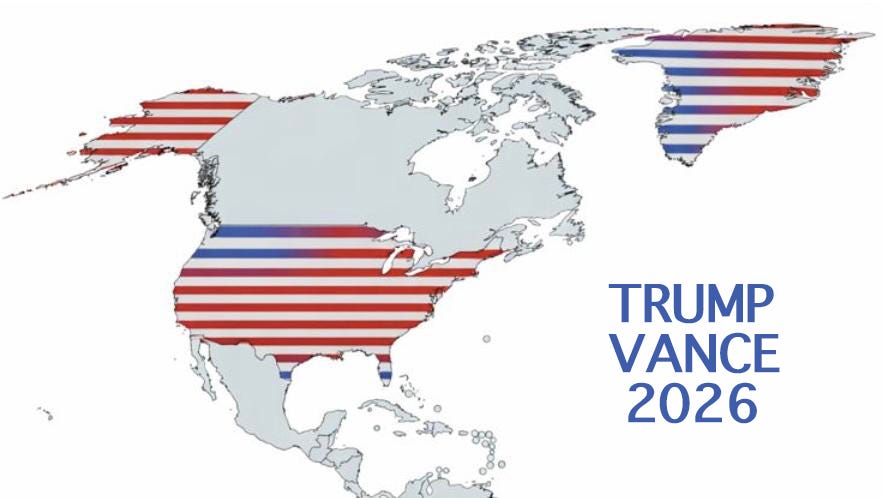
NOT JUST ANOTHER DAY AT THE OFFICE: It was a week that fit the Vladimir Lenin quote, “There are decades where nothing happens; and there are weeks where decades happen.”
While the fallout from American gunboat diplomacy last weekend refused to simmer down, a fresh threat to NATO bubbled up via Greenland. The most recent attempt to overthrow the Iranian government continued for a second week, with reports that security forces in the western cities of Abdanan and Malekshahi had fled early in the week. Thursday, January 8th, may have been the biggest night of protests yet, with remarkable pictures from Mashhad and Tehran. And some thirty odd ‘coalition of the willing’ countries met with Volodymyr Zelenskyy in Paris on Tuesday, with France and the United Kingdom making a potentially historic pledge to send their soldiers to Ukraine in the event of a cease fire.
Let’s start with the fallout from the ouster of Nicolás Maduro in Venezuela.
NO GUNBOATS NEEDED FOR CUBA: The president is probably right that the US need not pull off another kidnapping in Havana to bring down the Cuban government. The longer the US keeps Venezuelan oil off the island, the sooner the collapse is likely to come.
Because, for example, as the New York Times put it this week, “A typical monthly pension is 3,000 pesos, less than $7, while a carton of 30 eggs costs 3,600 pesos — $8. The Times wrote that “never before have Cubans experienced such a wholesale collapse of the social safety net that the country’s leaders - starting with Fidel Castro - once prided themselves on.”
There’s been a running side intrigue about whether another country might step up and supply Cuba with the oil it will no longer get from Caracas. We talked about Mexico in my Venezuela Special on Sunday, but there is another theoretically possible savior out there: Russia.
Havana and Moscow used to be the best of friends. Remember, there was that whole Cuban Missile Crisis thing.
Russia isn’t known as the most steadfast ally these days (see, well, several alliances, but lately, Syria, for example, and right now, today, Iran in its time of need) but should Vladimir Putin show solidarity with his allies in Havana, wouldn’t that set up an interesting moment between Presidents Trump and Putin?
WHY DID THEY DO IT, REALLY? At that Saturday press conference and elsewhere, the administration gave three main reasons for its gunboat diplomacy: drugs, immigration and oil.
Where the administration stands isn’t exactly shrouded in mystery. Marco Rubio has wanted regime change in Venezuela and Cuba since he was in diapers, and there’s something for everybody in the three declared reasons. Drugs is a ready-for-use hardy perennial. Steven Miller drools over deportation (send those damned Venezuelans back home!), and an oil windfall pleases Donald Trump.
He’s the boss, so that’s the main reason.
In May 2024 candidate Trump dined with oil industry executives to ask for a billion dollars for his campaign, in explicit return for a basket of goodies. A Washington Post article reported:
“Trump vowed at the dinner to immediately end the Biden administration’s freeze on permits for new liquefied natural gas (LNG) exports — a top priority for the executives, according to three people present. ‘You’ll get it on the first day,’ Trump said, according to the recollection of an attendee.”
I’m not sure whether oil executives consider the deeds to listing oil derricks as very much of a payoff, but the president must presume he’s making good with his financial benefactors.
And that’s likely pretty much it. No undergirding framework, no grand strategy, no plan for new Venezuelan leadership (although there’s a recent Nobel laureate handy), not even a plan for running the country.
Rubio wanted to do it. Miller wanted to do it, Trump wanted to do it. Hegseth surely thought it would be really cool. And it looks like Vance mostly holds the Greenland brief at the moment.
WHERE DOES ALL THAT OIL GO? Good question. It looks like the US means to sell the oil backed up in Venezuela because of the American blockade and hold the money hostage, in an offshore account the US controls, until Venezuela makes the changes the US wants.
“We need to have that leverage and that control of those oil sales to drive the changes that simply must happen in Venezuela,” Energy Sec Chris Wright said Wednesday.
News came in a Truth Social post from the president that Venezuela would be sending thirty to fifty million barrels of oil to the United States. The WSJ reported that “The value of the barrels would be between $1.5 and $2.5 billion based on Tuesday’s benchmark for heavy crude used on the Gulf Coast.”
Details are sketchy. If the United States had a Congress, the president couldn’t simply “control” money that the government receives without the Congress’s approval. The Constitution’s Appropriations Clause gives Congress the power of the purse.
Article I, Section 9 of the Constitution says: “No Money shall be drawn from the Treasury, but in Consequence of Appropriations made by Law,” meaning that funds can’t be spent unless Congress authorizes them. That’s the Constitution’s Appropriations Clause, the fundamental check on executive spending authority.

With billions of dollars involved here, it’s not surprising this would get murky fast, and so it has. This will be an ongoing story, but for now, here is reporting from a PBS correspondent that shows some of the murk:

COLONIALISM SCHOOL: Before we leave Venezuela, here’s the vice-president’s tiny contribution to Venezuela, with FOX News host Jesse Watters.
Watters: How does “taking out” a dictator help the average American?
Vance: “We’re gonna be able to control the incredible natural resources of Venezuela, which is good for America in a few ways. Number one, it allows us to put leverage on our enemies, number two it makes sure that if Americans need high quality, low cost power we’re always gonna have access to it, and then the third thing is it does demonstrate American military excellence, which makes people afraid to cross us in the future.”
(While we’re talking about FOX News and making people afraid, the president rattled sabres on FOX News Thursday night, telling Sean Hannity “We’re going to start hitting targets on land when it comes to the cartels. The cartels are running Mexico.”)
Once having deposed a leader he declared corrupt, a more conventional American president might demand freedom for political prisoners and arrange for the US military escort to escort the Nobel Laureate María Corina Machado on a triumphant return to Caracas. It doesn’t look like we’re going to see that. But Venezuela announced it would release “an important number” of political prisoners Thursday night.
The main justification the administration has given for its action in Venezuela is that it is about saving America from drugs. Let’s call that, maybe, a partial truth. Now compare the justification the Trump team is setting up for Greenland, namely, protecting the US from China and Russia. Some suggest that in the case of Greenland, that not the real reason either. Let’s have a look.

DENMARK & GREENLAND: “President Trump has made it well known that acquiring Greenland is a national security priority of the United States, and it’s vital to deter our adversaries in the Arctic region,” White House press secretary Karoline Leavitt said in a statement on Wednesday.
“The president and his team are discussing a range of options to pursue this important foreign policy goal, and of course, utilizing the U.S. military is always an option at the commander in chief’s disposal.”
Indeed, we’ve just seen how utilizing the military is an option for the president. And his administration has judged the threat from our adversaries in the Arctic region so acute that it has deployed 150 soldiers to its military base in Greenland.
That’s approximately 1 soldier every 5573 square miles (836000/150).
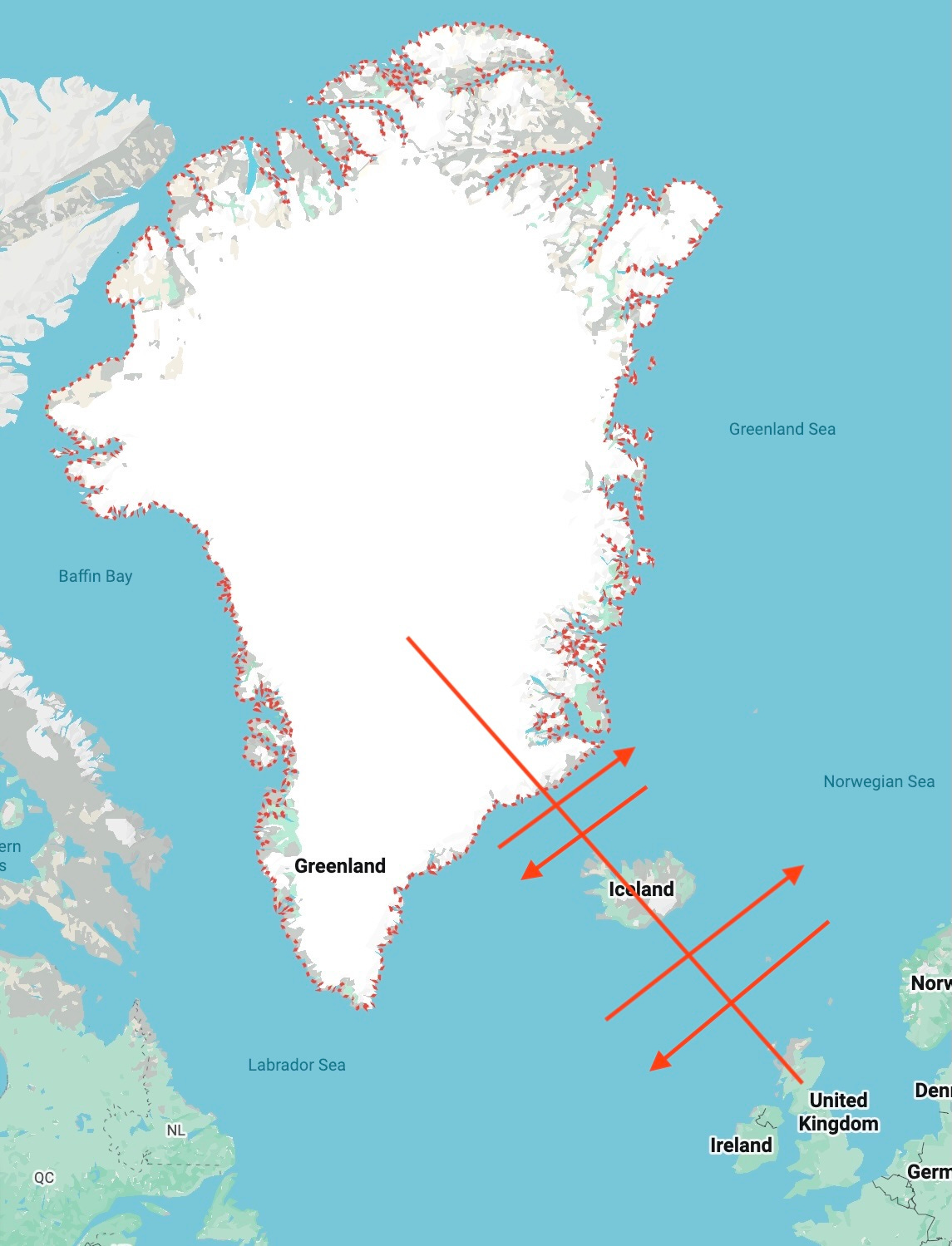
The Pituffik Space Base, where just about all the US soldiers are stationed, is used for early warning of ballistic missile launches and monitoring space. Greenland also guards part of what is known as the GIUK (Greenland, Iceland, United Kingdom) Gap, where NATO monitors Russian naval movements in the North Atlantic.
This comes from the US Naval Institute:
During the Cold War, the maritime choke points between Greenland, Iceland, and the UK were key to the defense of Europe. This “GIUK gap” represented the line that Soviet naval forces had to cross in order to reach the Atlantic and stop U.S. forces heading across the sea to reinforce America’s European allies.
Listening to Donald Trump, you’d be forgiven for thinking Greenland was seething with bad guys. From PBS:
“Greenland is covered with Russian and Chinese ships all over the place,” Trump said. “We need Greenland from the standpoint of national security, and Denmark is not going to be able to do it.”
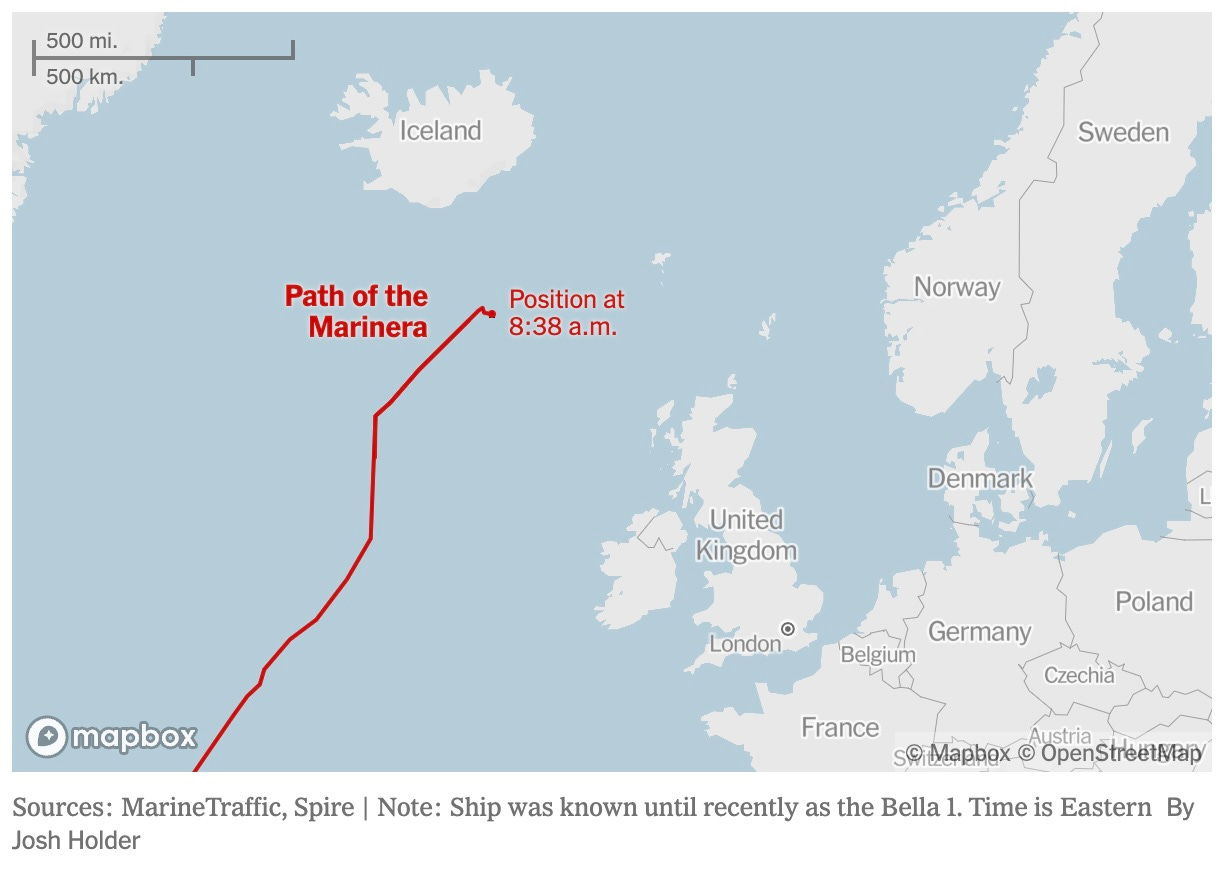
But the US did its case no favors early Wednesday by seizing a tanker precisely in the GIUK straits - with military assets based in England.
“Several U.S. military aircraft left bases in Britain on Wednesday morning heading toward the tanker, according to flight-tracking sites,” wrote the New York Times.
BUT HE’LL CHERISH THEM: The president won’t be drawn, naturally, on whether he’ll pull the trigger, so to speak, on annexing Greenland. I found a charming quote in the Guardian, which gets to the president’s golden heart:
“I don’t say I’m going to do it, but I don’t rule out anything. No, not there. We need Greenland very badly,” Trump told the US broadcaster NBC in May when asked about a potential takeover by force. “Greenland is a very small amount of people, which we’ll take care of, and we’ll cherish them, and all of that. But we need that for international security.”
AMERICANS BEARING GIFTS: Denmark provides Greenland with an annual block grant that works out to over $10,000 per Greenlander. Islanders are entitled to free health care, and if the main hospital at Nuuk lacks sufficient expertise they’ll be flown to Denmark proper for treatment. Education is available for everybody through college.
Reuters reported on Thursday that this may be how the US wants to “buy” Greenland:

EUROPE PREACTS: Turmoil. Europe, just like everybody else, has no idea what it would do if Trump were to move on Greenland. Whatever it is, they want to do it together.
On Tuesday the leaders of Denmark, France, Germany, Italy, Poland, Spain and the United Kingdom issued a fairly generic statement insisting that “It is for Denmark and Greenland, and them only, to decide on matters concerning Denmark and Greenland.” What they haven’t come up with is what to do about it.
The French foreign minister, Jean-Noël Barrot, said the subject of how to react to a seizure of Greenland would be discussed at a meeting with the German and Polish foreign ministers on Wednesday.
That meeting was held, but I’ve seen no public statements following that meeting. Barrot and others have been clear that Greenland is not for sale, its future should be The EU foreign policy chief, Kaja Kallas, said on Thursday that the bloc was weighing its response. As of now, there doesn’t seem to be a definitive European position.
It’s probably unavoidable given the utter uniqueness of this week’s news that Denmark and Greenland are bickering over how to handle the American threat. “Denmark is antagonising both Greenland and the U.S. with their mediation,” says Pele Broberg, the leader of Naleraq, the largest opposition party and the most prominent political voice for Greenland's independence. He wants Greenland to hold direct talks with the US and cut Denmark out entirely.
BUT WHAT’S REALLY GOING ON HERE? The center-right American Action Forum has come up with a potential value of $4.4 trillion for Greenland’s mineral and energy resources. Which could come at the cost of what up to now has been a pretty handy alliance.
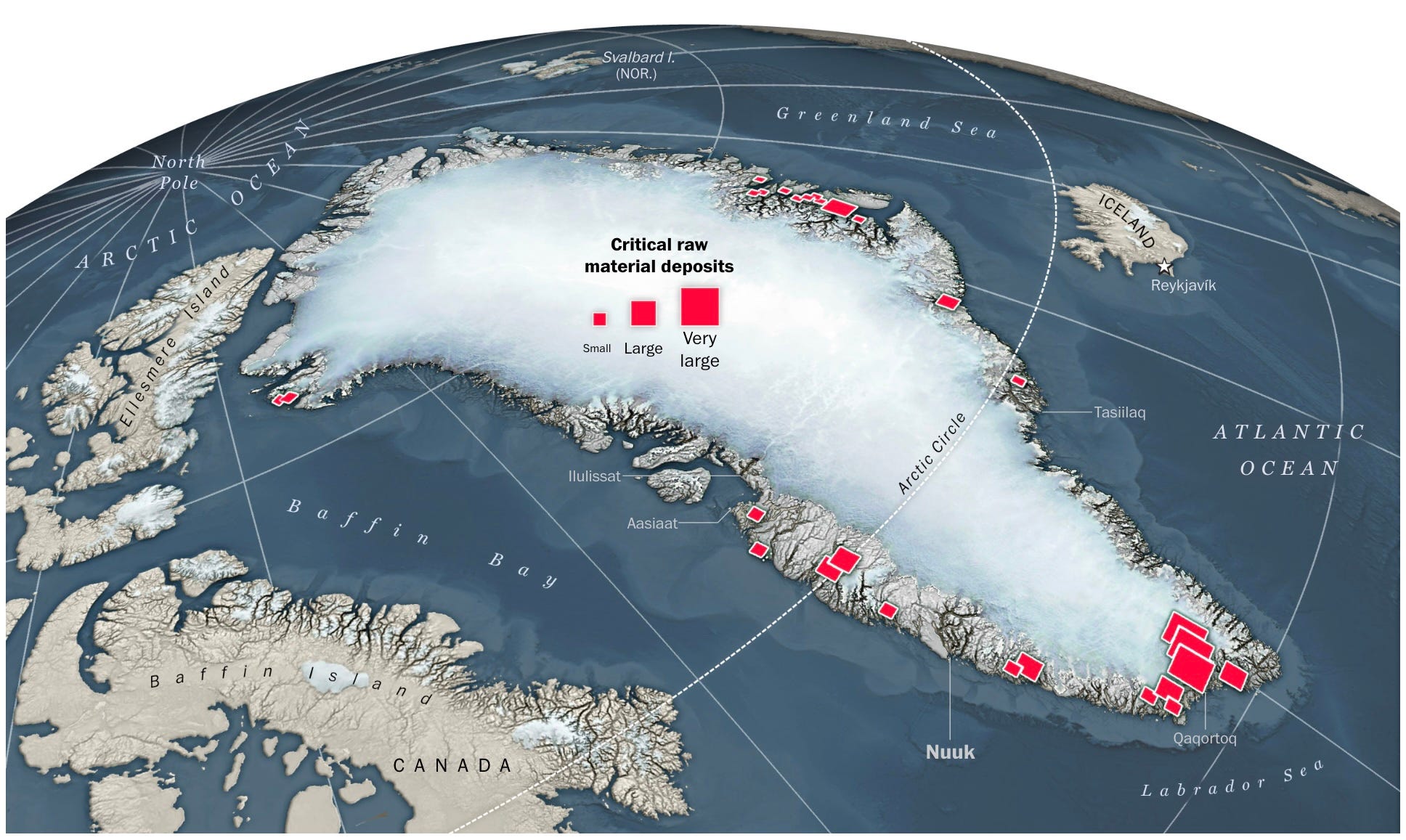
The Washington Post says Greenland has deposits of diamonds, graphite, lithium, copper, nickel and gallium. It also has oil and rare earth minerals, such as neodymium and dysprosium, of which China and Russia are right now the top global producers, according to the Royal Society of Chemistry.
DENMARK TALKS TOUGH: Finally, and this is hard to believe, according to the Telegraph:
Danish soldiers will be required to shoot first and ask questions later if the United States invades Greenland, under the army’s rules of engagement.
On Wednesday, the Danish defence ministry confirmed the existence of a 1952 rule requiring soldiers to “immediately” counter-attack invading forces without awaiting orders.
The defence ministry also said that the rule “remains in force” when asked about its status by Berlingske, a centre-Right Danish newspaper.
•••••

UKRAINE: It would have been the main story just about any other week: “Europe Pledges Troops to Ukraine.” Was history made? The French and British leadership wants us to think so. Some thirty odd ‘coalition of the willing’ countries (from here on, ‘the willing’ for short) met with Volodymyr Zelenskyy in Paris on Tuesday, and France and the UK made a potentially historic pledge to send their soldiers to Ukraine in the event of a cease fire.
There are skeptics, and there’s a lot to be skeptical about.
“Who does Sir Keir Starmer think he is kidding? Ukraine is two and a half times bigger than the old West Germany, where during the Cold War Britain had 50,000 soldiers, alongside 300,000 Americans, plus 200,000 French, all backed up with ample reserves and air power, as well as West Germany’s army.”
This is Ed Lucas, writing this week in the London Times. He says “the British Army has at best 25,000 combat-capable troops” and is “struggling to keep even 1,000 of them deployed as a tripwire in Estonia.”
France’s military is larger, and both countries, as formidable colonial powers in a previous era, have deep institutional experience in putting together expeditionary forces like what would be expected of them in Ukraine.
The London Times reported that Britain and France’s combined peacekeeping force would be limited to 15,000, but “The assumption is that fewer than 7,500 British soldiers will be deployed, two military sources disclosed, although that figure is also expected to be a struggle for the UK.”
The Times further reported that the previous chief of the British defense staff wanted a 64,000-strong force, but “in subsequent meetings defence ministers across Europe said there was ‘no chance’ they could reach those numbers and even 25,000 would ‘be a push.’ And now, when it’s time to finally put cards on the table, we end up at 15,000, which we understand will itself be a stretch, with exactly no countries offering troops but Britain and France.
Others among ‘the willing’ say they’ll participate in air support and other ways, but it turns out there’s not much of a coalition of those willing to put their boys in harms way on Ukraine’s behalf.
WHAT WE KNOW SO FAR: the US would lead electronic monitoring of the ceasefire line.
The willing would endeavor to reestablish international air travel into Kyiv.
Turkey and “other Black Sea countries” would handle demining in the Black Sea.
Zelenskyy insisted earlier that he wanted a treaty, approved by the US Congress. No mention of that. And there is no guarantee that the US won’t just change its mind.
I can’t find any hint of rules of engagement for ‘the willing’. For example, if French troops are fired upon by Russians, can they fire back? It’s true and proper that these things are by rights for Ukraine to decide, and not something that they would negotiate away with Russia in advance, so they’ve taken this decision to seek this promise of support, and it appears to have been granted on several contingencies the parties have yet to work out.
There are consequences to publishing this agreement. One of the points in the Witkoff/Russia proposal was that Ukraine would foreswear ever joining NATO. The promise of two NATO countries’ troops stationed in Ukraine in the event of a cease fire would seem to dampen Russia’s enthusiasm to sign a cease fire.
So it looks like the prospects of a cease fire remain distant. In fact, these talks among ‘the willing’ might be a mechanism that Putin can use to reject a cease fire without angering Trump. Another problem: any US action against Greenland, and all bets are off.
(The day after the summit of ‘the willing’ President Trump told the New York Times that he thinks the trans-Atlantic alliance was essentially useless without the United States at its core. When asked “what was his higher priority, obtaining Greenland or preserving NATO, Mr. Trump declined to answer directly, but acknowledged ‘it may be a choice,’” the Times reported.
Imagine Europe after a US occupation of Greenland. The allies’ unity would shatter. Countries would strain to maintain a common stance, and fail. An ‘appease the Americans’ camp would form and rightly outraged others would strongly disagree. Article 5 would teeter and invite a challenge.)
WOE IS EUROPE: This week’s signing in Paris is clearly a way of the Europeans inviting themselves into a process they (rightly) feel shut out of. For all the noise and summitry and condemnation of Russia and righteous indignation the European leadership has shown throughout a war about to enter its fifth year, this week, when it was time to sign on the dotted line, there just wasn’t much in the European package.
Which speaks to the reason Europe feels shut out in the first place. We’ve all seen that, gliding along for decades on America’s security guarantee, European countries have grown softer. Now the Europeans are frightened of losing the US, and they should be.
Its leaders flatter, they grovel, Donald Trump responds with contempt and the next day they come back for more. European capitals must understand, that approach didn’t work. It’s not going to work for the next three years, either.
Europe is going to have to stand up on its own, and the sooner the better. But what we’ve found out this week is that contrary to the hopes of just about everybody, even in this time of war in Europe, few on the continent are willing to rise to the occasion.
There’s a larger question, too. With all that’s happening just now, Ukraine might be about to be demoted in the grand sorting of the world’s news. The US has demonstrated that it’s moving away from the existing postwar international order as a framework for governing and toward a new international orientation around spheres of influence. (Much more on this idea to come.)
In so doing it is moving toward Vladimir Putin and Xi Jin Ping. The three of them just may shove this whole Ukraine thing down the hierarchy of great power importance, leaving Europe to sort things out with Russia on its own.
We’re heading toward an interesting moment in US/Russia relations, because at the same time that we have American gunboats in Venezuela, which is a stick in Russia’s eye, we also have the seizure of this Russian flagged ship (another stick) coming the day after the US’s agreement to work with the so called Coalition of the Willing, all of which together will likely force Putin into some kind of a reaction. Conveniently for him Wednesday was Orthodox Christmas, a holiday. He has been conspicuously quiet since.
•••••

If you’re reading this as an email, be aware that your provider may clip the article before the end. Try clicking on ‘view entire message’ to see the whole thing, or you can always read everything at Common Sense and Whiskey online.
•••••
MAYBE DON’T TAKE A JOB IN RUSSIA RIGHT NOW: Under the Putin regime Russia seems to have escalated from disrespecting just Russian lives, to disrespecting the lives of people in other countries. There’s the issue of kidnapping Ukrainian children (that’s why Putin himself can’t fly around - there’s an ICC arrest warrant out for his arrest for war crimes) - and now:

Geopolitics Unplugged explains:
“At least 200 Kenyans were deceived by recruiters promising high-paying jobs in Russia, only to be forced into brief military training and frontline combat in Ukraine, resulting in deaths like that of Martin Mburu. Victims, often mini-bus drivers, faced language barriers, extreme conditions, and deception, with Kenyan authorities investigating transnational networks and repatriating 18 individuals. Ukraine reports over 1,400 Africans coerced into fighting for Russia. Families and rights groups demand accountability amid suspicions of government complicity.”
•••••
AND FINALLY: In a recent Washington Post column Fareed Zakaria wrote this:
”One of the differences between President Donald Trump’s second term and his first has been a full-blown attack on the expert class. Vice President JD Vance urges that we trust our common sense over the ideas of ‘the experts.’”
That’s true, but it’s not an original insight, and it’s not new. In the run-up to Brexit Michael Gove, one of the LEAVE campaign leaders, decried experts three weeks before the Brexit vote, on June 3rd 2016:
“I think the people in this country have had enough of experts from organizations with acronyms saying they know what is best … and getting it consistently wrong.”
The vice president, whose remarks found quick affirmation on the Wall Street Journal’s editorial page, is a fine example of the rising wave of would be populist leaders who prefer to base their political positions on feelings rather than facts.
The rise of far right governments is a time-tested sign that trust in leaders is waning. When trust in government breaks down, people begin to feel insecure, unheard and frustrated. In those poltiical moments far-right (and sometimes far-left) movements can gain traction because they provide simple, emotionally compelling answers to complex problems.
(We can already see the dispiriting effects of dismissing experts in the desolation that is the Centers For Disease Control’s Atlanta campuses today.)
But it’s simple to see why Vance and his fellows do it - it is easier to manipulate people’s feelings than to make a rational argument. The vice-president’s method is no philosophy of governance. It’s a technique of manipulation. In essence, and we see this time and again and in every second or third or fourth Donald Trump sentence, it boils down to a common enough rhetorical manipulation: “If evidence contradicts your position, redefine evidence as elitism. If expertise challenges you, redefine expertise as the enemy of the people.”
•••••
That’s it for this week. Thanks for reading all the way down to here.
See you next week. Please pass this article around and invite your friends to subscribe. Like we say in Georgia, ‘It don’t cost nothing.’ And do let me hear from you.
Content on Common Sense and Whiskey is free. There’s no paywall, but if you subscribe for $5 a month or $50 a year, next time I’m in town I’ll come over and wash your car. Maybe I will.
Cheers,
Bill
