

Most people claim at least a partial attention span deficit they blame on the internet. I do. And what we have today fits—a few half-baked ideas I haven’t necessarily thought all the way through. Don’t hold me to ‘em; they won’t be on the test.
Hats off to the US Secret Service. We learned it initiated a new, exotic mode of transportation at the recent NATO summit when the president was ferried between planes aboard Catering Truck One. As with airplanes, whichever catering truck a president boards assumes the mantle of Catering Truck One. I checked.
Common Sense and Whiskey goes deeper than the headlines on a few stories a week, in a presentation that busy people can absorb quickly. It’s a short, sharp look at the world out there.
If you’re reading this as an email, have a look at the online version at CommonSenseandWhiskey.com, where all CS&W content is available, and if you like what you see, please subscribe. Talk to me in the comments section or directly, at BillMurrayWriter (at) gmail.com. Let me know what you think.
•••••

•••••
ARGENTINA:

New xenophobic rants aren’t a surprise these days. But that’s not all this is. Because the article above continues:
“Following the anti-foreigner decree, the president also announced, on July 30 on national television, a reform of the Central Bank, denouncing ‘the greed and passion for theft of high-level politicians.’”
That‘s curious. Because President Javier Milei’s sister, Karina Milei, Secretary General of the Presidency in Argentina, is so influential that her brother calls her El Jefe (”The Boss”). And Ms. Milei, who is among the highest-level politicians, is herself accused of theft.
She’s implicated in a pharmaceutical kickback scandal in which leaked audio recordings allege that companies supplying medicines to Argentina’s disability agency paid her kickbacks.
Ms. Milei was not merely an incidental beneficiary, the allegations go, but an organizer and central participant in the alleged influence network. President Milei has denounced the accusations as fabricated and politically motivated, while Karina has denied the allegations.
•••••

ISRAEL/GAZA: The Netanyahu government rejected the US-backed roadmap for Gaza this week, calling it ‘“a case of election politics'.”
Here is the reaction of a ‘senior US source’ quoted by the Turkish Anadolu news agency:
“We are not troubled by those comments from Netanyahu.”
“We understand his political needs [in this election period]. We have no problem with that, as long as he continues to do what we ask — especially as regards reining in the strikes in Gaza.”
The Trump administration is used to pursuing contradictory policies and saying different things to different audiences. Keep moving folks, nothing to see here.
•••••

RUSSIA: I’ve always had the impression, from my (I think) seven visits and from Russian literature, that the prototypical Russian citizen is stolid, superstitious, conservative and, if profane (probably), also god-fearing (usually). So Russia’s role as international loose cannon rolling around on the deck of international affairs for most of this century is puzzling.
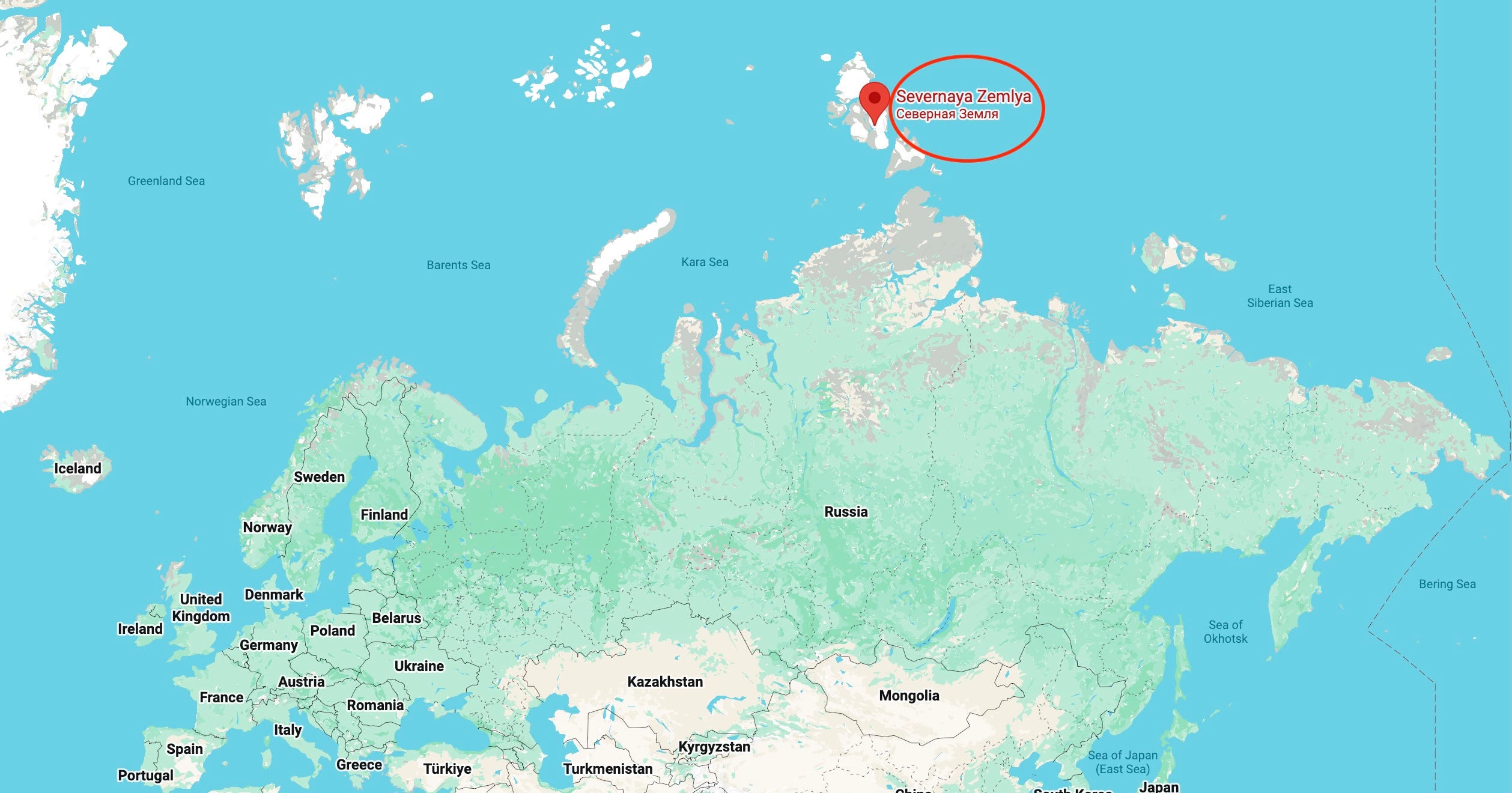
A convoy of at least fifteen vessels laden with a million tons of oil is en route this week to China on the Arctic route, sailing north of the Severnaya Zemlya archipelago, traveling farther north than any previous Arctic tanker convoy.
The Barents Observer reports it will sail to 81.5 degrees north latitude. That’s farther north than the world’s northernmost city, Longyearbyen (78.22° N), the capital of the Svalbard archipelago.
Not all of Russia’s sailing ships currently sitting on the ocean floor are there because of Ukrainian attacks; its maritime fleet has a rich and hapless history. As of Wednesday (August 12, 2026), oil from the Russian-linked tanker Caroline Bezengi, which grounded off Oman on June 30 carrying roughly 800,000 barrels, has produced a major spill that has now reached the Omani mainland.
Less than two years ago the Russian tankers Volgoneft-212 and Volgoneft-239 were caught in a storm near the Kerch Strait. Volgoneft-212 broke in half, killing a crewman; Volgoneft-239 was damaged and ran aground. Both were aging Soviet-era tankers. Thousands of tonnes of heavy fuel oil were spilled.
Eight years ago Russia’s only aircraft carrier, the Admiral Kuznetsov, was undergoing repairs when the giant floating dry dock where it was being tended sank near Murmansk. One of the dock’s 70-ton cranes crashed onto the carrier’s flight deck, punching a hole in it, killing one and injuring others.
The most famous incident was the sinking of the submarine Kursk during a Russian Northern Fleet exercise 26 years ago this month, taking 118 Russian sailors with it.
Consider the way sanctions force Russia to bring its oil to market. Every day Moscow pushes crude through increasingly exotic routes with insurance, maintenance and environmental safeguards that are questionable at best, aboard klunking, rusty, uninsurable hulks called a ‘shadow fleet.’
Best I can glean with my laptop this morning, several of the tankers are pushing twenty years old; two have no ice classification at all, and another has only a low one. So in sailing well beyond effective environmental mitigation, what could possibly go wrong?
•••••

THE VALUE OF AN AMERICAN PROMISE: About the Great Ankara Catering Truck Caper: if the president is willing to use close personal associates and senior figures in his own government (among them two of the most important figures in American government, the secretaries of State and Treasury), as unwitting bait on a flight his intelligence agencies considered too dangerous for Donald Trump himself, over a country bordering a war of choice he started, imagine what NATO allies must think of the US’s Article Five guarantee.
•••••

UKRAINE/POLAND: It’s disappointing, if understandable, that coverage of Russia’s war on Ukraine slips from media headlines in America. Because the thing is, Russia’s daily bombing of civilian targets across Ukraine hasn’t stopped. It goes on night after night after night.
But there’s something else we hardly hear anything about in US media, even when they do report on the war, the deep and pervasive disenchantment at the corruption that pervades not just the Zelenskyy administration in particular, but Ukrainian governance in general, how it promotes cynicism about every new policy Kyiv rolls out, and how it affects Ukraine’s neighbors.
I come to this topic via a recent dinner conversation with an American university professor of history who regularly visits family in Poland. Fresh from a recent trip to Lublin, just fiftyish miles from the Ukrainian border, he brought a downbeat report of disillusionment among a Polish population that was once among Kyiv’s most stalwart supporters.
He suggested that Ukrainian war veterans commonly have to run a gantlet of corruption to receive attention that we in the US would consider an entitlement after military service.
Indeed, wounded Ukrainian soldiers and veterans may encounter corrupt medical commissions, demands for money to obtain disability status, and an exhausting bureaucracy that often forces them to finance their own treatment.
It’s an issue covered in Ukrainian media. A tough-to-read report from March 2024 in the Kyiv Independent describes:
“a military medical system that’s fundamentally broken on every level, no matter where you are, no matter how you’re injured. As a reward for fighting Ukraine’s battles, veterans have to fight a callous, sometimes corrupt, outdated bureaucracy that’s often working against them, while they are at their most physically and psychologically vulnerable.”
I wrote a very short travel book in 2013 called Visiting Chernobyl, after my first of three visits to Ukraine, in which we drove up to Chernobyl from Kyiv one snowy winter day, with two men named Igor. Here’s a pertinent little bit:
The drive up to Chernobyl took just shy of two hours. The drive back took a lot less, with less snow and a lot more overtaking. Judging from our Igors, real Ukrainians don’t wear seat belts.
Out in the middle somewhere Igor got a traffic ticket. It came from a radar trap, a freezing cop in a little Lada like the one we passed on the way up. We were approaching a village, see, where the speed limit drops, and 74 kph in a 50 kph zone will cost you 260 hryvna, something more than thirty dollars.
We wanted to know. Would the cop take a cash bribe?
“Of course, this is Ukraine,” Igor the driver said.
Maybe he would take 200. But if Igor offered it, it wouldn’t be to save 60 hryvna. What it would save him was time. He’d pay it to avoid the consarned bureaucracy.
Otherwise he’d have to go to the bank to pay the fee, then go to the police station to show them he’d paid, so a bribe might save him a whole day’s pay at work. The system, he said, is made for bribing.
Maybe the cop would take the bribe and maybe he wouldn’t, Igor thought, because after all he didn’t know who he was stopping and it could be another cop who might report him. Either way though, the cop was making $400 a month and he had a family to feed, so Igor had no complaint. The cop did what he had to do. That the bribee has fundamental sympathy for the briber, seems to me that doesn’t augur well.
That was thirteen years, ago and judging from the newspaper report and my dinner companion’s stories, it sounds like not much has changed. For a country that demonstrated its deep desire to be part of the West—at the cost of more than a hundred civilian protesters’ lives in the 2014 Revolution of Dignity, for example—corruption is an especially pernicious foe.
Of course, corruption was embedded in the very day to day fabric of the Soviet system of governance Ukraine was born into, so maybe it’s maybe not surprising that it remains, and it’s also not the unique province of the Zelenskyy administration.
But its presence mustn’t continue indefinitely, not just because it’s wrong, but also because, as we can see in disillusionment among what should be Ukraine’s natural Polish allies in the war effort, it provides a ready device for Ukraine’s opponents to use to undermine its war effort.
•••••

If you’re reading this as an email, be aware that your provider may clip the article before the end. Try clicking on ‘view entire message’ to see the whole thing, or you can always read everything at Common Sense and Whiskey online.
•••••
ENGLAND: I asked ChatGPT to Americanize the candidate running in a bi-election against Nigel Farage. It came up with Garbage Man:
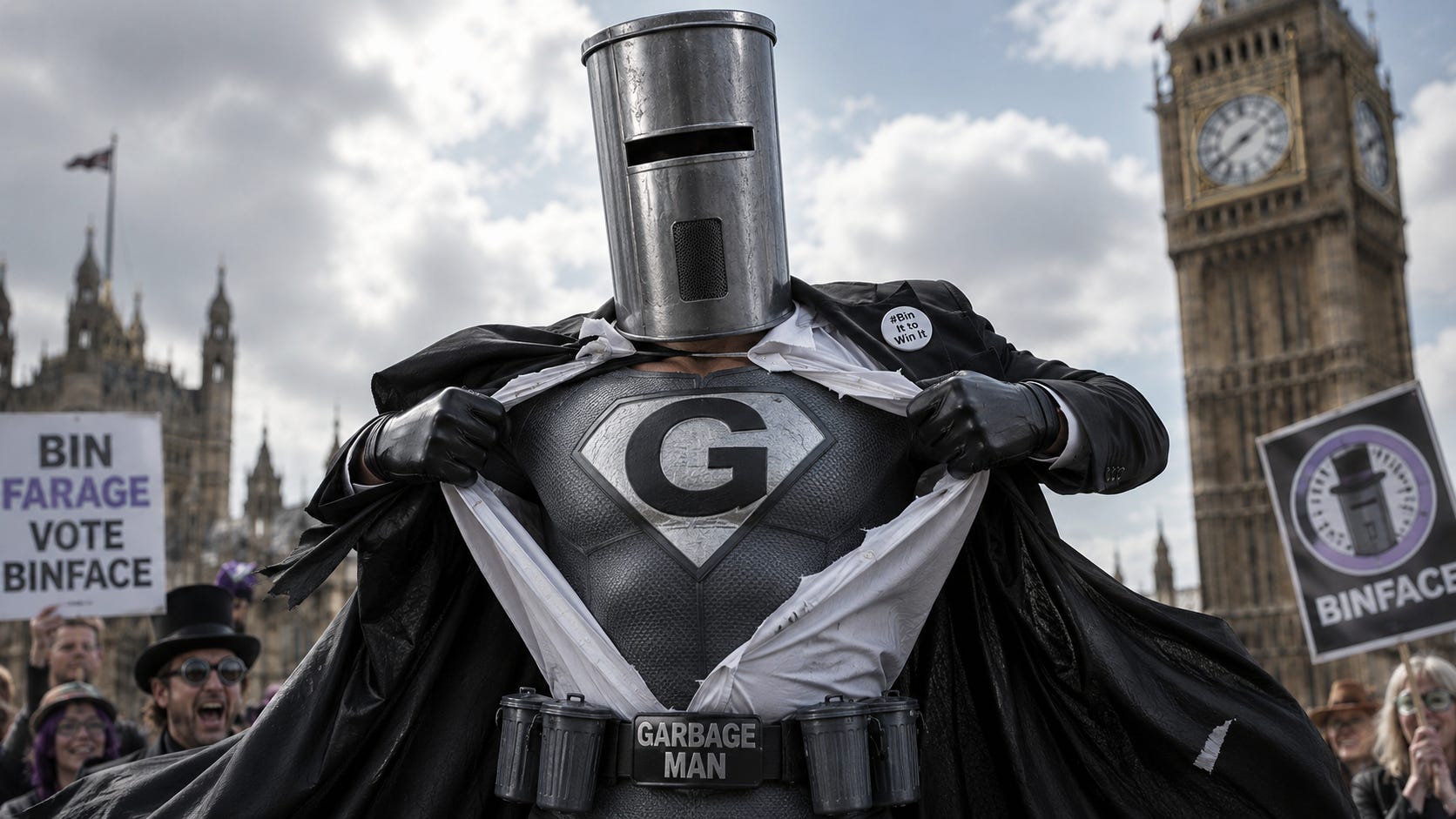
It’s not so different from the real thing:

The election was held in the Essex constituency of Clacton-on-Sea yesterday, Thursday, August 13th. When the results were read out, after 6:00 this morning Clacton time, the man who calls himself Count Binface and campaigns with a trash bin on his head took 26.93 percent of the vote against the leader of Reform UK, the far right British political party.
Farage’s election strategy was standard populist fare, a rhetorical framing that they’re after us, it’s you and me, Mr. John Q. Public, standing for all that’s right and holy, against the evil bad guys (who are everybody but you and me brothers and sisters) and I need your help to stop them!
Farage has been dogged by ethical challenges, mainly charges that he has accepted outlandish gifts, like £5,000,000 either to provide for his personal security, or maybe in appreciation for his campaigning for Brexit (he claimed both).
Whatever. His response to critics has been to call himself a common man just like you, a victim of corrupt but not quite identified forces. SkyNews coverage last night reported that, speaking before Reform UK supporters while waiting for results, in response to an investigation into the ‘gift’ of £5m that he did not declare, Farage said:
"Who cares? The voters of Clacton don't care."
Reframing a personal legal or ethical problem as a collective struggle between “the people” and a corrupt establishment, as Farage has done, looks very much like a move Donald Trump might make.
During both his impeachments, President Trump consistently maintained that Democrats were not really impeaching him but attempting to overturn the 2016 election, or nullify the votes of his supporters. Trump, too, couldn’t decide on his favorite reason.
In his fundraising efforts over the years, Trump’s pitch is usually a variation on “if they can do this to me, they can do it to you,” inviting supporters to see themselves as participants in the same great struggle that’s against you and me together, little man.
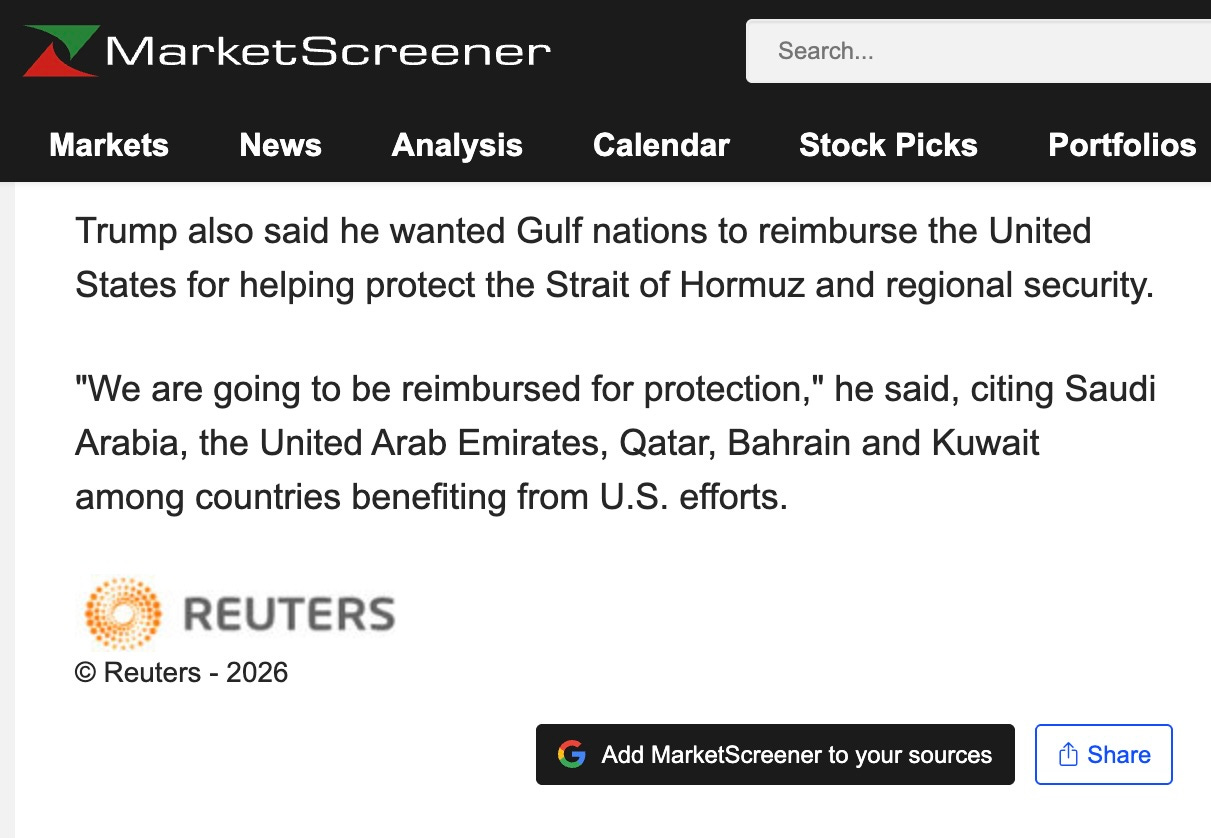
And now that we’re talking Donald Trump, was not his formulation a few weeks back of ‘protection money’ for providing safe passage through the Strait of Hormuz a straight up parody of Brooklyn real estate developer as wanna-be mobster turned would-be statesman? He said it out loud:
But who cares, really, not to worry, it was just one of those stabs at strategy like he does. It came and went. This week he was back at it, playing international strategist.
On Saturday, Iran’s Supreme National Security Council laid out its conditions for reopening the strait, and among them was the demand that the United States “completely compensate” Iran for war damage.
Donald Trump’s response on Monday had a certain playground quality:
“They asked for reparations, you might say. Or they asked for money for the damage that we’ve done. I said that’s a good idea. Well, we’re going to ask for money for the damage they’ve done over a 50-year period.”
It’s the diplomatic equivalent of "Oh yeah? Well same to you!”
Al-Jazeera points out one nifty detail: in seeking his own compensation for ’50 years’ of alleged damages, the president cited the families of 17 sailors killed aboard the USS Cole in 2000 as among those due compensation. The Cole bombing was carried out by al-Qaeda, not Iran.
Whatever.
•••••

AND FINALLY, TIME WAS: I like the idea in a new book, The Fullness of Time, that today we think of the hours as identical abstract units, but they’re not, really. The author, Cathy Haynes, writes that once upon a time, “we called a phase of darkness cockcrow.” We used to tell time by shadows shrinking or the glow over a mountaintop.
By endowing different times of day with natural attributes instead of mathematical precision, I expect past generations grew up thinking of the day as a more animated thing, vibrant and full of life. That’s a more colorful, fanciful way of living in the world.
Once upon a time people looked at the world around them with wonder—superstitious, wide-eyed, and maybe a little fearful. Only much later have we begun immediately trying to measure everything, to assign boundaries, to quantify. We can thank science for just about everything these days, but not for stealing the romance from things once unmeasured.
•••••
That’s it for today. Enjoy this most leisurely of months and I’ll see you next week.
Thanks for your time, and let me hear what you think. Please pass this article around and invite your friends to subscribe. Substack authors, feel free to restack this or any other column on your own Substack anytime.
Content on Common Sense and Whiskey is free. There’s no paywall, but if CS&W is beneficial to you, please subscribe for just $5 a month or $50 a year. Big American media is increasingly falling under the control of government-friendly oligarchs. The future is on Substack and platforms like it — please invest in independent writers you trust. We’d all appreciate your support.
Cheers,
Bill

You have considered this more thoroughly than I.
I thought the Catering Cart Caper was reasonable. It worked. It showed cooperation between CIA, Secret Service and the military. And they kept it under wraps. As for innocent diplomats exposed to danger in the bait plane,...diplomats go into this knowing the dangers. They are often tight with CIA. A good way to get yourself killed. Best of all for the administration, this kerfuffle has been a great diversion from an investigation into the rape of children.