

What Just Happened #95
Week in Review

Welcome. Today, the US and China meet, Hungary and Ukraine patch things up, Germany flounders, Armenia reaches for Europe, some African dictators just won’t quit, and we try to decide the right way to govern.
Common Sense and Whiskey goes deeper than the headlines on a few stories a week, in a presentation that busy people can absorb quickly. It’s a short, sharp look at the world out there.
If you’re reading this as an email, have a look at the online version at CommonSenseandWhiskey.com, where all CS&W content is available, and if you like what you see, please subscribe. Talk to me in the comments section or directly, at BillMurrayWriter (at) gmail.com. Let me know what you think.
•••••
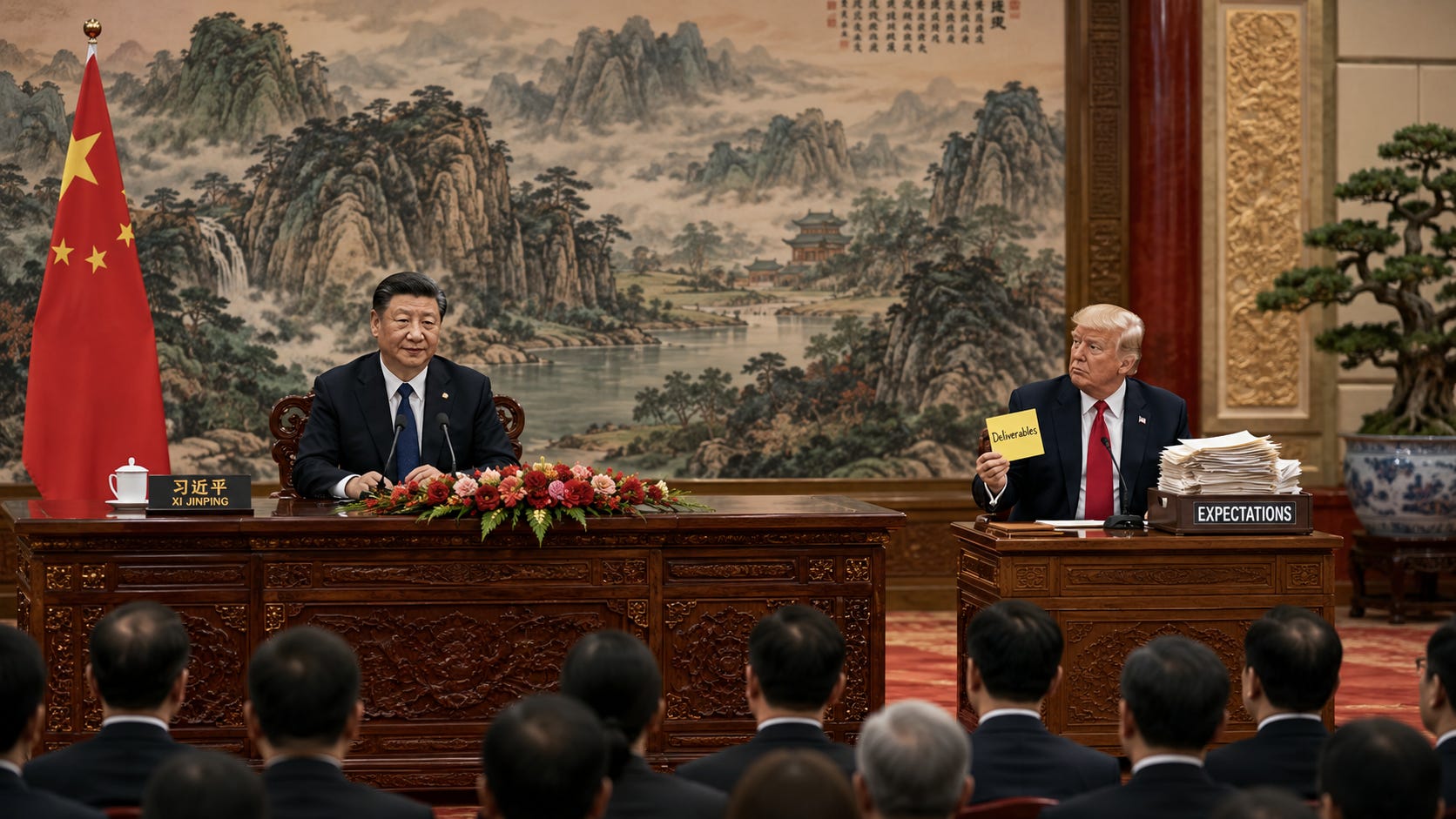
US/CHINA RELATIONS: This column was away last week, so just a couple of words on Donald Trump’s visit to China. The president came back without a lot to tout. And to the administration’s credit, it didn’t set expectations all that high.
There were the Boeing jets. The press just about marched in lockstep on this one. Almost every single review played a variation on this theme: “The package was for fewer airplanes than most had thought, but it was still a deliverable delivered.”
That view was so nearly unanimous that I went looking for anybody who disagreed. Reuters reported that 200 planes was “far fewer than analysts had expected.” No disagreement. The number bandied about before the trip was 500 planes.
Boeing CEO Kelly Ortberg called the 200 an “initial tranche” and emphasized that the important achievement was reopening China after nearly a decade of stalled orders.
Everybody was tactful enough not to mention the ‘stalled orders’ came about because of the Trump tariffs in the first place. Boeing stock fell more than 4 percent after the announcement.
At some point during the summit the president surely urged Beijing to use its influence to pressure Iran, but, again in fairness, that was always going to be a tough sell. For the same reasons the Chinese haven’t used their leverage with Russia to end its war in Ukraine, they were unlikely to do so with Iran. That’s because they’d much prefer to see the US occupied in the Middle East than finally getting around to its never-materialized pivot to Asia.
The Obama administration proposed that pivot even before Trump’s 2015 golden escalator ride. The Trump administration’s 2017 National Security Strategy and its National Defense Strategy the next year both identified China as the US’s primary long-term competitor.
The Biden administration began to build a coalition to actually do something about it. Remember the QUAD? (Don’t worry if you don’t, it won’t be on the test.) That was Biden.
The second Trump administration recruited Elbridge A. Colby as Under Secretary of Defense for Policy, which is the title for the Pentagon’s main policy guy. Colby wrote a book on how he saw the China challenge and called it The Strategy of Denial, to position himself as the “China can’t have hegemony over Asia” guy.
It’s interesting how ‘Bridge’ Colby has just about completely disappeared into the bureaucracy since taking office. It’s ironic because it was a real battle for Colby to land his job in Trump II. He wanted influence over strategy, not simply a title, he said, and he made clear he wanted to get things done.
Colby’s nomination ran into opposition over the degree to which the United States should prioritize Asia over other places. He once asserted that it is “eminently plausible and practical” to constrain a nuclear-powered Iran,” which got Senator Tom Cotton particularly riled up. Eventually, though, JD Vance and Don Junior gave Colby the push he needed, and he got the gig.
In office he hasn’t exactly made new friends among remaining defense Republicans by holding up Ukraine weapons shipments, and as a skeptic about US support for Europe. And neither has his proposed China policy come anywhere close to fruition, because the administration in which he pledged to prioritize China, hasn’t.
•••••
HUNGARY/UKRAINE: For years Viktor Orbán government stood in the way of various EU initiatives involving Ukraine, including progress on membership talks. Orbán’s Hungary argued that Ukraine didn’t adequately protect the rights of the ethnic Hungarian minority in Ukraine’s Transcarpathia region.
The new Magyar government this week announced it had negotiated an agreement with Kyiv on minority-language, education, and cultural-rights issues in Transcarpathia, such that Hungary would no longer stand in the way of Ukraine’s EU accession process. And because Moldova’s accession track has been moving in parallel with Ukraine’s, both may now move forward.
The next step in that process is an intergovernmental conference in Luxembourg on June 15, where the first of cluster of items to be negotiated, on fundamentals, is set to be formally opened. There are six clusters, and realistically, any eventual EU accession for Ukraine or Moldova is years away.
(Incidentally, in case you’re a real Hungarophile, here is a link to probably the definitive account of everything you wanted to know about what really happened in the Hungarian election.)
•••••
HOW TO GOVERN: Why has good governance so evaded the grasp of so many Western governments in this new 21st century? Just meeting basic, long-held expectations, of a good education, well-paying jobs and reliable public safety, never mind more ambitious goals like keeping deficit spending under control, rescuing retirement programs, climate change and the like.
Facile answers like ‘social media did it’ won’t do. Could it be that we have reached a certain critical mass of population, that there have just gotten to be too many people?
A few huge cities work, though. Beijing works, mostly. China has cities you’ve never heard of with ten million people. Might there be something along the fractious democracy/oppressed authoritarianism axis that affects governability?
John Kampfner (I think) wants to pin the governability problem here in the West on a lack of courage. I say ‘I think’ because I haven’t read his new book about it, titled Braver New World, just recently published in the UK (not until September in the US). But he introduced it recently with a longish feature article in the Times of London.
Kampfner, an international affairs reporter for forty years, argues for a new approach to governance of a certain kind. It’s bigger than a strategy, or an approach, or a style. It doesn’t seem like something you can exactly feel in a leader’s character.
Is it grabbing the bull by its horns? Mark Carney did this in Canada in the service of democracy, while, in this moment of budding worldwide ‘postliberalism,’ a clutch of far right leaders have applied a take-no-prisoners approach to the way they govern.
Donald Tusk, in turn, brought an almost blunderbuss technique into office to try to repair the damage done by the previous far right ruling party in Poland. Safe to say that so far, Péter Magyar is not using quite the same heavy-handed approach in Hungary, but it’s early days there.
It looks from here like Kampfner may be after a politics of hands on, or high-agency governance. And so he’s brutal with Keir Starmer. He doesn’t call Starmer the culmination of decades of political caution, exactly, although he might.
But caution is natural in politics. Bill Clinton was cautious; he offered no huge new initiatives over eight years in office. We recall his ‘triangulation’ as a sort of political survival strategy.
And in a time of relative prosperity like the Clinton era, it served him well for most of a decade. Starmer, less than two years into the Prime Ministership, may not survive the summer.
Kampfner wants to shake us awake. He thinks government has an obligation to impose long-time-horizon solutions on short-horizon electorates. He writes that “By 2050, four in ten Japanese are expected to be pensioners.” Six workers paying for every ten - that can’t possibly work.
Kampfner seems to take the position that ‘at least they’re trying’ in Japan. He says Japan has a system in which your eligibility for medical treatment is determined by software, and regularly reassessed.
He pits Japan’s care system against the UK’s, and in such a comparison, Japan shines. As he puts it, the UK system “is based on the blithe assumption that most elderly will buy their care through the sale of assets.”
Kampfner concludes:
“Neither hubristic populists nor frightened mainstream governments are levelling with citizens about the rewiring required across all areas of society. No serious discussion is taking place about how public services can be maintained in the future, or about the skills required to equip the next generation,”
And
“accept that the old ways are over; be ever self-critical, open to best practice elsewhere and reject “we know best” hubris; accept that what matters is delivery not ideology and be prepared to ditch shibboleths; embrace modernisation and digital solutions; plan for the long term, not merely the next election; be candid with citizens and don’t hide problems from them. Most of all, demonstrate courage…. If we don’t, we will have only ourselves to blame.”
•••••
GERMANY: Can’t catch a break. Germany, Austria and Portugal campaigned for two European seats on the United Nations Security Council, and on Wednesday, Germany came in third.
Portugal was generally reckoned the favorite, with support from its Lusophone diaspora, and sure enough, Portugal got the most votes in the secret ballot. That left Germany and Austria to fight it out for the final seat.
Both countries actively campaigned, Austria on its neutrality (it’s a member of the EU but not of NATO) and Germany fought for the seat, too, maintaining that as a powerful country it could get things done. Foreign Minister Johann Wadephul flew to New York last week to lobby members in person.
Wadephul might as well have stayed home, as Germany came last, adding to a general - and solidifying - sad sack impression of the Merz government. The tally: Portugal 134, Austria 131 and Germany 104. So Portugal and Austria will join Kyrgyzstan, Zimbabwe and Trinidad and Tobago as new Security Council members on January 1st.
[DOES THE MATH WORK? Add all those votes and you get 369, but there are only 193 UN members. Why? Because since two seats were allocated to Europe, all countries got two votes. 193 countries x 2 votes = 386 possible votes. Which just means that seventeen nations abstained or cast fewer than two votes.]
•
In a column on Wednesday, I argued that Germany can’t seem to get to grips with the real world - that it can even declare a zeitenwende and still just carry on with the status quo without missing a beat.
There is a flip side to that coin.
If current plans are realized, Germany is set to become the biggest military spender in Europe, and if sustained over a decade or so, it could be the biggest by far. Everybody wants Germany to do more in the defense of Europe than send helmets to Ukraine, but in reality, a remilitarized Germany presents a different version of Europeans’ prior fears of German reunification:
Because what if not in these or the next elections, not even in say, a decade, but somewhere down the road the Russia-friendly Alternative für Deutschland - currently the highest polling political party in the country according to several national polling averages - comes to power, and wields all that weaponry?
•••••

If you’re reading this as an email, be aware that your provider may clip the article before the end. Try clicking on ‘view entire message’ to see the whole thing, or you can always read everything at Common Sense and Whiskey online.
••••

ARMENIA: Parliamentary elections are this weekend. Armenian elections are not always a subject of American news coverage, but there are potential geopolitical consequences. And there’s an American angle besides.
The Armenian Prime Minister is Nikol Pashinyan, who has made a real effort to move his country away from Russia and toward Europe and the United States. He has campaigned on regional reconciliation and economic integration, which in Armenia’s case means peace with Azerbaijan and the normalization of ties with Türkiye.
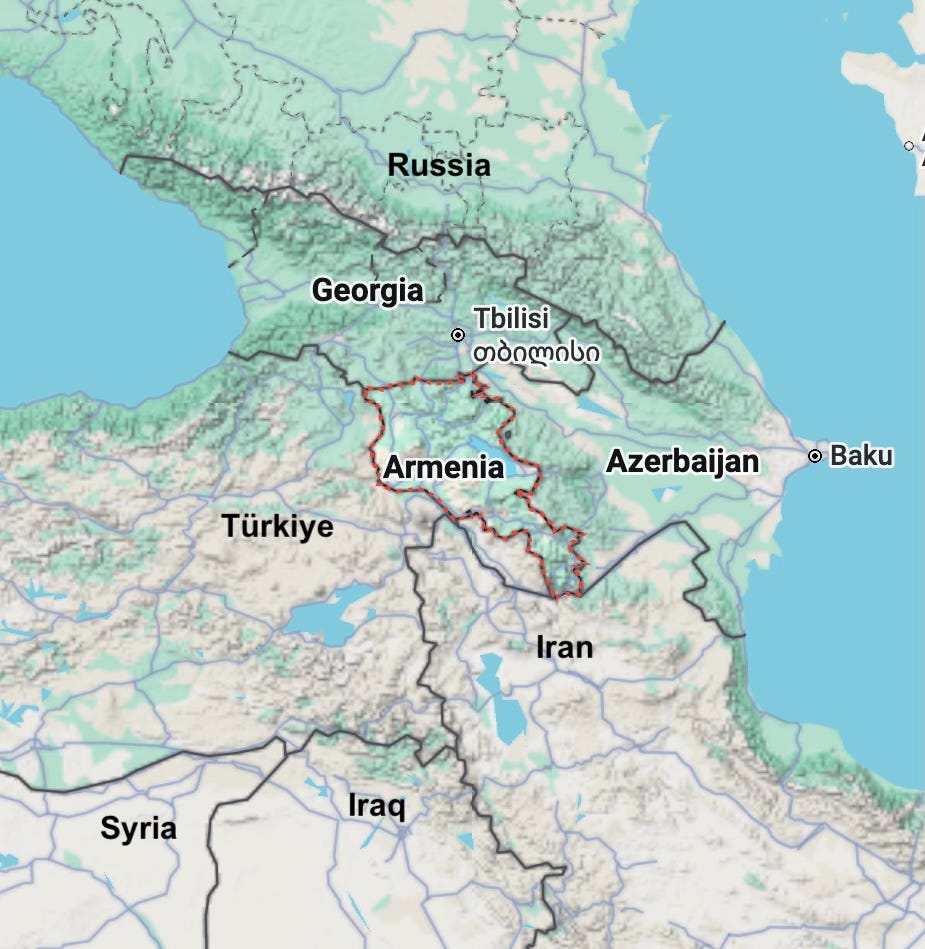
Pashinyan’s Civil Contract party leads the polls. It’s a quick turnaround after the difficult days of the loss of Nagorno Karabakh to Azerbaijan not three years ago. In September 2023 protests erupted in Yerevan, demonstrators demanded the president’s resignation and the government claimed to have foiled a coup.
Pashinyan argued that Karabakh was lost, Russia failed to protect Armenia, chasing the dream of recovering Karabakh could become existential for the whole country, and so Armenia should normalize relations with Azerbaijan and Turkey. And it worked.
From 1993 until this month Armenia had been subject to a trade blockade by Türkiye, a strong fellow Turkic ally of Azerbaijan during the long Armenia/Azerbaijan conflict. As you can see on the map, in the neighborhood where Armenia lives, there aren’t a whole lot of other ready trade partners.
Vladimir Putin, naturally, has been hostile to Pashinyan’s goal of Armenian alignment with Europe, and is predictably engaged in one of his disinformation efforts, calling Pashinyan abusive, dishonest, a fraud, a warmonger, a criminal, a corrupt oligarch, a dictator, a traitor, secretly controlled by foreign powers and, in a secret deal with France, preparing war with Russia.
Less predictably, Donald Trump has also taken an interest.
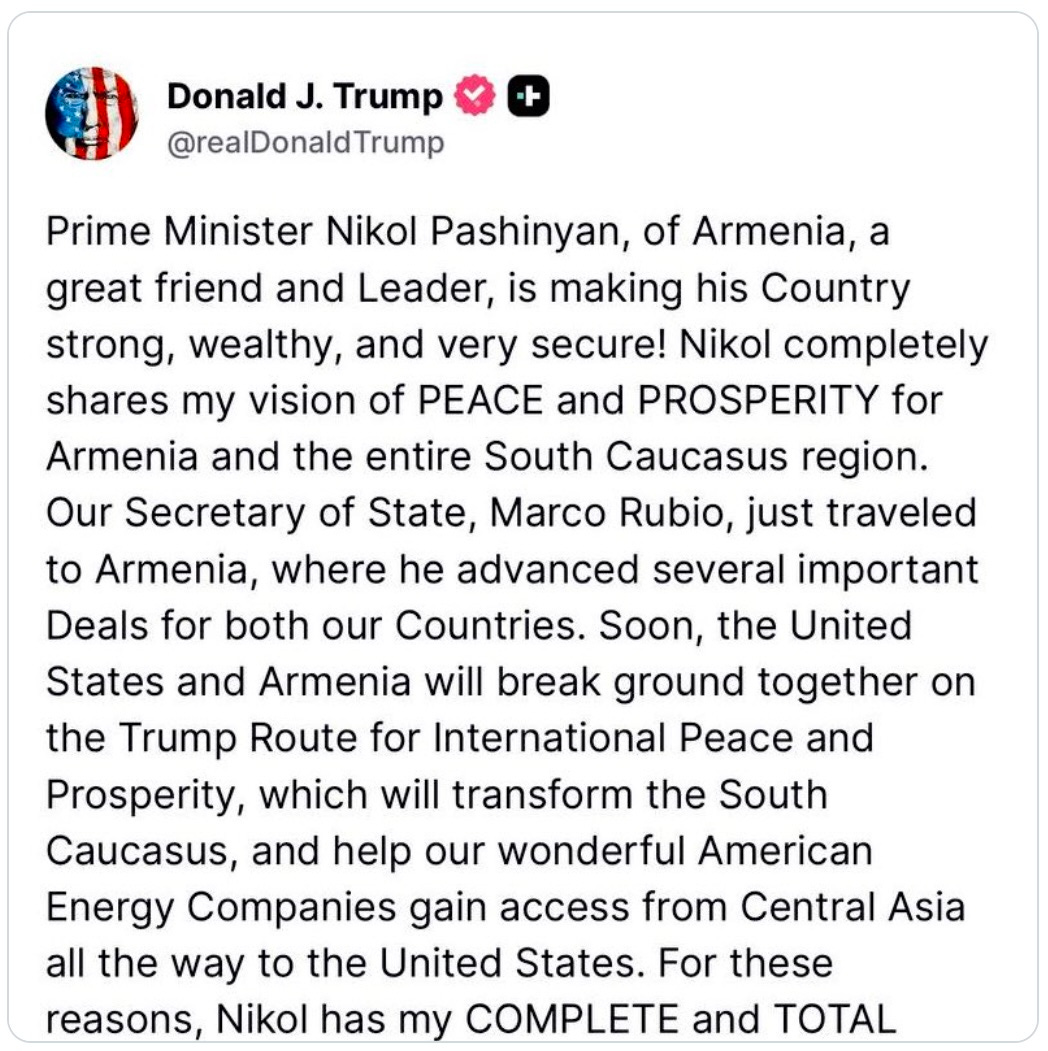
A Trump endorsement might seem surprising at first glance, given the president’s generally Putin-friendly worldview. But recall that one of the eight wars the president claims to have ended is the Armenian/Azerbaijani conflict.
Trump ended his endorsement this way:
“Make (Armenia) Great Again — MAGA!”
•••••
UGANDA: Uganda’s President Yoweri Museveni, 81, has been sworn in for a record seventh consecutive term following his most recent landslide victory in disputed elections back in January.
He is among the few African leaders in power for more than 40 years. Others include Congo-Brazzaville’s Denis Sassou Nguesso, Equatorial Guinea’s Teodoro Obiang and Cameroon’s Paul Biya.
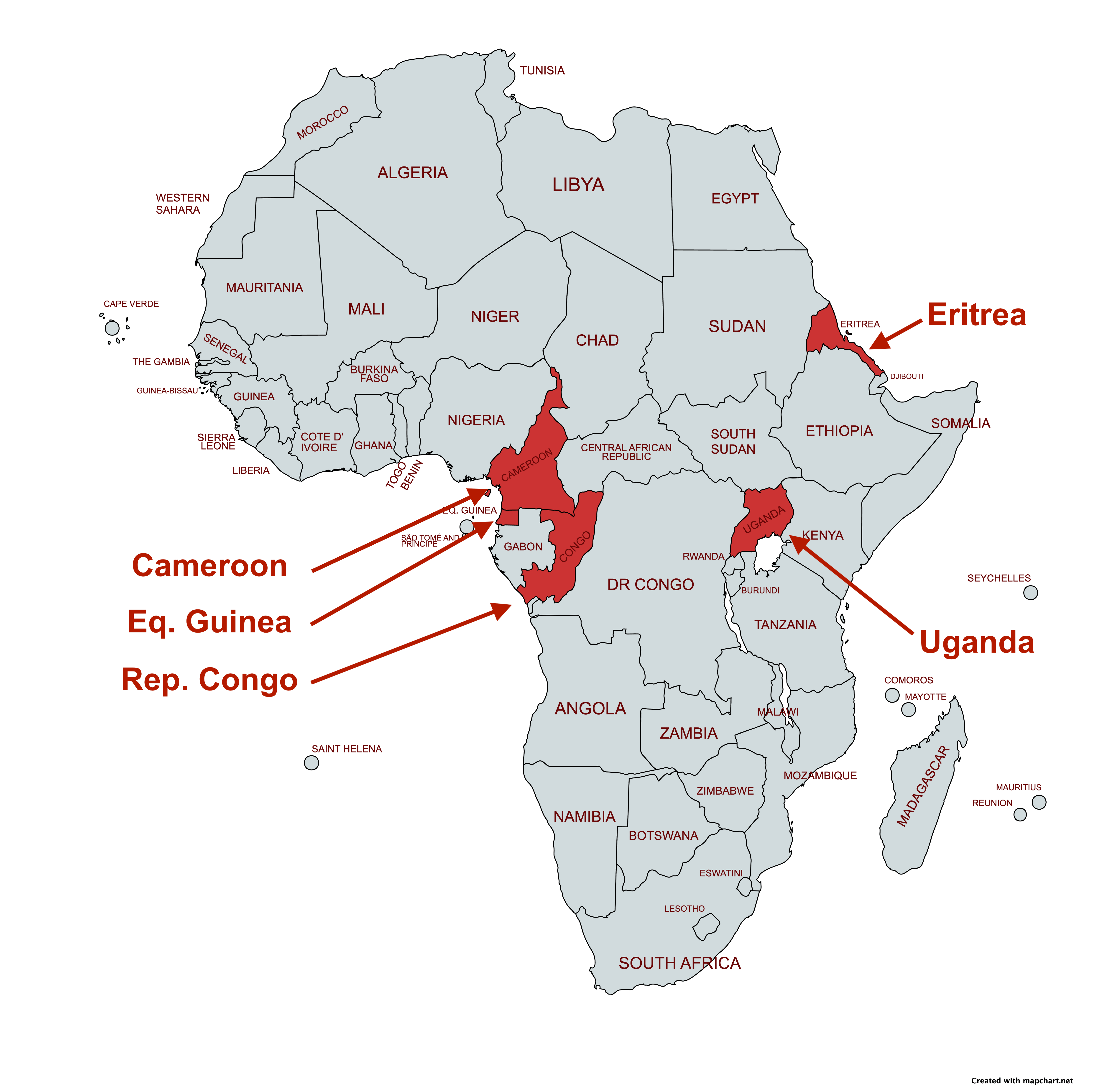
If you’re having your 40th birthday this year, these guys have been in power since before you were born.
An honorable mention is due here to Isaias Afwerki, who has ‘only’ ruled Eritrea for about 33 years, but effectively without elections for the entire life of the state.
That’s it for today. Thanks for your time, and let me know what you think. Good weekend, and see you next week.
Please pass this article around and invite your friends to subscribe. Substack authors, feel free to restack this or any other column on your own Substack anytime.
Content on Common Sense and Whiskey is free. There’s no paywall, but if CS&W is beneficial to you, please subscribe for just $5 a month or $50 a year. Big American media is increasingly falling under the control of government-friendly oligarchs. The future is on Substack and platforms like it — please invest in independent writers you trust. We’d all appreciate your support.
Cheers,
Bill

So much to unpack and absorb here, Bill. As always, you offer more in the way of content and perspective than the general populace is used to. That's why I'll continue to pick up what you're puttin' down. Carry on toward the light and turn that light up as bright as it needs to be.