

What Just Happened #83
The Election Sprint to the Finish in Hungary

Welcome to Common Sense and Whiskey. Thank you for visiting. Common Sense and Whiskey goes deeper than the headlines on a few stories a week, in a presentation that busy people can absorb quickly. It’s a short, sharp look at the world out there.
If you’re reading this as an email, maybe have a look at the online version at CommonSenseandWhiskey.com, where all the content is available, and if you like what you see, please subscribe. Talk to me in the comments section or directly, at BillMurrayWriter (at) gmail.com. Let me know what you think.
•••••
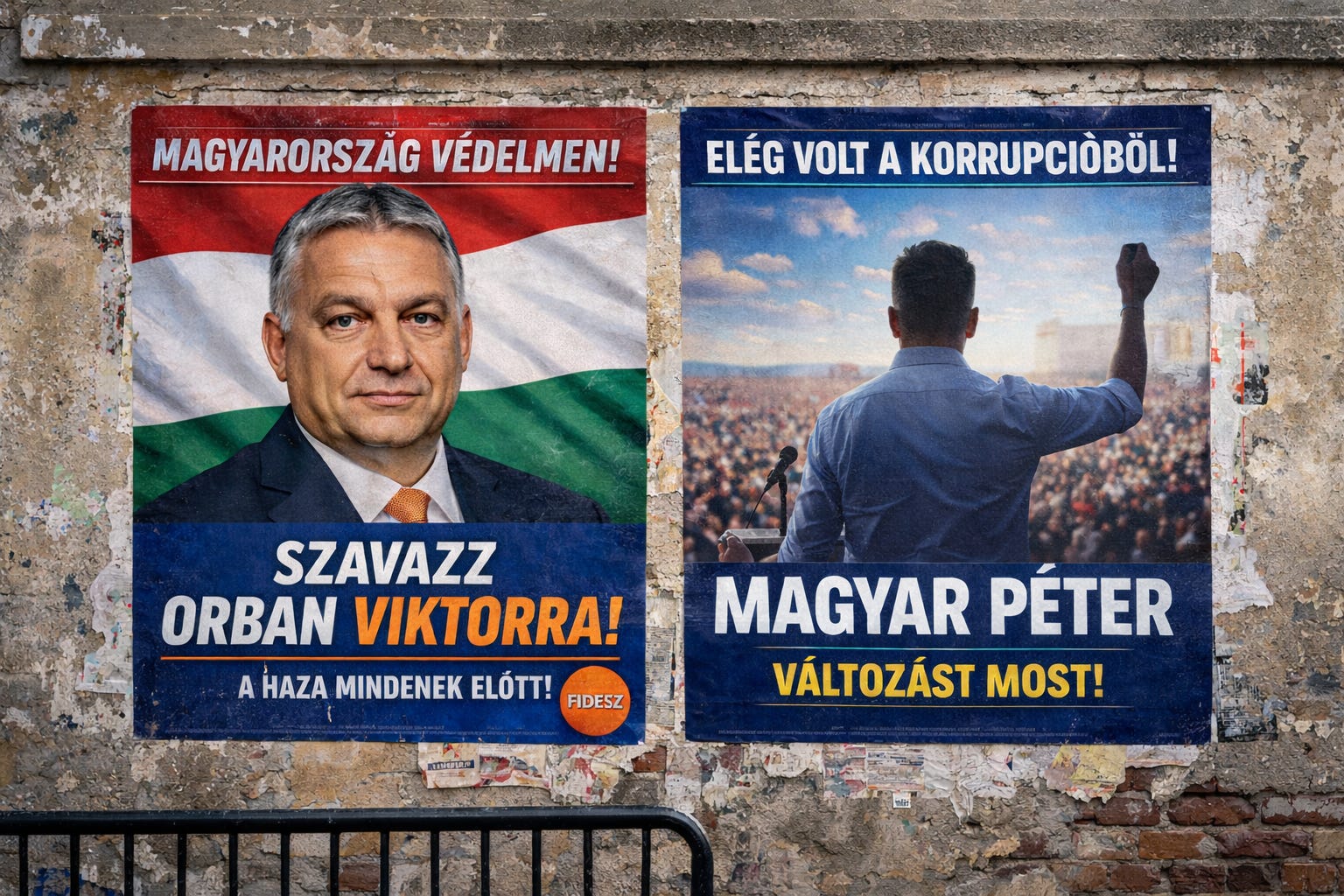
AN ELECTION THREAT TO MOSCOW’S BIGGEST FAN: A potentially consequential European election, in Hungary, is virtually upon us. It’s only 65 days away as of today, Friday, February 6th, 2026.
Stage setting: It’s parliamentary elections, on April 12th, 2026, to determine control of the 199 seats in the National Assembly.
Viktor Orbán has ruled Hungary continuously since 2010 under the current Fidesz-KDNP (Christian Democrats) alliance, which maintains a 2/3 super-majority in parliament, with 135 out of 199 seats. That’s well above the 100-seat threshold that allows allows it to do things like rewrite the constitution to better suit Fidesz, and revise it as Fidesz sees fit.
Prior to this coalition, I remember Orbán (vaguely) as part of an inspiring cadre of young eastern European leaders chasing the former Soviet-aligned leaders out of power.
FAST HISTORY: In June of the revolutionary year of 1989, before hundreds of thousands in Budapest’s Heroes’ Square, the 26-year-old Orbán demanded free elections and the withdrawal of Soviet troops. The Soviets had yet to relinquish power at the time of Orbán’s speech, so his speech was risky, and made him an icon of the post-Soviet future. Here is Orbán in 1989.
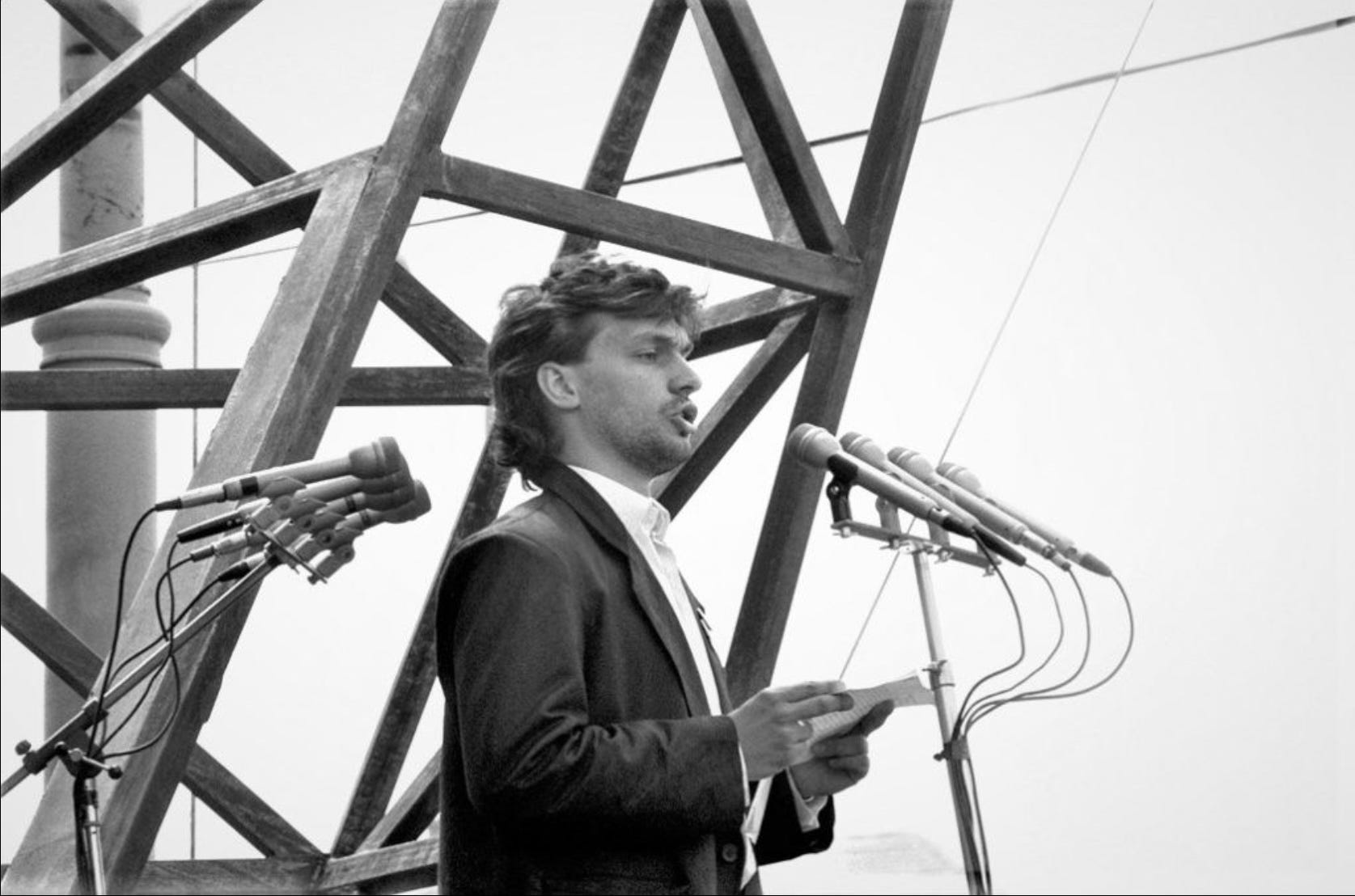
(Maybe just pay no attention to the bank of microphones pointed at the back of Orbán’s head. That kind of stuff happened in the Soviet era.)
The speech elevated Orbán to the pantheon of independence leaders like Vaclav Havel in Czechoslovakia. Havel wouldn’t become president until December of ‘89, but he was already something like the conscience of the eastern European opposition.
Orbán entered the scene as a firebrand, something of a breakout figure to be watched, but he wasn’t yet a leader. In fact, it took another ten years before Orbán became Prime Minister the first time, in 1998, as head of a center-right coalition government.
The question is, what happened between his anti-Communist ‘breakout leader’ moment and today that turned him into the EU’s most pro-Russian leader? He started out explicitly anti-Soviet. In his first term as PM (1998–2002), Hungary joined NATO.
Here’s what I think. When he lost an election in 2002, Orbán concluded that the post-communist left retained real, though informal, power in his country through it’s previous domination of society, through media, crony economic networks, through popular culture and so on. He realized that elections weren’t the only way to wield power.
Orbán remained an MP and head of Fidesz from 2002 until 2010 and like our current American leader, he implied that it wasn’t so much that he’d been beaten, but rather that Hungary had been captured by post-communist ‘elites.’
Orbán took over control of Fidesz completely during his years out of government. In 2008 the government in Budapest collapsed and Orbán was ready to move in with his political machine. It has worked for him for the past sixteen years.
WHAT NOW? As of today Viktor Orbán trails his main opponent, Péter Magyar, in polls by a consistent margin, even double digits in some polls. The Central European investigative site VSquare argued in a newsletter this week that, with some winking and nodding, “if Fidesz can narrow the gap to around three or four points, structural features of Hungary’s electoral system” may help Orbán eke out a win.
This election has a lot to do with scandal, and I wrote at some length about Magyar and the scandals that helped launch his candidacy, back last May. For more detail on that, read What Just Happened #53 here. Here’s the briefest thumbnail sketch:
Magyar is a 44 year old insurgent politician. His background suggests he was meant to be in politics. His grandfather was a judge and TV show host, and his great-uncle, Ferenc Mádl, was Hungary’s president from 2000 to 2005.
Magyar was born in Budapest, and if any one issue flutters warning flags, that may be it. He’s a city boy, where the institutional backbone of Fidesz’s and Orbán’s support is rural, in small towns and villages. To counter, Magyar has waged his campaign traveling to Orbán country - to small-town cafés, provincial squares and factory gates.
Magyar’s story is compelling, combining youth, intrigue and tabloid gossip.
Consider: Péter Magyar and his wife Judit Varga divorced in March 2023. Varga was then Hungary’s Minister of Justice, but later resigned, preparing to lead the Fidesz list for the 2024 European Parliament elections. Magyar continued as a board member at government-controlled MBH Bank.
A scandal erupted in February last year around a presidential pardon and coverup of child abuse. This ultimately led to the resignation of Hungarian President Katalin Novák, and of Magyar’s ex-wife (who, as Minister of Justice, countersigned the pardon as required by Hungarian law).
Magyar then uploaded a video to Facebook demonstrating his disgust, and alleging deep corruption in government. Next, he released an audio recording in which his ex-wife appeared to discuss the removal of evidence in a separate high-profile corruption case involving a former Justice Ministry State Secretary.
Varga accused Magyar of verbal and physical abuse during their marriage, allegations he denied, claiming they were meant to discredit him. Cynics among the political press called it all a carefully choreographed maneuver by Magyar to begin his campaign to dethrone Orbán.
Magyar rolled out his new political platform, the Respect and Freedom Party, or (Tisztelet és Szabadság, ‘TISZA’), on March 15, 2024, just over a month after the clemency scandal came to light.
(A WORD ABOUT ‘TISZA’: it’s an acronym cobbling together the Hungarian words ‘Tisztelet’ and ‘Szabadság,’ ‘respect’ and ‘freedom,’ with an ad man’s touch, because Tisza is also the name of Hungary’s second-longest river. It carries national symbolism, geographic familiarity, and suggests desirable values, all in just five letters.)
(A WORD ABOUT ‘MAGYAR’: it means ‘Hungarian.’ Now, if a U.S. politician named “Joe American” showed up in the United States, most people would roll their eyes. Apparently, in this case it’s his real name, and it’s not that uncommon. Many Hungarians’ surnames, they say, suggest ethnicity or geography—like Tóth, for example, which means ‘Slovak.’)

A Publicus Institute poll, Reuters reported this week, shows Magyar holding a roughly eight-point lead over Orban’s Fidesz among decided voters. Debate rages about the reliability of polls and whether the incumbent, with control over the levers of power, may be able to negate a poll advantage by the challenger.
Official campaigning, which is bounded by silly rules and resembles the British purdah, or a ‘period of sensitivity,’ begins fifty days before the election, so on February 21st.
But in reality campaigns have been in full swing for months, with Orbán concentrating on sovereignty and security, and Magyar on corruption and a return to normal democratic government. Orbán essentially offers to buy votes in a $157 million scheme to reduce heating costs. Magyar points to unlocking frozen EU funds by restoring the rule-of-law. He suggests that could mean tens of billions of euros for Hungary.
Orbán could use a campaign intervention by his ally Donald Trump. He’s said to be working hard on getting Trump to visit Budapest, with VP Vance as a second best stand in. That’s still up in the air, but on Thursday Trump delivered a social media endorsement to Orbán: “I was proud to ENDORSE Viktor for Re-Election in 2022, and am honored to do so again.”
WHAT IF ORBÁN LOSES: No matter what happens, I don’t think Hungary suddenly becomes a bastion of Brussels thought. Budapest’s standing threat to block anything threatening to Moscow may disappear, but if he is to win this election, Magyar won’t be able to straight up align himself EU orthodoxy. The politics of the Hungarian electorate ≠ the politics of European Union elites.
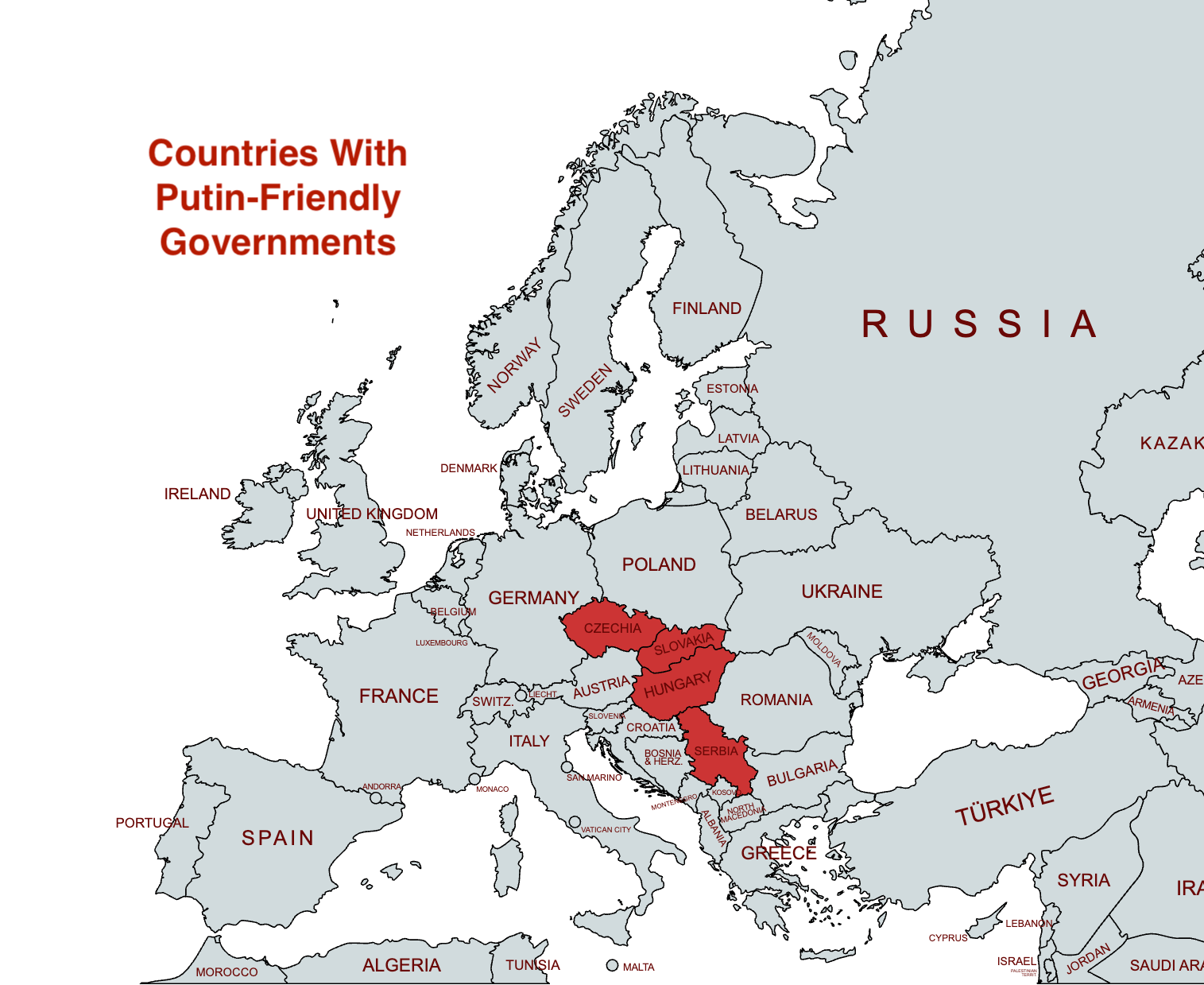
If Orbán loses, the question will become whether another player in the Moscow-friendly cluster of east central European states might simply assume Orbán’s role -there is no shortage of aspiring regional little authoritarians. Robert Fico is an obvious candidate to start.
(Fico is an interesting figure who just may have found some humility after the assassination attempt that nearly killed him. Fico was shot multiple times in May, 2024 in the provincial town of Handlová, Slovakia.)
Although he’s still a Trump man, Fico seems to have left a little shaken after flying in for a private bilateral meeting in Florida last month. News outlets reported that Fico told fellow European leaders he was “shocked” by the American president’s mental state.
A White House spokesperson called that “completely fake news from anonymous European diplomats trying to stay relevant.”
Hungarian election day is nine weeks away. We’ll keep watching.
•••••

HIGH NOON IN LONDON AND WARSAW: Polish Prime Minister Donald Tusk used unusually blunt language this week, declaring it “highly probable that this was a premeditated operation by the Russian KGB” as he suggested Jeffrey Epstein’s sprawling criminal enterprise may have been exploited by Russian intelligence. Tusk set up an ad hoc ‘rapid reaction’-type team of investigators to see if there are implications for Poland.
At the same time in London the British Prime Minister found himself apologizing yet again, this time for trusting Peter Mandelson, a ‘New Labour’ figure in the Tony Blair years who is likewise associated with Epstein. Mandelson served for a time as Starmer’s ambassador to Washington.
Starmer has endured a never ending string of low grade scandals, apologies and humiliations. By now he has crossed a dangerous threshold for a political leader: he’s now the ‘hapless Prime Minister Starmer.’
•••••

RUSSIA’S WAR ON UKRAINE: The Institute for the study of war wrote in a piece on Thursday that:
“Russia is continuing efforts to formalize its control over the occupied Zaporizhzhia Nuclear Power Plant (ZNPP), setting conditions to restart power generation at the plant and connect it to the Russian power grid.”
An ISW analyst said on X that “Russian discourse surrounding the ZNPP makes it clear that Russia has no intention of compromising on the plant's operation (contrary to US/ Ukrainian proposals), and instead is moving full-steam ahead on fully integrating it into the Russian system.”
It’s really not possible to believe that US officials consider moves like these and Russia’s slow-walking ceasefire negotiations as good faith actions by the Russian side. Although some American negotiators do a fair impersonation, they aren’t stupid people. So you have to conclude that what they’re after is something more important than good faith negotiations with the Russians.
It’s just possible US officials have made the calculation that yet another frozen conflict on Russia’s borders is acceptable in return for a chance for America to turn its full attention to China. There are advocates of this position in the administration. Maybe it’s something even darker than that.
But please let it be so that whatever they’re really after is something more ambitious than postwar economic cooperation with Moscow. Please don’t let all this unending willingness to look like credulous fools be about a Trump Moscow hotel.
•••••
HYBRID WAR AND SCHENGEN - AN ESTONIAN INITIATIVE: European political figures blame a constant number of violent incidents on Russian ‘hybrid warfare.’ Here’s a partial list:
1) The Marywilska shopping centre fire in Warsaw (May 2024). Polish investigators said a fire that destroyed a shopping centre was arson orchestrated by Russian intelligence.
2) DHL/DPD freight hub bombs (Summer 2024). European security officials blamed a series of explosions and bombs at logistics depots in Birmingham, England, Leipzig, Germany and in Poland in mid-2024 on Russia.
3) Poland and Romania in late 2025 arrested people allegedly preparing other explosive parcel attacks on behalf of Russian handlers.
4) Arson at an IKEA store in Vilnius (May 2024). Lithuanian prosecutors linked a fire at a Vilnius IKEA to a Russian-linked sabotage network.
5) Arson on UK logistics in the UK (2024). British investigators tied an arson attack on a warehouse in east London containing aid supplies for Ukraine to Russia’s Wagner Group.
6) Ongoing sabotage in Poland and elsewhere (2024–2025). Poland detained people allegedly involved in sabotageon behalf of Russian intelligence, including arson.
7) Undersea cable disruptions in the Baltic Sea (2022–2025). Undersea telecommunications and power cables between Estonia, Finland, Latvia and Sweden have been repeatedly damaged or sabotaged. Governments suspect Russian shadow fleets.
8) Assassination plot in Germany (2024). German and US intelligence foiled an alleged plot to assassinate CEO of Rheinmetall Armin Papperger and blamed it on Russian operatives.
9) Railway sabotage and explosions in Poland (2025). Late last year Polish authorities blamed a train derailment/explosion near Warsaw sabotage tied to Russian intelligence.
10) Further espionage and vandalism. European countries publicly attribute these activities to Russian hybrid tactics: hacking of railway systems (Czech Republic), almost constant GPS/GNSS jamming of flights in the Baltic and high north, and vandalism campaigns in Estonia (things like smashing cars and monuments).
11) Governments in Prague and Warsaw have called the 2014 munitions warehouse explosions in Czech Republic an early example of Moscow’s covert sabotage campaigns in Europe.
Estonia has a new initiative to fight back. It wants former Russian soldiers who have fought in the war in Ukraine banned from entering the Schengen area. (In case you’re not familiar with Schengen, it’s one of the most brilliant innovations that comes with the European Union. It’s that arrangement by which, when you arrive in certain European borders from a non-EU country, you’re stamped in at that border and then may travel within the Schengen block without further bureaucracy. (There are some current exceptions brought about by Russia’s war on Ukraine).
Rikard Jozwiak, a survivor of the US administration’s drastic cuts to Radio Free Europe/Radio Liberty who is still working as RFE/RL Europe Editor in Prague, reports this week that:
“Combat experience and the use of violence, including likely participation in war crimes and other atrocities against the Ukrainian population, are common characteristics of these individuals. Their potential entry into and presence within the EU carries not only a general risk of violent crime but represents a major vector for the infiltration of organized crime, extremist movements, and hostile state operations across Europe.”
The idea is that Vladimir Putin doesn’t want idle provincial former soldiers trained in violence coming home, most of them unemployed on arrival and looking for diversion. So he might be inclined to press them into missions sowing violence in Europe.
“According to Tallinn, an estimated 1.5 million Russian citizens have taken part in combat operations in Ukraine since the full-scale invasion of Ukraine in February 2022 -- including both regular armed forces of the Russian Federation and proxy units such as the Wagner Group. Of these it is believed that 640,000 remain actively engaged, meaning that there are close to 1 million ex-fighters that are potential targets for the EU.”
Jozwiak writes that the idea was well received in Brussels but that a problem may be the “practicality of preventing so many people from entering the bloc.”
•••••

If you’re reading this as an email, be aware that your provider may clip the article before the end. Try clicking on ‘view entire message’ to see the whole thing, or you can always read everything at Common Sense and Whiskey online.
•••••
While we’re here, let’s talk a little bit about the Schengen area, and the creative political tradecraft it represents. There is a portion of highway in Atlanta, state route 400, that was originally paid for by tolls, and rather than keep the tolls on the books forever, once the road was paid for, officials tore out the toll booths. Now, every time you pass by, it’s satisfying to see the toll booths’ old location is nothing more than a wide spot in the road.
The same is true all across the Schengen zone as customs and border control posts have been torn away by countries from the Arctic to the Algarve.
BACKGROUND: ‘Schengen’ is called the Schengen area after the name of the town in Luxembourg in which the agreement was signed in June 1985. Most recently, on January 1st, Bulgaria and Romania joined the club. Only Cyprus and Ireland among EU countries are not part of Schengen.
Cyprus says it will join in 2026, but Ireland opts instead to remain in a common travel area with the United Kingdom, which has never been a member of Schengen. Passport control on the Eurostar channel tunnel train is done before you board, inside the departure station in England or France, not on the train and not on arrival.
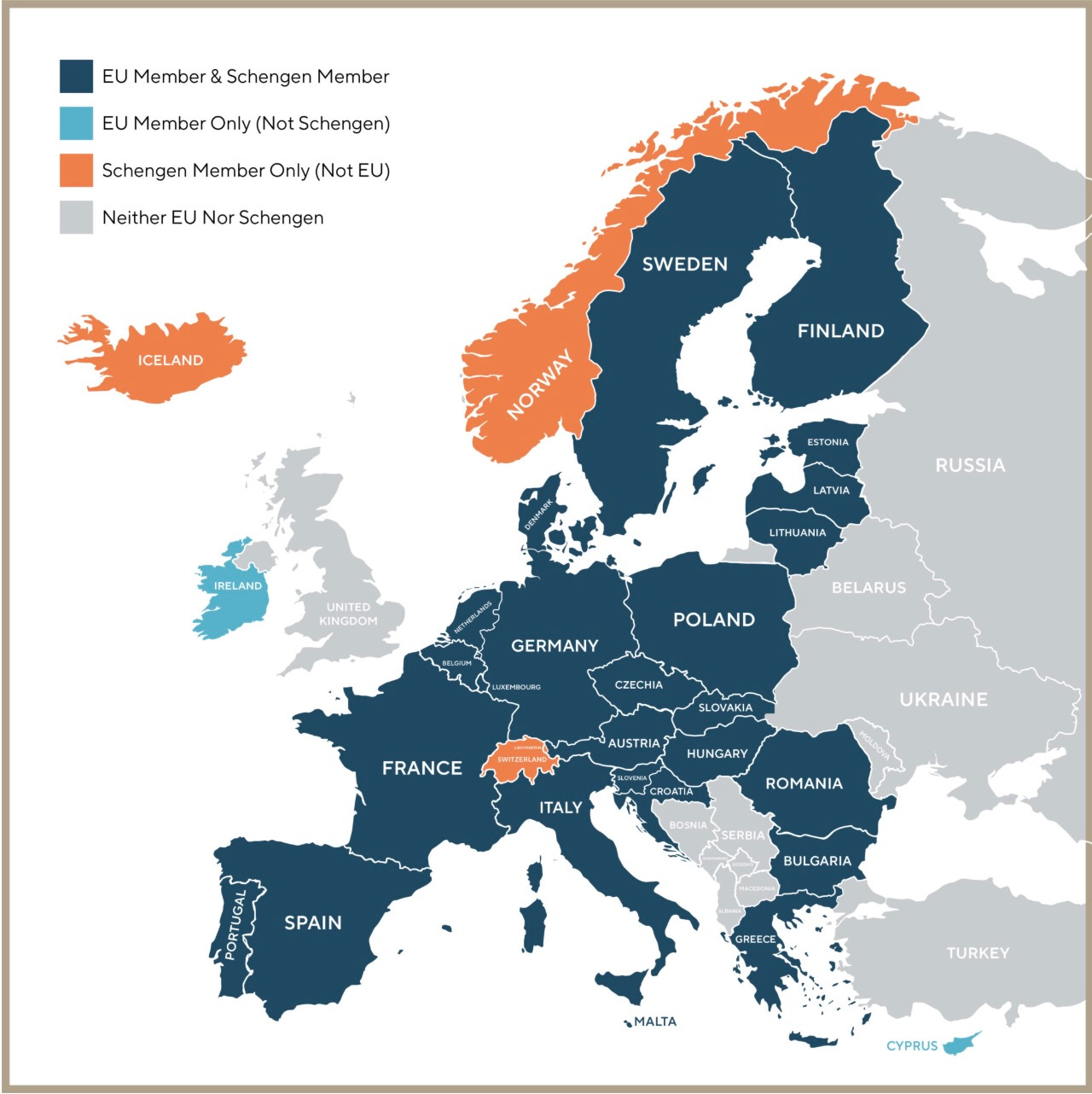
More border quirks: if you fly to the United States from Dublin or Shannon, Ireland, you do United States border formalities in Ireland, so that when your flight arrives in the US, it’s treated as a domestic flight. You just go to baggage claim, if you have checked bags, and then leave. That does not mean any part of Ireland is treated as sovereign US territory (besides the US Embassy), however. Therefore pre-clearance US authorities cannot arrest you under US criminal law, nor can they compel entry the way they can on US soil. Ireland retains ultimate jurisdiction.
The same is true at Toronto’s huge Pearson International Airport, and airports at Calgary, Edmonton, Halifax, Montreal, Ottawa, Vancouver and Winnipeg, as well as Toronto City Airport. Same sovereignty rules apply. The US runs pre-clearance for Etihad flights from Abu Dhabi International Airport and closer to home, from Aruba, the Bahamas and Bermuda.
You can clear US border checks at major Canadian train stations before boarding Amtrak to the US.
Sweden signed a pre-clearance agreement in 2016 with Stockholm Arlanda airport in mind, but that’s still pending, perhaps because there’s not so much volume of travelers from Sweden to the US, and therefore not high demand.
•••••
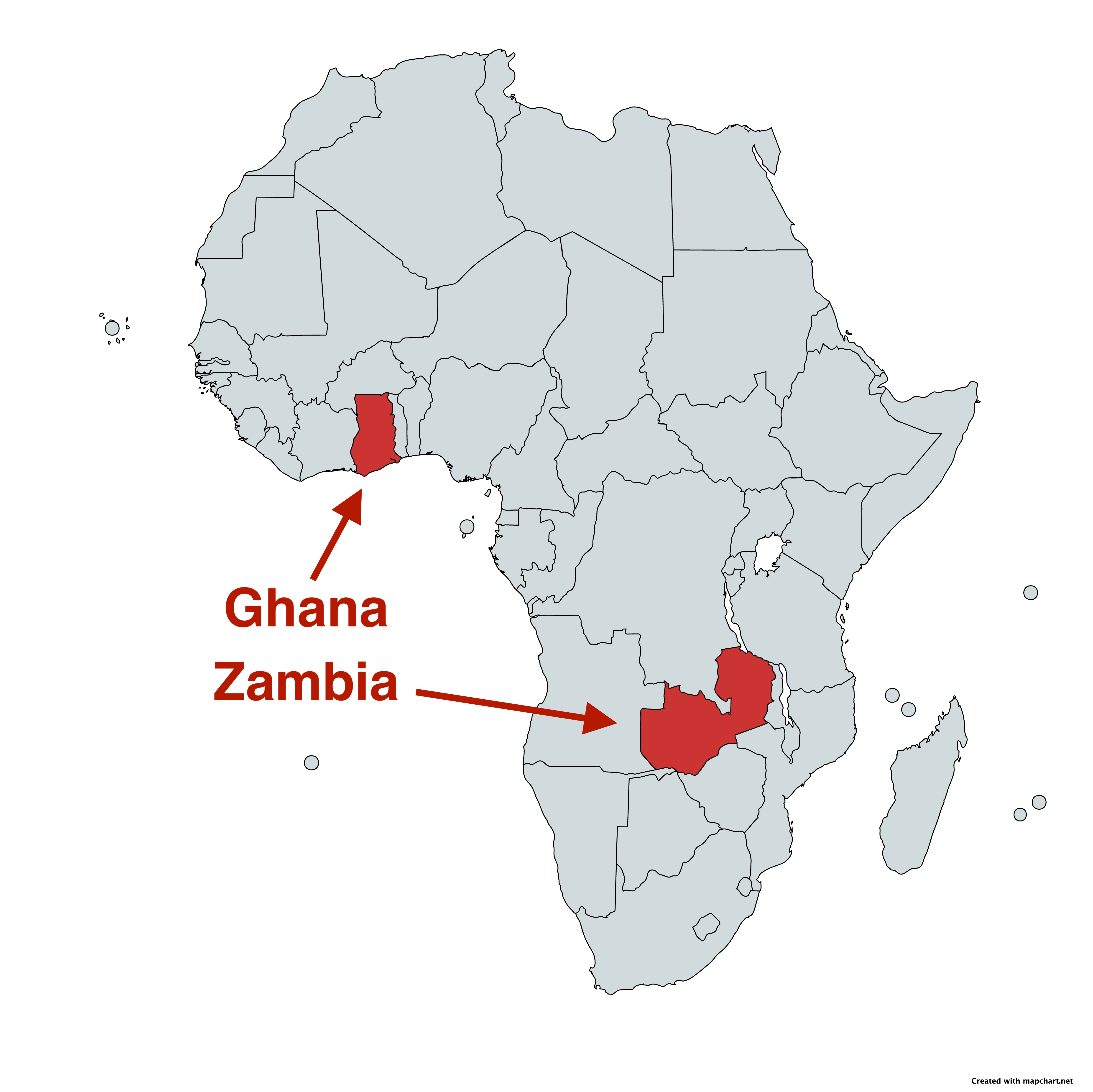
FINALLY: Ghana and Zambia have agreed to abolish visa requirements for each other’s citizens. My guess was that, while that’s a nice, brotherly policy, it wouldn’t really make life all that radically better for very many people. I decided to make ChatGPT earn its subscription fee this month, and in so doing I learned: In 2019 Zambia recorded 1,266,427 international arrivals total. 6,918 were Ghanaians. That means Ghana accounted for 0.55 percent of Zambia’s international arrivals, for a rate of fewer than 20 Ghanaian arrivals per day. Ghana apparently doesn’t publish similar figures, only listing the top three countries for visitors are Nigeria, the UK and the US. And now you know.
•••••
Thanks for reading all the way to the end.
Please send feedback. If you like what you see, please subscribe. Even better, if anything here makes you think, subscribe for $5 a month. I’d like to see a couple new paid subscriptions this month, and YOU can make it happen. Thank you!
I’ll see you twice next week. For now, a good weekend to you —
Content on Common Sense and Whiskey is free. There’s no paywall, but if you subscribe for $5 a month or $50 a year, next time I’m in town I’ll come over and wash your car. Maybe I will.
Cheers,
Bill
