

What Just Happened #77
Not a good week for the Trump peace prize campaign

Welcome and thanks for reading. This week is light on Ukraine news because peace negotiations are moving fast and it feels like just about anything you might have to say one day could be old news by the next. But I’ll have a longer article here next week, trying to sort things out, to see where we stand.
The relative lack of war news gives us the opportunity to look at a few places we don’t get around to so often, like the conflicts in Cambodia/Thailand and Rwanda/Congo, and South America.
Common Sense and Whiskey goes deeper than the headline stories, in a format busy people can absorb quickly. Have a look at today’s column, and if you like what you see, please subscribe. Let me know what you think. Here we go.

TRUMP PEACE PRIZE WATCH: Not a good week for the Trump peace prize campaign. While María Corina Machado, safe after fleeing Venezuela, charmed the Peace Prize committee in Oslo, the American president got negative points for seizing an oil tanker near Venezuela. Also this week, two of the conflicts he thinks he has solved flared up again.
“Clashes raged at more than a dozen locations” along the Thailand/Cambodian border this week “in some of the most intense fighting since a five-day battle in July,” according to AsiaOne. The president told his political rally in Pennsylvania that he’d give ‘em a call to work things out over there, but Thai Prime Minister Anutin Charnvirakul told reporters not so fast: “Other national leaders may have good intentions in wanting peace,” Anutin told reporters. “It cannot be as simple as picking up the phone and calling. There must be proper appointment and agreed talking points.”
In the other war Mr. Trump thinks he has solved, between Rwanda and the Democratic Republic of Congo, Congolese President Félix Tshisekedi started the week by accusing Rwanda of violating the agreement signed just last week in Washington. According to the Congolese Information Minister, the Rwanda-backed M23 rebel group continued to push across eastern Congo, entering Uvira, a town near Burundi.
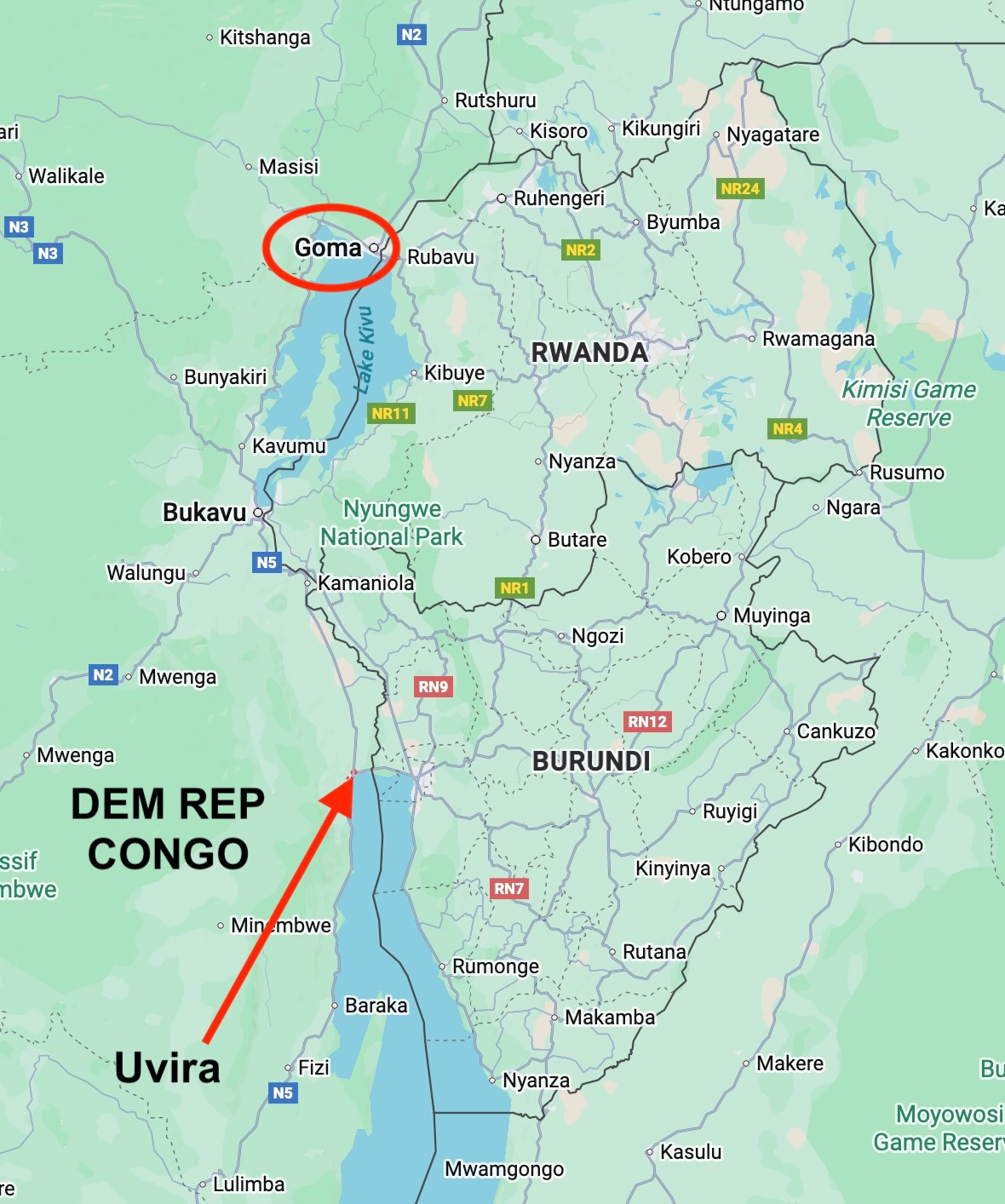
As you can see on the map, the Great Rift Valley lakes Kivu and Tanganyika form part of the border between Congo to the west and Rwanda and Burundi to the east. Until this year M23’s heartland had been to the north of Goma, but with its arrival in Uvira, the rebel group has penetrated south all the way past Bukavu to Lake Tanganyika.
•••••
UKRAINE: With serious negotiations underway between Ukraine, the United States, Europe and Russia - and serious twisting of Ukrainian arms by the Americans - here’s one short, succinct opinion about Ukraine’s dilemma, from a Ukrainian journalist:
Our enormous problem … lies in the fact that, on the Ukrainian side, these vital negotiations—unquestionably the most important in the entire history of Ukraine’s independence—are being conducted by (American) dilettantes who lack sufficient experience and competence to stand firm against today’s existential challenges confronting a country bleeding out, exhausted and weary of war, yet unwilling to surrender to the aggressor.
•••••
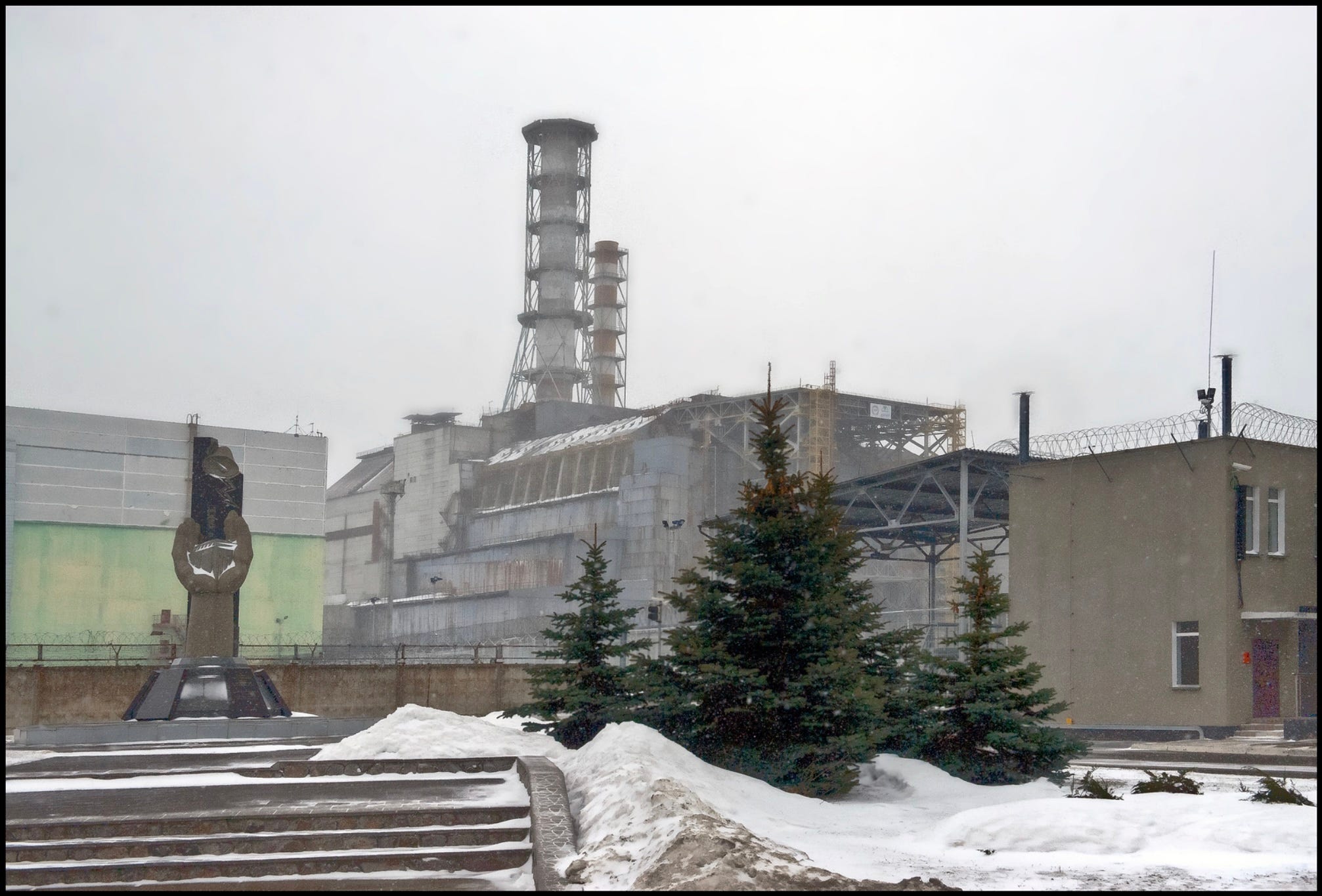
CHORNOBYL: I wrote a short travel guide to Chornobyl in 2013 based on a visit there in March of that year. Back then you’d walk right up to reactor number four and the crude ‘containment’ building, the sarcophagus they’d built in haste over the reactor.

Since then they’ve built what they thought was a sturdier $1.75 billion cover over the destroyed reactor. A French led consortium built the cover off to one side, and rolled it on tracks over the top, to cover the reactor.
Then, back in February, the Guardian reported that:
“A Russian drone carrying a high-explosive warhead struck the protective containment shell of the Chornobyl nuclear power plant in Ukraine overnight, the country’s president, Volodymyr Zelenskyy, has said.”
The International Atomic Energy Agency said last week that the shell “can no longer perform its main function of blocking radiation.” The IAEA said an inspection found that the drone impact had degraded the structure.

Side note to the Chornobyl news: this week the UN General Assembly adopted what looked like an anodyne resolution “aimed at strengthening international cooperation and minimizing the consequences of the Chernobyl disaster.” Ninety-seven states supported it, 39 abstained and the Democratic Republic of Congo, Belarus, China, Nicaragua, Niger, Russia, North Korea - and the United States - voted against it.
•••••
INDIA/RUSSIA: Russia’s labor market has historically suffered from a lack of healthy males. Start from there and add a war that has killed or conscripted at least hundreds of thousands of young men and caused another perhaps 650,000 to emigrate, and as the beginning of the fifth year of Russia’s war on Ukraine looms, workers are increasingly hard to come by.
Estimates say Russia will need to find workers to fill three million manual labor jobs by 2030. At the India/Russia summit in New Delhi earlier this month, India offered President Putin some 70,000 Indian workers.
In the meantime, back in August the Trump administration added a secondary 25 percent tariff on Indian goods linked to its oil trade with Russia, on top of 25 percent reciprocal tariffs. In October it further sanctioned Russian oil companies Rosneft and Lukoil, further legally exposing Indian firms to US penalties.
As a result one source found a nine percent drop in India’s Russian crude imports in September, immediately after announcement of the new sanctions, and other analysts reckon that Indian imports of Russian crude “declined significantly” last month as sanctions and tariffs took effect.
The India/Russia summit was heavy on optics (a chummy Putin/Modi limousine ride) and not so strong on (announced) results. The agreement on manpower, like the one in which North Korea provided an estimated 10,000-15,000 soldiers to Russia, wasn’t a secret. It was noted, but it wasn’t featured in media, which showed friendly things like the limo ride instead. Back home Russian TV viewers must think golly, Putin gets to ride around with all the world leaders.
As the US makes it harder for India to buy Russian oil, the manpower deal looks like one more way India can continue to support Putin without particularly being seen to, at least not in the brazen way that buying crude oil from the Russian shadow fleet has been seen.
•••••
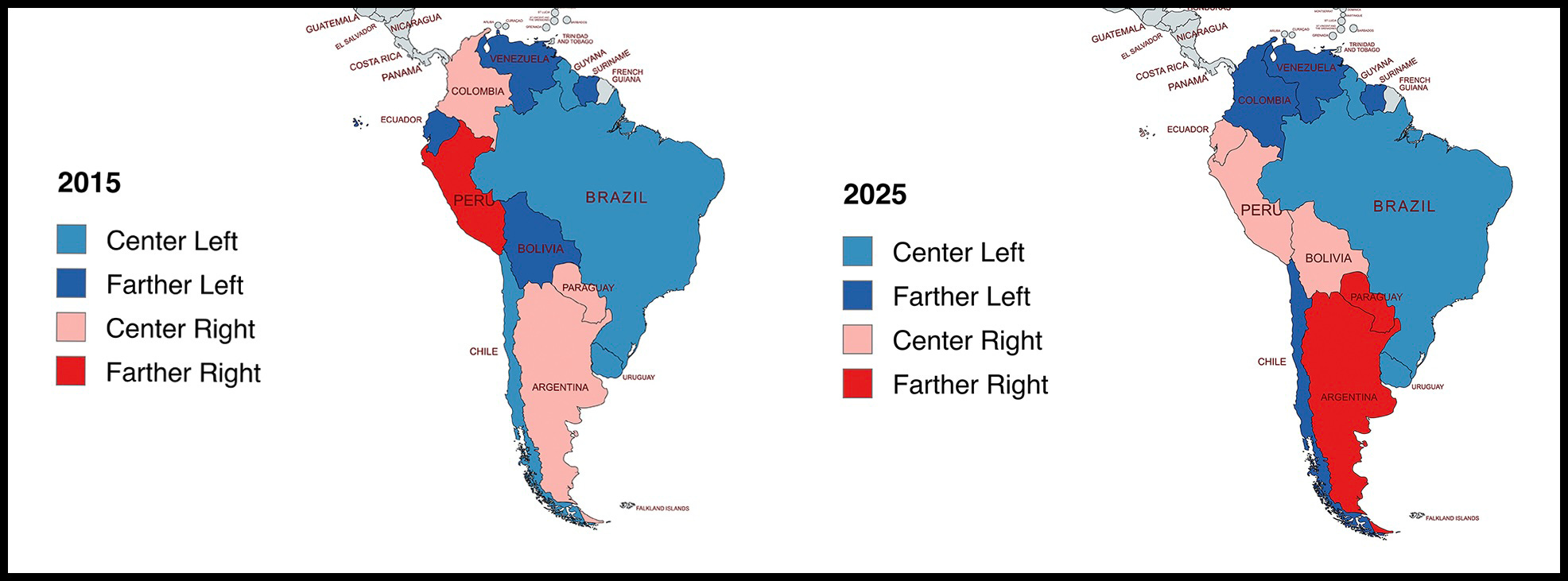
CHILE & SOUTH AMERICA: Chile’s presidential runoff election is this weekend, Sunday, December 14th, and it looks like they’ll be replacing Gabriel Boric, the most left-wing Chilean president in years, with its most right-wing president since Augusto Pinochet.
Boric’s governing leftist coalition’s is standing Jeannette Jara, a member of the Communist Party, against far-right candidate Jose Antonio Kast, who has a commanding lead in tracking polls, like so:
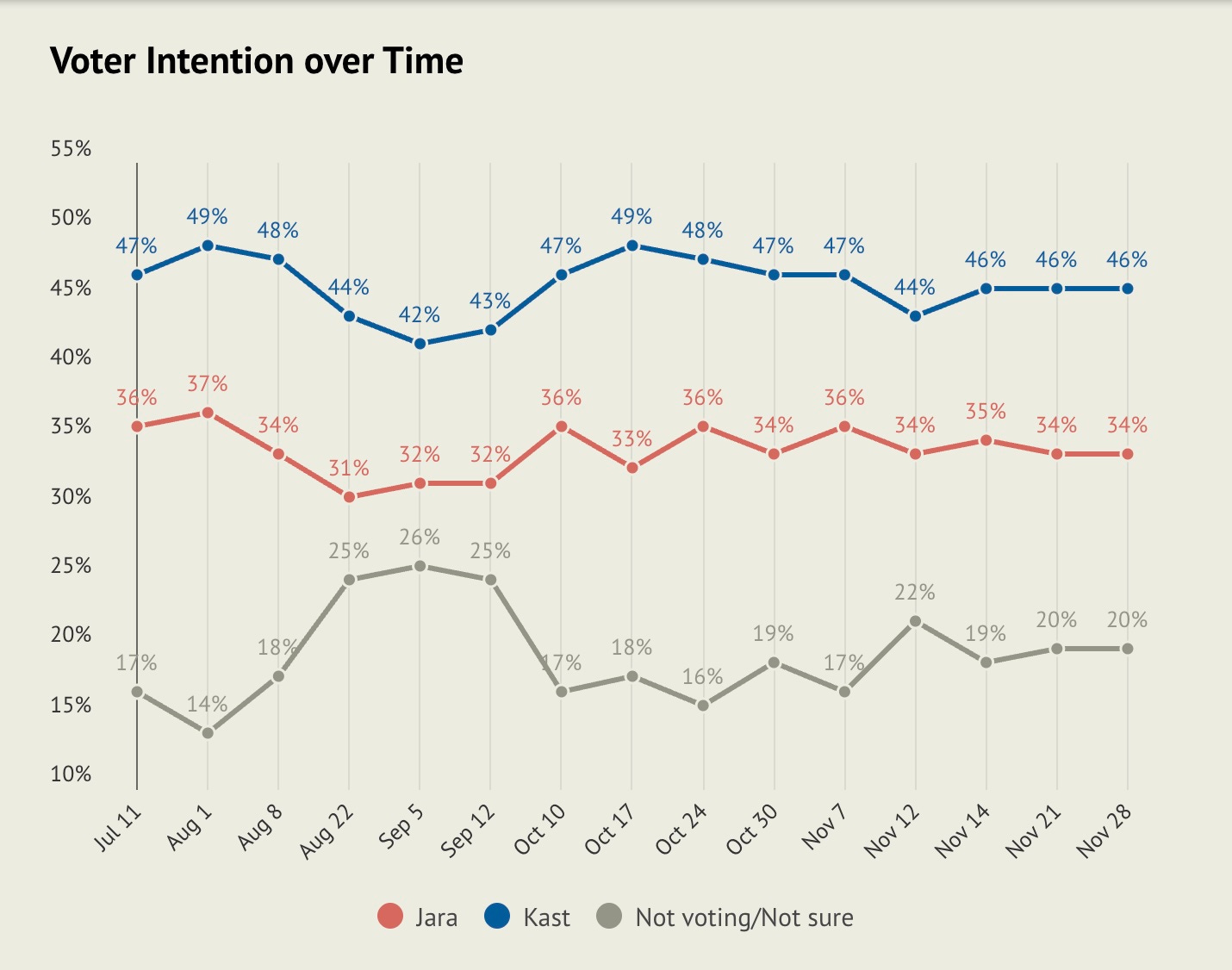
It will be a radical change for Chile, which got me wondering whether movement to the right is a trend in South American politics. Here is a comparison of ruling parties in the South American countries ten years ago versus today. If Chile flips to deep red on Sunday, that will confirm a rightward trend. Not a rightward march, exactly, but we’ll see six right of center governments among South America’s twelve independent countries versus four a decade ago. (French Guiana doesn’t count. It’s not a country, it’s French.)
•••••
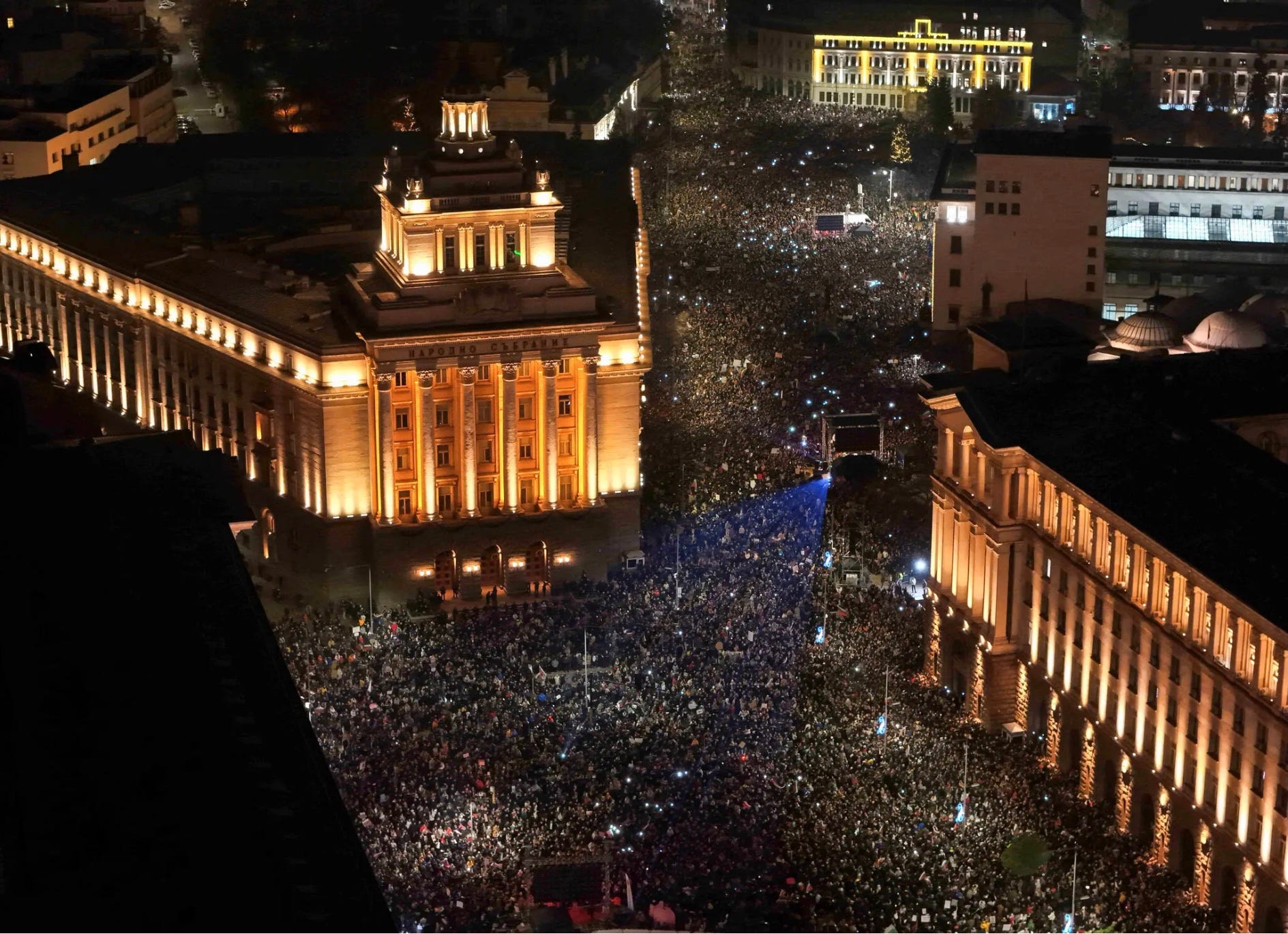
BULGARIA: A convincing crowd in Sofia prompted Bulgaria’s latest Prime Ministerial resignation this week. On Wednesday night protesters used lasers to project the words “Resignation”, “Mafia Out” and “For Fair Elections” on the parliament building.
Prime Minister Rosen Zhelyazkov called it quits after less than a year in office. His resignation comes just three weeks before Bulgaria joins the Eurozone on January first.
President Rumen Radev declared his support for the protesters last week, and wrote that Wednesday’s demonstrations were effectively a vote of “no confidence in the (entire) cabinet.”
There’s always been backroom intrigue in Bulgarian politics. Protesters have long singled out a politician named Delyan Peevski, who previously owned the most popular daily newspapers in Bulgaria, as a symbol of Bulgarian corruption. Peevski has the distinction of having been sanctioned by the UK, the US and others, and opponents accuse him of manipulating the government behind the scenes.
In 2013 Peevski was appointed head of Bulgaria’s main security and intelligence body with no particular qualifications. His appointment was reversed within days but protests continued long afterward. A new round of protests kicked up in 2020 with Peevski again a central figure. This was when foreign governments publicly accused him, a sitting Bulgarian MP, of systemic corruption, not an everyday occurance.
Peevski is apparently not currently under criminal investigation.
Of the 178 countries rated in Transparency International’s Corruption Perceptions Index, Bulgaria ranks 67th. Bulgaria has seen seven snap elections since 2020.
•••••
HUNGARY: Timothy Ash notes that on Wednesday Hungary “released its budget financing plans for the year ahead which included a plan to tap SAFE (Security Action for Europe) programme for at least €2 billion in cheap EU loans.” He speculates the money won’t be used for defense spending, as is intended, but rather to help Viktor Orbán in his reelection bid.
“However, Hungarian officials have made clear they have little desire to increase spending on defence much above 2% of GDP, and see SAFE funding as just cheap financing - coming at around 200bps below Hungary’s existing borrowing costs. It feels here that Hungary is gaming the system - and all this will help provide cheap funding for Orbán as he looks to pork barrel this side of elections due in April 2026 and where opinion polls suggest he is trailing to the opposition.”
•••••
AND WE THOUGHT THE PLANE WAS AUDACIOUS:
Back in May, news organizations reported that the Qatari royal family would give Donald Trump a Boeing 747-8 airplane. He could use it for Air Force One while he was president, and later he could just keep it. Trump said it would be stupid to turn down a free plane.
Those who thought Trump a canny geopolitician thought he was brilliant and those who thought otherwise, thought otherwise, and the Defense Department set about debugging it, a process that the Air Force says “could be done in less than a year.” Others suggest a full retrofit could take “up to three years,” just in time to fly the president to his Mar-a-Lago retirement.
However it all works out (or doesn’t), for some, the whole spectacle set a marker for Donald Trump’s price: about $400 million.
But wait. Now comes Vladimir Putin, offering the American president a bright, shiny “roughly $300 billion of Russian central bank assets,” with the small detail that they’re frozen in Europe just now.
But as the Wall Street Journal says, “By dangling multibillion-dollar rare-earth and energy deals, Moscow could reshape the economic map of Europe—while driving a wedge between America and its traditional allies.”
[The US doesn’t need help driving wedges. The new American National Security Strategy does a nice job of that. More about that next week.]
The Wall Street Journal is right. Enticing Trump with frozen Russian assets in Europe is a sure way to divide the alliance, since everybody wants to get their hands on the money.
That’s not surprising, or even terribly interesting, except that the Europeans say they want to spend the money on rebuilding Ukraine, and it’s less certain what Donald Trump might want to do with it.
One thing to note: if Putin is bargaining with frozen assets he currently hasn’t got, he may already be reconciled that he’s never getting them back.
•••••
That’s it this week. Thanks for reading all the way down to here.
I’ll see you twice next week with a longer article about where the US stands with its European allies, and then the Friday column. Please pass this article around and invite your friends to subscribe to Common Sense and Whiskey. Like we say here in Georgia, ‘It don’t cost nothing.’ And do let me hear from you.
Content on Common Sense and Whiskey is free. There’s no paywall, but if you subscribe for $5 a month or $50 a year, next time I’m in town I’ll come over and wash your car. Maybe.
Cheers,
Bill
This post is public so please feel free to share it with your people.

Fascinating and very informing column Mr. Murray. Always good and important reading.