

What Just Happened #76
Just the Usual Turmoil and Insecurity

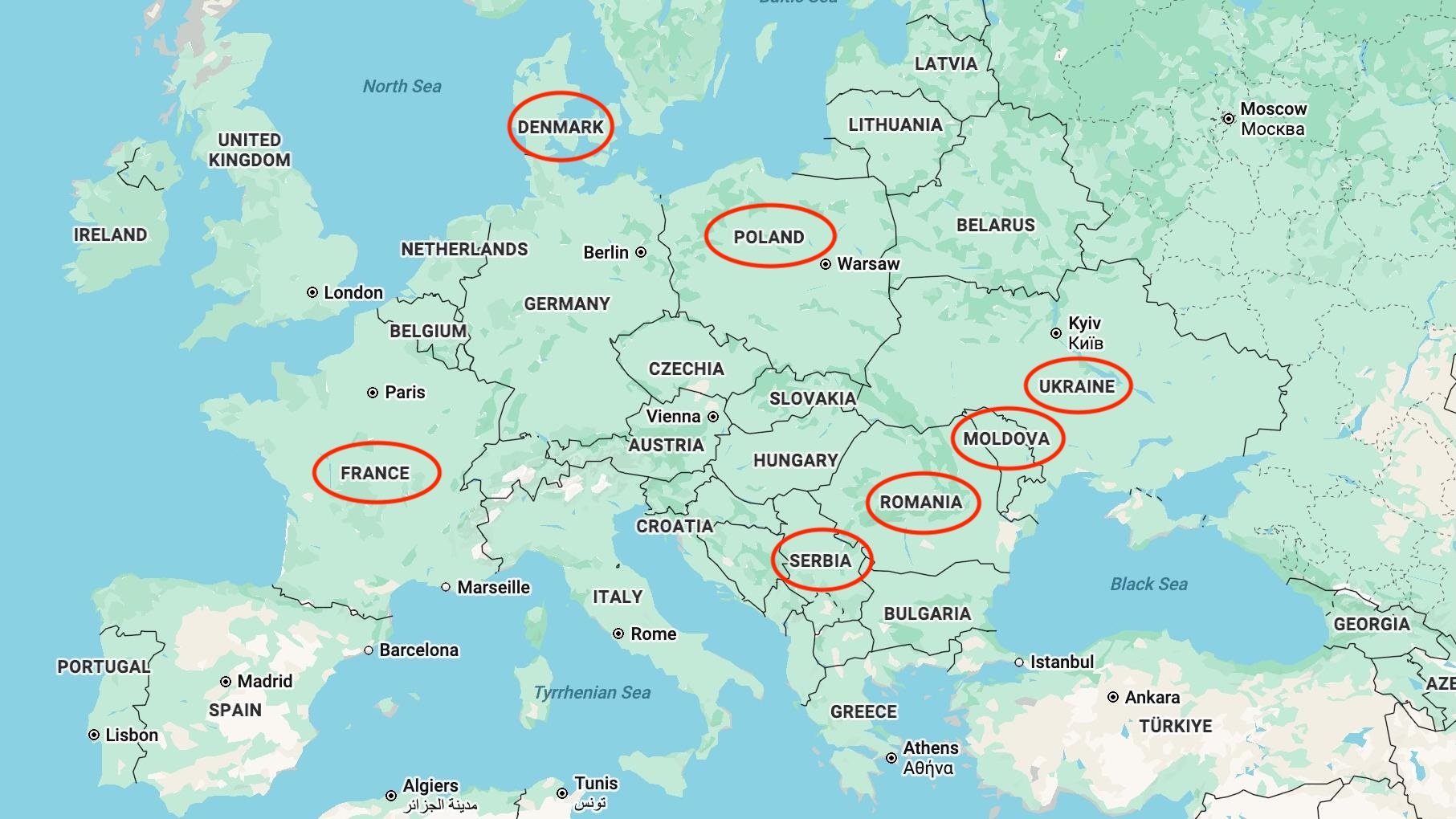
Welcome and thanks for reading. This week we have several items on United States/European/Russian/Ukrainian politics, and a few shorter takes on developments in Denmark, France, Poland, Romania, Serbia and Ukraine - among other places.
Have a look at today’s column, and if you like what you see, please subscribe. Let me know what you think. Here we go.
THE EUROPEAN BRAIN TRUST on Ukraine, Volodymyr Zelenskyy, German Chancellor Merz, French President Macron, Finnish President Stubb, NATO Secretary General Rutte, Polish Prime Minister Tusk, Italian Prime Minister Meloni, Danish Prime Minister Frederiksen, Norwegian Prime Minister Støre, European Commission President von der Leyen and European Council President Costa held a confidential conference call on Monday.
These leaders’ public posture is all about lauding Donald Trump’s every move. Rutte called him “Daddy.” A Der Spiegel story this week says it obtained notes from the conference call, and it turns out the leaders’ opinions are a little different among themselves.
Macron, according to the story, told the group “There is a chance that the US will betray Ukraine on territory without clarity on security guarantees.” Stubb said “We must not leave Ukraine and Volodymyr alone with these guys,” meaning American negotiators, and Merz told Zelenskyy “They are playing games with both you and us.”
Merz sounded positively plaintive, standing beside Tusk at a post-conference call press conference in Berlin. They were holding “the trans-Atlantic community together as well as we possibly can,” he said.
Meanwhile, after failing to act to seize frozen Russian assets despite repeated urging from just about everybody, now that the US revealed in its 28 point plan that it wants those funds, suddenly everybody is grabbing for the money.
Michael Weiss reports that:
“In a guest article for the influential daily Frankfurter Allgemeine Zeitung, published on Wednesday, Merz reiterated that Europe cannot “leave the decision to other, non-European states about what happens to the financial assets of an aggressor that have been lawfully frozen within the jurisdiction of our rule of law and in our own currency.”
Just another week of European diplomacy.
•
UKRAINE/TRUMP ADMINISTRATION: About that American 28 point plan, retired Australian Major General Mick Ryan, writing for the Sydney-based think tank the Lowy Institute, observed:
“During the first Trump administration, the United States conducted secret talks with the Taliban to end the Afghanistan war. The deal was negotiated without input from the Afghan government at the time. The final deal, known as the Doha Accord, had its ultimate manifestation in the humiliating, chaotic and tragic evacuation of troops and civilians in late August 2021. While blame was laid at the feet of the Biden administration, the foundations were cast by Trump.
Now, with the Russian-American 28-point peace plan for Ukraine, there is a similar demonstration of perfidious behaviour by Trump’s representatives to secretly negotiate a war termination deal with an enemy behind the backs of friends and allies. The demonstrated behaviour of Trump in two different administrations towards two different wars provides insights into how the Trump administration thinks about its relationships with foreign nations.”
I think that pairs well with this Maria Popova quote:

The glue of the emerging Russo-American alliance is corruption. The consequences will be imperialist aggression and war crimes.
As to the the ‘emerging Russo-American alliance,’ Russia’s goals aren’t a secret. It intends for Ukraine’s sovereignty to be compromised. It’s clear that this doesn’t much upset Trump, who governs not on principle but for profit.

DEAD ARTICLE FIVE?: Does it sound here like the US will storm the border for its ally if Lithuania invokes NATO’s Article Five when Russia and Belarus move to block the Suwalki Gap? Does it sound here like the US is prepared to stand and fight along the Estonian border with Russia?
After a barrage of fake Russian social media messages disrupted Romania’s elections a year ago, J D Vance warned Romania and his European allies that if foreign digital ads could “destroy” a European election, then “your democracy … wasn’t very strong to begin with.” When a future drone incursion kills a Romanian family across the river from Ukraine’s Izmail port, will the US send its soldiers to stand behind Romania?
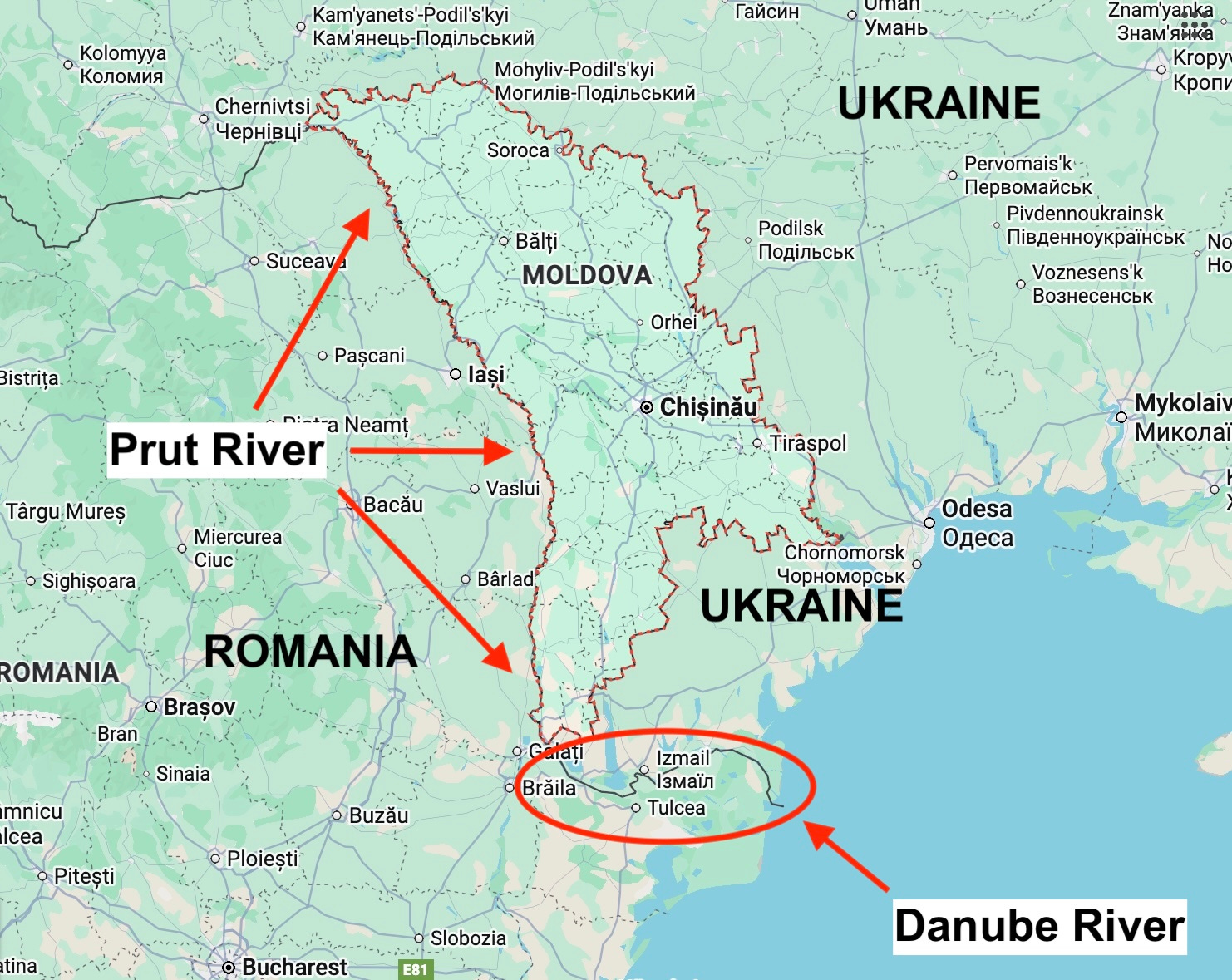
The Prut River separates Romania and Moldova. It flows into the Danube when Moldova ends in the south, and the Danube flows on to the Black Sea. Russian drones have repeatedly struck the Ukrainian port of Izmail (inside the oval).
When Russia attacked Ukraine’s big port at Odesa, Ukraine exported huge volumes of grain via Izmail. They can then be shipped on down the Danube to Romania’s port at Constanța, and on to global markets.
UKRAINE: And finally in Ukrainian news, Valerii Zaluzhnyi, the commander-in-chief of the Ukrainian armed forces at the beginning of the war and now Ukraine’s ambassador to Britain, wrote an article for the Telegraph last weekend that looks a lot like prepositioning for a political challenge to Zelenskyy.
Zaluzhnyi is one of Ukraine’s most popular figures. In a November, 2023 article in The Economist (a non-paywalled link from National Security Archive is here), Zalushnyi characterized the war as a “stalemate” and called for mobilizing up to 500,000 additional troops. Not long after that article Zelenskyy removed Zaluzhnyi as military commander and sent him to London.
Zaluzhnyi’s article last weekend was titled How to defeat Putin and build a better Ukraine. It highlights “the heroism of Ukrainian citizens” and declares “Peace provides a chance for political change and deep reforms.” Zaluzhnyi proposes
“the beginning of the formation of a safe, protected state through innovation and technology; of strengthening the foundations of justice through the fight against corruption and the creation of an honest court system; and of economic development, including on the basis of international economic recovery programmes.”
Zelenskyy’s right hand man, confidant and chief of staff Andriy Yermak resigned amid scandal last Friday, November 28th, in Kyiv. The Zaluzhnyi Telegraph article appeared the next day.
•
INDIA: The Financial Times reports that in Delhi on Thursday, “Russia’s president was greeted warmly at the airport by India’s prime minister at the start of a two-day state visit aimed at boosting economic co-operation between the two nations.”
It’s Putin’s first visit to India since Russia’s full-scale invasion of Ukraine in 2022, and it comes as US secondary sanctions have caused Indian companies to import less Russian oil.
Modi offered boilerplate, calling the friendship between India and Russia “a time tested one that has greatly benefited our people”. He put up posters of Putin around town, “with Russian and Indian flags draped along main roads.”

POLAND: Adopting anti-migrant rhetoric and policies is starting to be a trend across Europe. Witness Denmark, where since her election in 2019, Prime Minister Mette Frederiksen’s Social Democrats have adopted immigration policies that land much farther to the right.
As a result, among other things, asylum approvals there have dropped to a 40-year low and 95 percent of failed claimants are deported. Now The Independent and others report that the UK wants “to model its immigration system on Denmark.”
In Poland, immigration protests have turned ugly. Right wing President, Karol Nawrocki, who was elected with the strong support of the far right Prawo i Sprawiedliwość (PiS) party, first vetoed a bill on extending assistance for Ukrainian refugees.
Then when Prime Minister Donald Tusk’s coalition developed a new bill that extended support for Ukrainian refugees - just until March - but restricted access to some social benefits and healthcare, Nawrocki signed the bill last month. But after signing the amendments into law he declared it was the “last time” he would do so.
Polish anti-immigrant protests have taken a nasty turn this year - mostly affecting Ukrainian immigrants. In a newsletter from Meduza, Agnieszka Pikulicka writes from Warsaw that “Polish police recorded 543 hate-motivated crimes in the first seven months of this year alone, a 41-percent jump compared to the same period in 2024.”
In Warsaw, the Tusk government is adopting anti-immigration stances of its own. This year the government has announced that Poland will not accept any migrants at all as part of the E.U. relocation plan, and it has suspended the right to asylum at the border with Belarus completely.
•••••

If you’re reading this as an email, be aware that your provider may clip the article before the end. Try clicking on ‘view entire message’ to see the whole thing, or you can always read everything at Common Sense and Whiskey online.
•••••

SERBIA: An interesting story this week from Serbia illustrates one of the ways Washington wields its sanctions power. Naftna Industrija Srbije (NIS) is Serbia’s main oil company. It operates the only oil refinery in Serbia, the Pančevo refinery, which covers most of Serbia’s needs.
NIS is majority-owned by Gazprom Neft and Gazprom, two Russian companies, and because of that, the U.S. has sanctioned NIS as part of broader sanctions on Russia’s energy sector. Those sanctions effectively cut off crude oil supplies via Croatia’s Janaf pipeline, which is the refinery’s key import route.
Serbia asked Washington for a sanctions waiver/license so the refinery could keep getting crude until the Russian owners could find a buyer for their stake. The U.S. said no at the beginning of this week and Pančevo suspended operations on Tuesday.
Vucic’s administration said Serbia “has sufficient fuel reserves to supply the domestic market,” but nobody will be terribly upset to see the Moscow-friendly government in Belgrade have to scramble to find a way to heat the country, or to deal with any new political crisis that results.
Further reading: The new book Chokepoints by Edward Fishman explores the creative ways the United States uses sanctions.

FRANCE: Emmanuel Macron has found more success than he probably expected with his plans to expand military service among French young people. Last week Macron proposed a voluntary youth military service starting next summer. ‘Voluntary,’ I imagine, is the word doing the heavy lifting here.
Participants will serve for ten months and limited to service on French soil or in France’s territories. (Suggestion to French teenagers: angle for French Polynesia or Réunion Island.)
Macron hopes to ease into this thing, as if stronger defense were just aspirational, aiming for 3,000 volunteers next summer, 10,000 by 2030 and of up to 50,000 per year by 2035.
A poll by Institut français d’opinion publique showed 81 percent of respondents supporting the scheme. Sixty-four percent said they were even in favor of compulsory service for 18-25 year olds.
And speaking of France, this is so very French:

•
AND FINALLY: Honestly? you know this guy is standing there right now, thinking, “I am trying to look like this.”
•••••
That’s it this week. Thanks for making it all the way to the end.
See you next Friday. Please pass this article around and invite your friends to subscribe. Like we say in Georgia, ‘It don’t cost nothing.’ And do let me hear from you.
Content on Common Sense and Whiskey is free. There’s no paywall, but if you subscribe for $5 a month or $50 a year for 2025, next time I’m in town I’ll come over and wash your car. Maybe I will.
Cheers,
Bill
Thanks for reading Common Sense and Whiskey! This post is public so please feel free to share it.
