

The MoU, Mostly
What Just Happened #97

Welcome. Last night in the UK, Greater Manchester Mayor Andy Burnham won a convincing by-election to become a Member of Parliament and set up a challenge to the Prime Minister for leadership of the Labour Party, and the country. Earlier this week Ukraine’s President Volodymyr Zelenskyy convincingly bombed targets around Moscow, exposing an embarrassing deficiency in air defenses around the Russian capital.
Both those events point to an active summer to come, and will require discussion in the weeks to come. Today we have first thoughts about the US/Iran Memorandum of Understanding. Then we look at how leaders choreograph elaborate diplomatic road shows around summit meetings like this week’s G7 summit on Lake Geneva.
Common Sense and Whiskey goes deeper than the headlines on a few stories a week, in a presentation that busy people can absorb quickly. It’s a short, sharp look at the world out there.
If you’re reading this as an email, have a look at the online version at CommonSenseandWhiskey.com, where all CS&W content is available, and if you like what you see, please subscribe. Talk to me in the comments section or directly, at BillMurrayWriter (at) gmail.com. Let me know what you think.
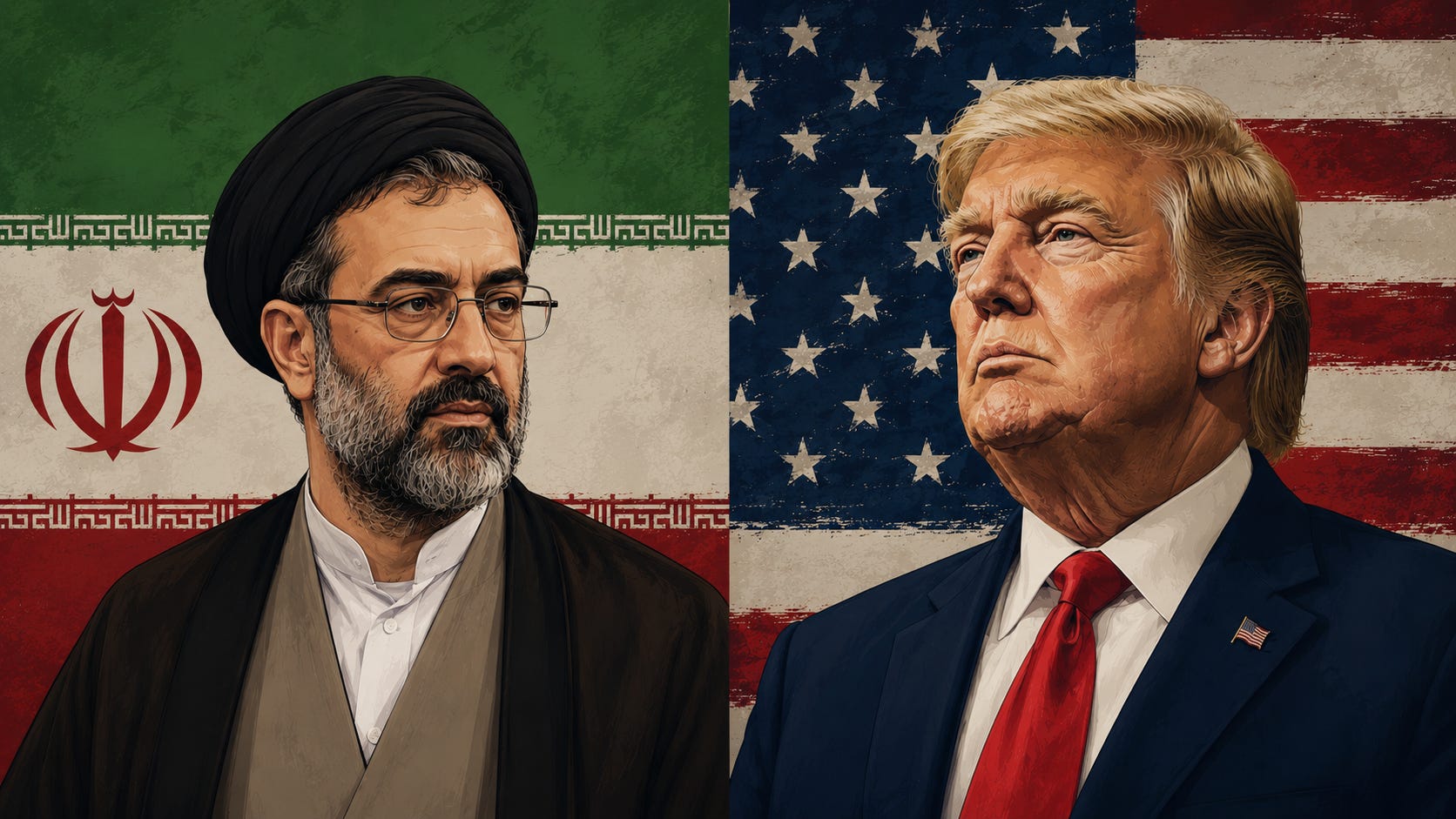
First, a few first impressions of the US/Iran Memorandum of Understanding:
The document as published Wednesday morning by Bloomberg was significantly different from the version that a White House official read to reporters on a Zoom call Wednesday afternoon. Apparently, every reporter transcribed that version as they heard it.
Then on Thursday the White House sent a photocopy of the apparently final version, signed by the president, to Congress.
Releasing an agreement this way is maybe not a best practice.
Paragraph 5 strikes me as the most geopolitically consequential. In fact, it strikes me as historic. Here it is, from the version the president signed in France:

It says that Iran will provide safe passage “with no charge for 60 days,” but after that “the future administration and maritime services in the Strait of Hormuz” are up for discussion by a group that does not include the United States.
That means that the US isn’t insisting on freedom of passage without charge after sixty days. Which would mark the end of the US guarantee of freedom of the seas in international shipping lanes.
Since the US emerged from World War II with the world’s dominant navy, it has underwritten worldwide maritime commerce. It has called freedom of navigation through international straits a principle implicitly protected by international law, and occasionally explicitly guaranteed by American naval power. Until the Trump administration, apparently.
After the Iranian revolution in 1979 the Carter Doctrine specifically guaranteed access to Hormuz. essentially elevating the Persian Gulf into a vital American security interest. There’s one more Democratic president whose work the Trump administration looks set to undo.
I can find no US concerns in the MoU about Iran imposing tolls for passage after sixty days. If that is true, Paragraph Five will never not be part of Donald Trump’s legacy, because with it, the US appears to cede its eighty-odd years of enforcement of freedom of navigation.
•
J D Vance came out all carrots this week in a media blitz aiming to frame the MoU as a revolution in US/Iran relations. On Monday he told CNN:
“one of the really cool things and interesting things about this entire process is that we actually have a direct relationship with a number of people at the highest levels of the Iranian government. That really hasn’t happened in 47 years of our relationship with Iran.”
It remains to be seen just how cool killing a country’s leadership in search of new interlocutors will turn out to be.
Vance has clearly been put out front as the administration’s point man. If need be, Trump defenders will twist and turn to pin the blame on Vance. Trump said as much. Vance is perhaps being made to pay for letting it be known that he personally advised against this war. The VP may calculate it’s a price he must pay for Trump’s 2028 endorsement (if it’s eventually forthcoming).
Marco Rubio has tried to disappear from the entire Iran question, as he did from Gaza. On Greenland Rubio tended to process as a cabinet member while Vance was again the front man.
Rubio also tends to north Atlantic organizations. He would represent remaining traditional Republicans on Europe if he did any actual advocacy, but instead Defense Secretary Hegseth and others go to Europe to make scary headlines. Rubio appears to be keeping his powder dry for Cuba.
•
The Obama administration’s previous agreement with Iran was called the Joint Comprehensive Plan of Action, or JCPOA, ‘joint’ because it was jointly negotiated with the other members of the UN Security Council, China, France, Russia and United Kingdom, along with Germany and the European Union.
Trump withdrew the US from the agreement during his first term. Much of the criticism from the American right, Israel, and Gulf Arab governments was that it didn’t deal with Iran’s regional proxies like Hezbollah, Iraqi Shiite militias and the Yemeni Houthis. But neither does the MoU.
Donald Trump likes the story he tells often about the Obama administration raiding banks in the capital region to come up with cash to send “on pallets” “in a Boeing 757” to Iran as part of the JCPOA. This week he again said the amount of cash Obama sent was $1.7 billion.
Article Six of the MoU offers Iran “at least USD 300 Billion for the reconstruction and economic development of the Islamic Republic of Iran.”
•
The MoU sets a sixty day negotiation period to resolve all outstanding issues. Sixty days from today, the original ceremonial signing date, is August 18th. (Although Vice President Vance is no longer traveling to Geneva for the signing today, and talks have already been postponed.)
A prediction: outstanding issues between the United States and Iran will not be wrapped up by August 18th. From August 18th until the US midterm election day on November 3rd is 77 days.
Vanishingly few Republican politicians (or Americans in general) will want to return to war less than three months before election day. The Trump administration will be under heavy pressure not to resume fighting. At the same time it will face constant pressure from Iran to accede to Tehran’s demands, at pain of another blockage of the strait.
A better political option would have been to set the MoU’s negotiating period at six months. Historians might wish to explore whether that occurred to the Trump administration.
•
Since the US began this round of war began on February 28th, President Trump has exhibited no strategic patience. Iran has shown strategic patience for decades.
Trump has very publicly hustled the process along for all the world to see, claiming a deal was imminent some forty times. Iran has gone without sanctions relief for decades.
My guess is that short of a serious domestic uprising, something not currently on the horizon, Iran will use the same rope-a-dope negotiating strategy they’ve used historically, well beyond the sixty day negotiating period to come. It is bound to drive the American administration crazy.
•
Israeli prime minister Benjamin Netanyahu has explicitly rejected withdrawing his forces from the territory Israel currently occupies in southern Lebanon. He said this week that Israel would remain in a Lebanese “security buffer zone” “for as long as necessary.”
He has reserved freedom of action in Lebanon regardless of arrangements between Washington and Tehran. He has argued that his campaign against Hezbollah is incomplete and that Hezbollah must ultimately be taken apart.
He is, after all, the leader of a sovereign state, and as such he needn’t necessarily bend to the will of either Iran or the United States.
To say that Netanyahu is “seeking to topple its (Iran’s) clerical regime and boost his political standing at home,” as Reuters did this week, is to be journalistically careful. That’s not something to which an opinion column is bound.
Opinion: Netanyahu will do his best to deliberately prolong military conflict if it preserves his own political position. As the International Crisis Group analyst Mairav Zonszein put it about Gaza, “Prolonging the war would first and foremost provide Netanyahu time to ensure his political survival.”
An Israeli election must be held no later than October 27, 2026, though it could be held earlier. October 27th is ten weeks after the expiration of the MoU.
•
In the end, there’s no reason to believe the MoU is a good faith document in the first place. It’s riddled with potential for either side to hold up negotiations or suspend their participation entirely. So there’s a long road ahead.
•••••

If you’re reading this as an email, be aware that your provider may clip the article before the end. Try clicking on ‘view entire message’ to see the whole thing, or you can always read everything at Common Sense and Whiskey online.
•••••

THE G7: The G7 was born as France, Italy, Japan, the United Kingdom, the United States and West Germany in 1975. That’s six countries, not seven. Canada joined the next year and the group became the G7, which stands for nothing more grand than ‘the group of seven countries.’
The European Community (which became the European Union) joined later (without getting a number), and then post-Soviet Union, Boris Yeltsin’s Russia was invited at the urging of Bill Clinton. Thus was born the short-lived G8, which died with Vladimir Putin’s invasion of Crimea in 2014.
Leaders from non-member countries are routinely invited at the discretion of the host country’s leader, and this year’s guests were Brazil, Egypt, India, Kenya, Qatar, Saudi Arabia, South Korea, Ukraine and the United Arab Emirates. Syrian President al-Sharaa was invited but declined. He plans to meet with Donald Trump at the NATO summit in Ankara three three weeks from now instead.
Ukrainian President Volodymyr Zelenskyy came for a Ukraine working meeting, and the Middle Eastern leaders attended for bilateral meetings with various other leaders.
For European leaders, Évian les Bains, a resort town thirty-odd miles from Geneva, is just a day trip. But when leaders come from farther away for a summit like the G7, they can’t just beam in and beam back out. So they make a trip of it.
Canada’s PM Mark Carney arrived first for talks in Paris, where he continued his deepening engagement with Europe by announcing, with French President Macron, an agreement allowing deeper sharing of classified information. He then flew off to Dublin to meet the Irish Taoiseach, and County Mayo to meet the president, before returning to Évian and the G7.
Indian Prime Minister Narendra Modi met French President Macron in Nice to jointly attend a business conference. Modi made a quick run over to Slovakia for an official visit, the first by an Indian prime minister since Slovakia became its own country in 1993, focusing “on expanding cooperation in trade, investment, automobile manufacturing, and railway infrastructure.”
Modi held talks with Slovak President Peter Pellegrini and Prime Minister Robert Fico, and then returned to France for the summit.
Sanai Takaichi , the Japanese prime minister, is making her first European trip since taking office, with stops in Britain and Italy before the summit.
In London Takaichi and Kier Starmer used talks “to push Japan-U.K. ties toward ‘quasi-alliance.’” In Rome, she and Prime Minister Giorgia Meloni “reaffirmed support for accelerating GCAP, the joint fighter jet project involving Japan, Italy and Britain.” Boilerplate.
With both the British and Italian leaders, Takaichi tried to nudge forward “support for accelerating GCAP,” a joint fighter jet project involving Japan, Italy and Britain.
On his own visit to Rome, South Korean President Lee Jae Myung attended religious events at St. Peter’s Cathedral and invited Pope Leo XIV to visit South Korea for World Youth Day 2027. Mark your calendar.
Lee’s was one of the more elaborate of all the leaders’ road shows. He began in Brussels, where he met Bart De Wever, the Prime Minister, then paid a courtesy call on the King before getting to his main business.
Because Belgium is the home of the European Union, Belgian leaders must be accustomed to getting second billing in their own country. After meeting Belgian leaders Lee went on to meet with the European Council President António Costa then Ursula von der Leyen.
Then he was off to Rome at the invitation of President Sergio Mattarella for a state visit. He met Mattarella, Prime Minister Meloni, and at the Vatican, the Pope.
Rome and Seoul have been pursuing cooperation on tech—semiconductors, AI, aerospace, defense. Meloni visited Seoul in January, and Lee returned the favor. The leaders elevated the relationship to a “Special Strategic Partnership,” suggesting that Meloni’s January visit was fruitful enough to institutionalize with an Italy/South Korea “2026–2030 Action Plan.” Only after all that politicking did Lee turn up in France for the G7.
WHILE YOU’RE IN TOWN: Lee also met with Kenyan leader William Ruto on the sidelines of the summit, while they were both in France, to discuss economic and development cooperation.
As for Ruto, like Lee, he visited Brussels, calling on António Costa, European Parliament President Roberta Metsola and King Philippe. He moved on to Finland for the first formal state visit for a Kenyan leader, meeting President Alexander Stubb in Helsinki. Then it was off to Oslo and meetings with Norwegian Prime Minister Jonas Gahr Støre and Crown Prince Haakon, followed to a visit to the Storting (the parliament) for a visit with Storting President Masud Gharahkhani, and from there the last stop was Évian, where the official meetings began for all the leaders.
•••••
That’s it for today. Thanks for your time, and let me know what you think. Good weekend, and I’ll see you next week.
Please pass this article around and invite your friends to subscribe. Substack authors, feel free to restack this or any other column on your own Substack anytime.
Content on Common Sense and Whiskey is free. There’s no paywall, but if CS&W is beneficial to you, please subscribe for just $5 a month or $50 a year. Big American media is increasingly falling under the control of government-friendly oligarchs. The future is on Substack and platforms like it — please invest in independent writers you trust. We’d all appreciate your support.
Cheers,
Bill
