

Morass
What Just Happened #87

Welcome to Common Sense and Whiskey. Thank you for visiting.
The news has come in torrents this week. Today, short comments about living on earth in our unusually fraught moment. Starting with this week in America’s war on Iran.
Common Sense and Whiskey goes deeper than the headlines on a few stories a week, in a presentation that busy people can absorb quickly. It’s a short, sharp look at the world out there.
If you’re reading this as an email, have a look at the online version at CommonSenseandWhiskey.com, where all the content is available, and if you like what you see, please subscribe. Talk to me in the comments section or directly, at BillMurrayWriter (at) gmail.com. Let me know what you think.
•••••
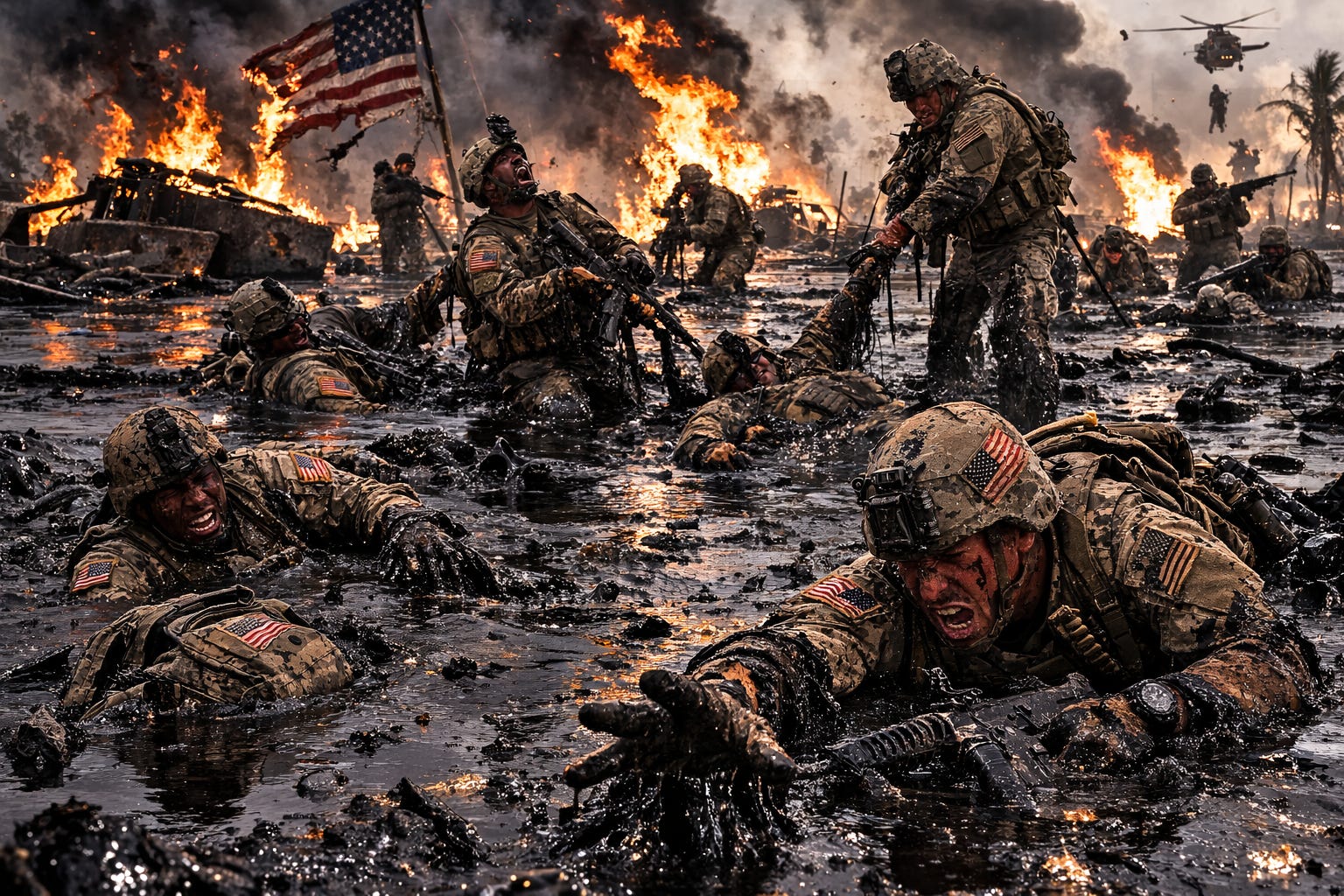
The US took two decades to replace the Taliban with the Taliban in Afghanistan, as Ed Luce wrote this week. Donald Trump has replaced a Khamenei with a Khamenei in just one week. What’s not to like?
Quite a bit, I’m afraid.
The Middle East is always in turmoil. By all accounts, with the coming of America’s war on Iran, it will now continue to be for a decade or probably more. I’m sorry for the innocent people of the greater Middle East. In only a handful of visits the region, I’ve found some of the cleverest minds and wittiest people I have ever met.
•
To place this war in context, consider: the Middle East’s population (less Turkey) is something like 430 million, maybe five and a half percent of the world’s people, while the fight between Europe and Russia over Ukraine involves countries, in rough figures, representing something over twelve percent of the world.
But beyond numbers, the war in Ukraine is fundamentally a contest between democracy and authoritarianism, while there is little prospect that democracy will suddenly break out across the Middle East, regardless of how America’s war on Iran ends.
Both are deadly military conflicts. But a great political struggle is also being waged across the European continent. The far right is ascendant in many countries. We talk about it often here.
Far right parties aspire to sunder the European Union in Germany (AfD), France (Rassemblement National) and the United Kingdom (Reform UK).
In Poland an effective far right PiS party and its allies campaign for a return to their previous system of illiberal rule. In Hungary Viktor Orbán, who proudly labels his own rule “illiberal democracy,” is in the tightest reelection campaign of his career.
When the dust from the rubble of this spasm of violence settles across Iran, Europe will still face the fight of its life.

In reaching for his Krakatoa moment, Donald Trump has exposed America’s allies to peril and himself to withering criticism. On Thursday the Wall Street Journal quoted a China research institute as saying, “everyone is observing that Iran has, at best, a middling military capability—and the Americans can’t take them out.”
“This war hugely damages U.S. standing in the world, which means that China has much more scope to establish its own standing in the Middle East and the Global South generally,” Steve Tsang, director of the SOAS China Institute in London, said.
The United States has been reluctant to supply Ukraine with many Patriot missiles, among other assets. The suggestion is that they could be needed to defend Taiwan.
Ukrainian President Volodymyr Zelenskyy said this week that “in just three days of fighting in the Middle East, more than 800 Patriot missiles were used — more than Ukraine has received throughout the entire Russian full-scale invasion.”
American will need time now to replenish the missiles it had stockpiled for use in Asia, but has used in the Middle East instead.
Suppose there were a conflict in Asia now. And more generally, with the US now once again preoccupied with the Middle East for the foreseeable future (a quick two-day Trump visit to Beijing beginning March 31st notwithstanding), what happened to that pivot to Asia?
•
My guess is the mullahs’ strategy since the beginning of the war is neither desperate nor accidental. Under the US gun for all 47 years of their rule, they’ve had decades to debate what their response would be when a wider war finally came.
They surely didn’t decide on the spur of the moment to send drones and missiles into neighboring countries. Rather, they mean to widen and lengthen the conflict, the more pressure to apply to the Americans.
Because as ever, US war plans (to the extent the Trump team had plans) go out the door when the first munitions hit. See Afghanistan. See Iraq. See Vietnam.
•
However odious the group of (all) men who make up the Iranian Assembly of Experts, the 88-strong clerical body of mujtahids elected to choose the new supreme leader, most can understand when they give the back of their hand to the foreigner who blusters in insisting that he have a choice in selecting their new leader.
Similarly, it won’t be surprising if Mojtaba Khamenei, the previous ayatollah’s son and apparently the new Iranian leader, should be reluctant to sue for peace. He reportedly was injured in the initial attacks in which his father, mother, wife and son were killed.
(First reports had Mojtaba Khomeini’s mother killed. Late this week there was a report that she had survived. It’s unclear. Fog of War.)
•
This far, the US has deployed a series of tactics without revealing much of a strategy beyond degrading Iranian military capability and waiting to see what happens. It’s a play by play scheme with no long game.
Consider American messaging:
On Tuesday March 3rd the president said on social media that “if necessary, the United States Navy will begin escorting tankers through the Strait of Hormuz, as soon as possible.”
But on Saturday March 7th a reporter asked him: “What about the Strait of Hormuz? There’s really no traffic going through it right now.” Trump replied “That’s, you know, the ships’ choice.”
And late this week the US energy secretary was asked “Do you think that by the end of this month, some ships passing through the Strait of Hormuz will be escorted?” and replied, “Yes. I think the possibility is very high.”
UNINTENDED CONSEQUENCES: Under Secretary of Defense for Policy in Trump’s Department of Defense, Elbridge Colby, grandson of CIA Director William Colby, could by all rights expect a distinguished sinecure in Washington. Here is his big idea, from his 2022 book The Strategy of Denial, on page five:
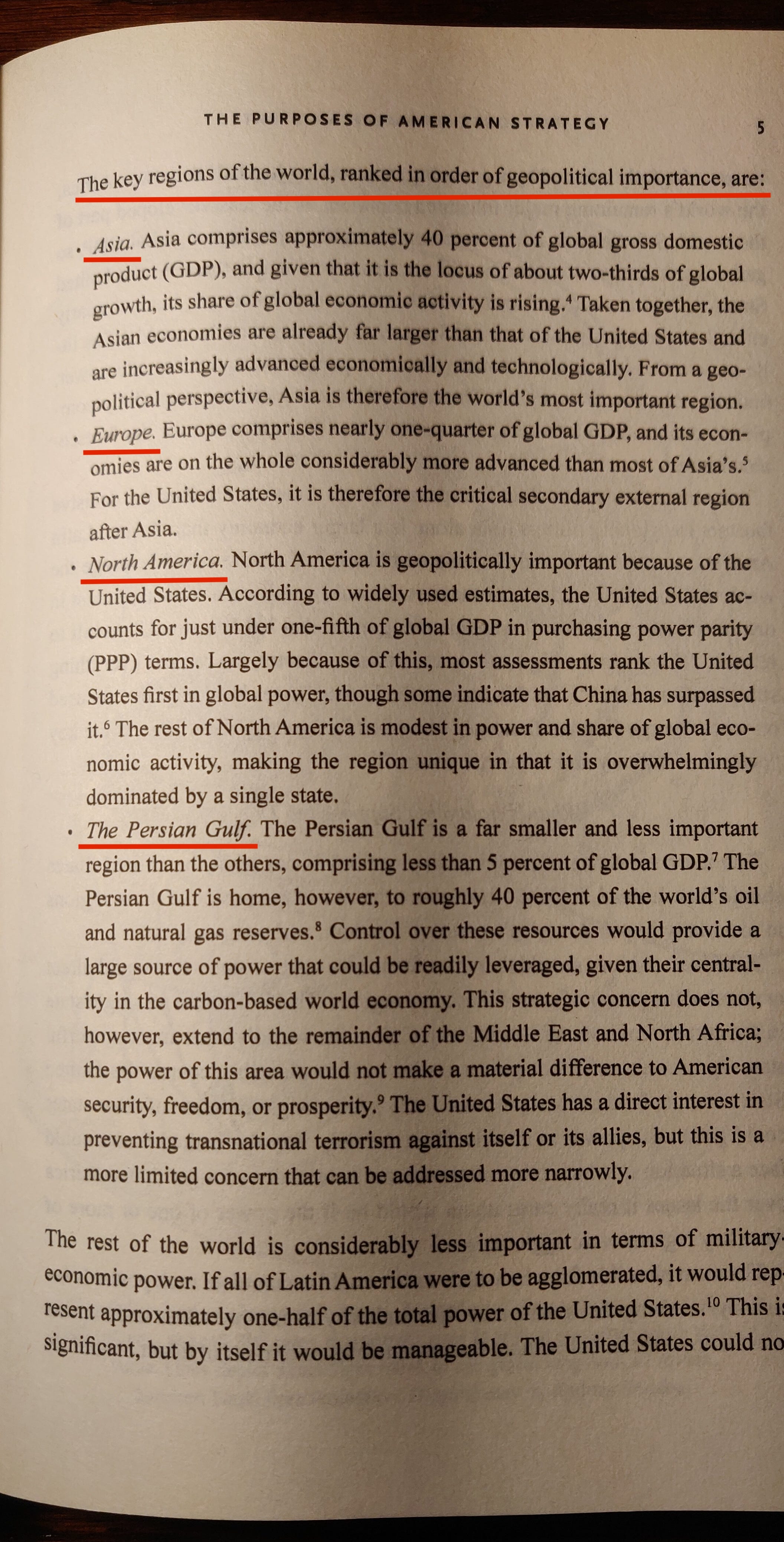
The pivot to Asia? Now questionable for the medium term.
Whoops.
Finally on this war, even Trump critics have to acknowledge that after this US and Israeli assault, Iran will be much diminished. The problem there is that with its diminished capacity, the regime might turn to a more desperate tactic it knows well — terror. We’ve seen the first stirrings this week in the United States.
•
ACTING IN CHARACTER: Russia has a “comprehensive strategic partnership treaty” with Iran, but as Tom Masters writes for Novaya Gazeta in a great weekly newsletter, (here), Foreign Ministers Lavrov and Araghchi talked early in the American war on Iraq, and:
“During their call, Lavrov offered Araghchi all the platitudes and yet none of the military support that Tehran could reasonably have expected since the two countries signed a comprehensive strategic partnership treaty in Moscow last year. That deal, an analogue of the one Russia signed with its other favourite rogue state, North Korea, to extract the shells and troops it urgently required to recapture the parts of its Kursk region that humiliatingly fell under Ukrainian occupation last year, was clearly only meant to be honoured when Russia needed military aid, and the Kremlin naturally saw fit to overlook its terms once the bombs began to fall on Tehran.”
No surprise. It’s just Russia’s current government acting in character. As it does in other ways across Europe.

The charges are being tried in national courts in Vilnius and Warsaw. The European Union Agency for Criminal Justice Cooperation notes that the investigation discovered “test packages” sent to the United States and Canada, suggesting that the operation may have been probing routes for future attacks on North America.
That’s not all. A month until very close elections in Hungary, with the apparent tacit support of Prime Minister Viktor Orbán, the Kremlin has “endorsed a plan … to bolster Orbán’s Fidesz party by flooding social media with messages designed in Russia and posted by influential Hungarians,” the Financial Times reported this week.
This plan sounds similar to one Putin carried out, nearly successfully, in last year’s election in Moldova, and it puts Orbán in explicit - not ‘suspected’ - alignment with the same Vladimir Putin who has sponsored efforts to blow up airplanes over Europe.
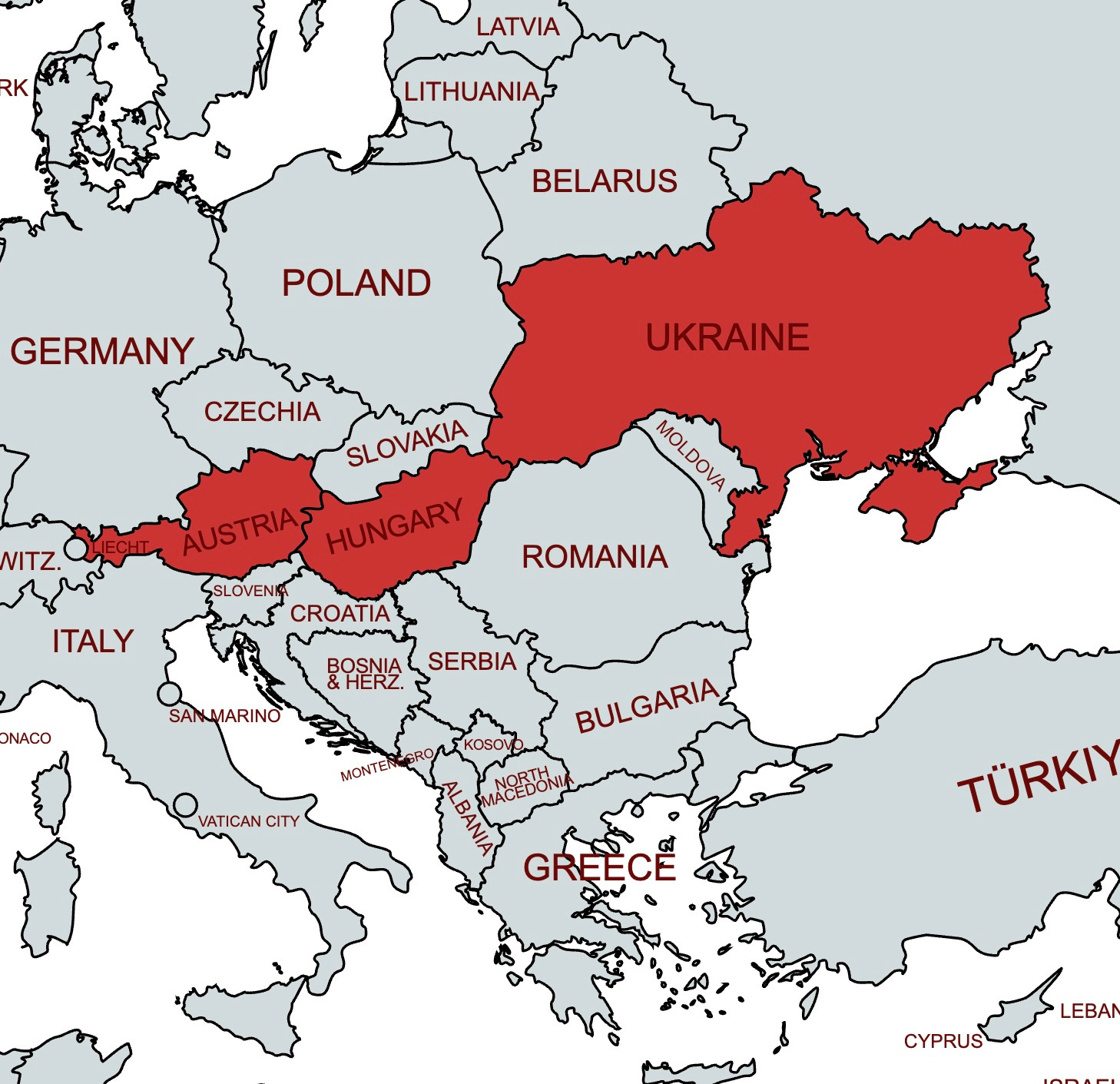
HUNGARY: That election is just a month away now. Instead of supporting Ukraine in its war with his Russian ally, Mr. Orbán has kicked up a dispute with Zelenskyy, accusing Ukraine of corruption (pot, see kettle).
Last week Orbán seized a Ukrainian convoy carrying money from Raiffeisen Bank in Austria across Hungary to Oschadbank, the State Savings Bank of Ukraine, and the trouble is, that move could turn out to be an electoral masterstroke.
Before the crisis Orbán’s main opponent Péter Magyar’s movement generally led polls. I can’t find any authoritative polls since the convoy seizure, but the incident has clearly backfooted the Magyar team which has gone from criticizing the Orbán government to, once Orbán escalated the dispute with Zelenskyy, shifting in tone to avoid appearing pro‑Ukraine.
For the moment Orbán controls the agenda. Magyar is off his message of corruption in the Orbán government and criticizing high fuel prices and the cost of living. Orbán released the Ukrainians in the convoy but this week ordered Hungarian authorities to retain the seized money for up to two months, insuring it remains a campaign issue.
Through Thursday midday, no criminal charges had yet been filed. But on Thursday Hungary announced it would declassify a national security report that Orbán claims will show Kyiv has funded Magyar’s opposition Tisza Party. It may intend to cite the convoy cash seizure is being cited as possible evidence.
Orbán’s feud with Ukraine looks like a way to establish a storyline that foreign actors are interfering in Hungarian politics, in order to contest the election if he should lose. However thin (for there is no apparent connection between the convoy and the election) that narrative might also help justify legal or procedural challenges after the vote.
Magyar plans a big-as-he-can-get rally Sunday for a march through central Budapest ending at Hősök tere, Heroes’ Square.
One more note in Central Europe:

POLES MOVING IN THE WRONG DIRECTION: Grzegorz Braun, a far right Polish leader who heads the Konfederacja Korony Polskiej, the Confederation of the Polish Crown, visited the Iranian embassy in Warsaw this week to sign a book of condolence for Ali Khamenei. “God bless the Iranian nation,” he wrote.
Braun’s support has risen sharply over the past year. A February 2026 United Surveys/IBRiS poll gave it ten percent, plenty to clear Poland’s five percent parliamentary threshold to enter the Sejm, or parliament.
Braun is the character, you may recall, who once used a fire extinguisher to put out Hanukkah candles in the Polish parliament.
And this week Poland’s far right PiS party, the main opposition, displayed its strategy for recapturing the Prime Ministership from Donald Tusk by nominating Przemysław Czarnek as its candidate in parliamentary elections next year.
As The Eastern Flank reported, Czarnek, an education minister in the PiS government that lost power in 2023, gained “notoriety for advocating for hardline anti-LGBT policies and for strengthening Catholic teaching in schools.”
Choosing Czarnek over the more moderate former PiS PM Mateusz Morawiecki is a strong and clear rightward shift for the PiS.
•••••

If you’re reading this as an email, be aware that your provider may clip the article before the end. Try clicking on ‘view entire message’ to see the whole thing, or you can always read everything at Common Sense and Whiskey online.
•••••
Enough politics. A few short bits:
INCREDIBLE: Russia’s population is something like 143.5 million. Ukraine’s Zelenskyy claimed this week that:
“In their classified official reports, the Russians themselves estimate their irrecoverable losses at 1 million 315 thousand killed and seriously wounded. We have reason to believe that these figures are understated.”
That’s very close to one percent of the entire Russian nation sent by Putin to its death or destruction since 2022.
•••••
LOSING THE MEDIA: Also incredible. The United States is losing its independent media, in moves that come straight from an authoritarian playbook. The method? Have friendly oligarchs buy them.
Dan Pfeiffer, a Senior Advisor in the Obama administration wrote this week:
“Pro-Trump billionaires now own:
CBS, Washington Post, The Wall Street Journal, Fox News, TikTok, Facebook, Instagram, and WhatsApp, Twitter/X.
And many of the outlets not owned by Trump billionaires are owned by corporations too afraid to anger him.”

CNN is in line to be co-opted next. Warner Brothers Discovery, CNN’s owner, is set to be bought later this year by Paramount Skydance, run by David Ellison, with the help of his father, Trump ally Larry Ellison.
What would Ted Turner say?
•••••
SOCIETAL DISTRESS: Suggested weekend reading: This together with this might go some way to explaining why right nationalism is on the rise. The first is right. The second is not.
•••••
AFRICA THIS WEEK: Bloomberg reported in a newsletter this week that Israeli officials are preparing a strategic partnership with the government of Somaliland that may involve building a base – possibly covert – on the Gulf of Aden.
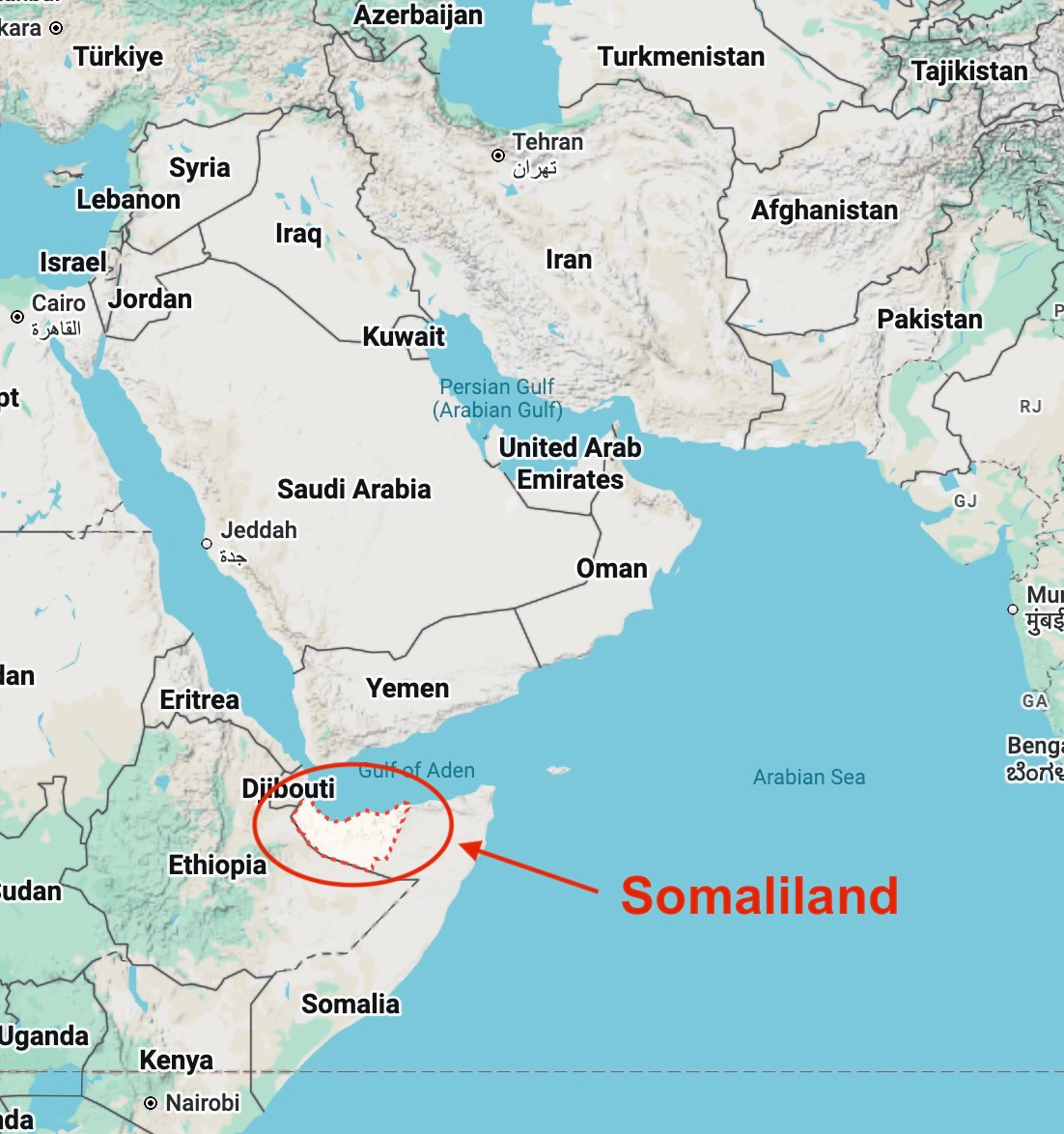
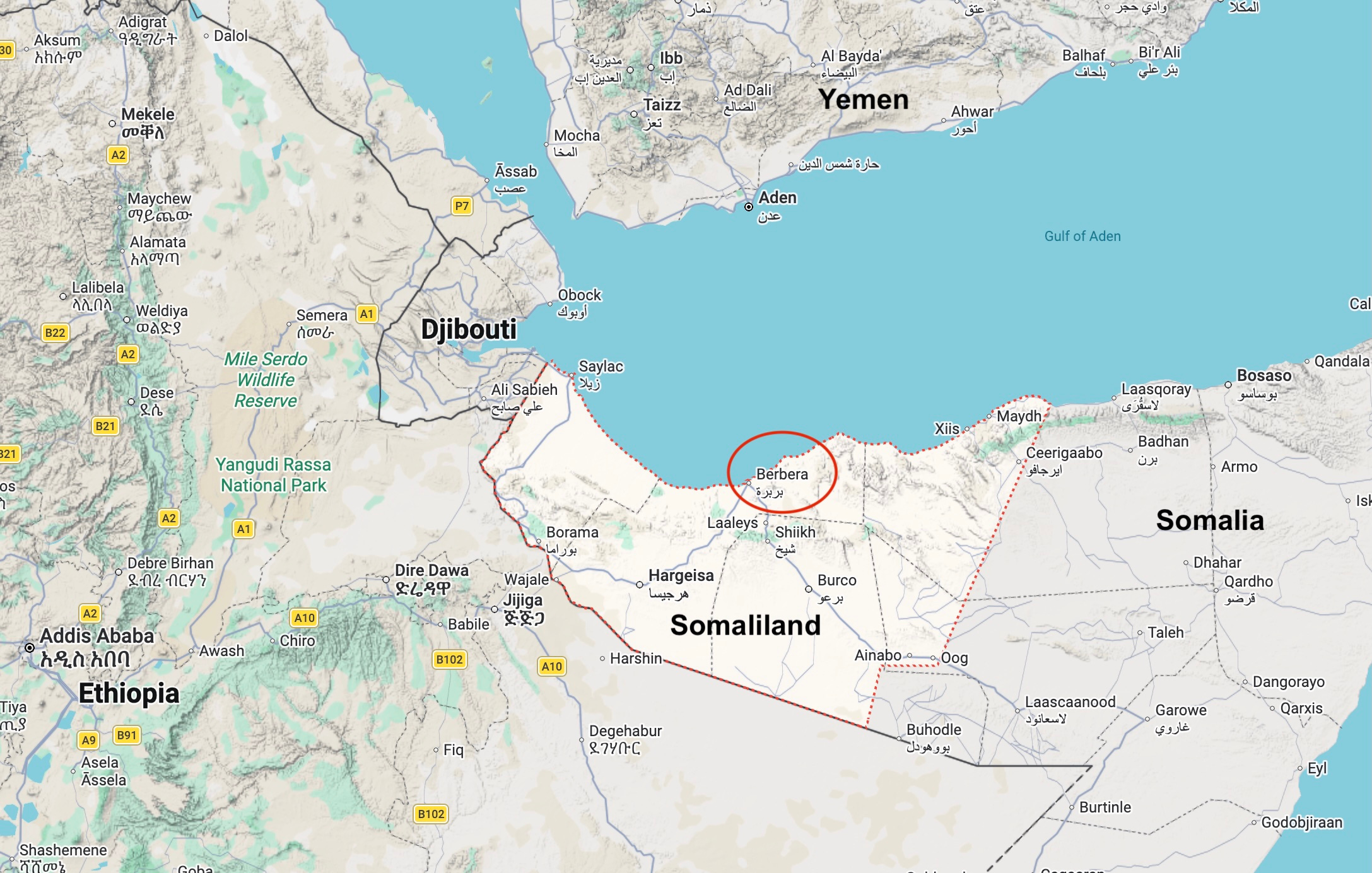
Somaliland has seriously increased its diplomatic jockeying these last couple of years. Very briefly: Somaliland has been de-facto independent from Somalia since 1991. Since early 2024 it has pursued a much more active foreign policy in an attempt to gain formal international recognition and security partnerships.
In early 2024 it reportedly granted landlocked Ethiopia access to its coastline and the port at Berbera, potentially including a naval or commercial facility. In return, Ethiopia signaled it could recognize Somaliland as an independent state, though it has slow walked that recognition.
The Emirati logistics company DP World has invested hundreds of millions of dollars in the Berbera port, and Abu Dhabi used Berbera as a military and logistics site during Yemen’s wars.
For Somaliland, the breakthrough came last December, when Israel formally recognized it as a sovereign state. Somaliland, as the maps show, sits near the entrance to the Red Sea, and just across the Gulf of Aden from Yemen, home of the Houthis, which would presumably be Israel’s main strategic interest.
While Somaliland may be looking for protectors in Israel and the UAE, these moves risk painting a big future target on its Berbera port.
AND FINALLY, a meditation on the state of the nation. From a campaign speech on March 11th on behalf of a challenger to Republican Congressman Thomas Massie of Kentucky, who wants the Epstein files out.
This lasts :41 seconds. Watch the man who leads America.
“I want to watch myself on television.”

•••••
That’s it for today. Please pass this article around and invite your friends to subscribe. Substack authors, feel free to restack this or any other column on your own Substack.
Content on Common Sense and Whiskey is free. There’s no paywall, but if CS&W is beneficial to you, please subscribe for just $5 a month or $50 a year. Big American media is increasingly falling under the control of government-friendly oligarchs. The future is on Substack and platforms like it — please invest in independent writers you trust. We’d all appreciate your support.
Cheers,
Bill
